Zazzle Shop

Screen printing
Showing posts with label Urban Future. Show all posts

Tuesday, October 13, 2009

The DIY fish supper: Future kitchen grows its own vegetables and seafood

By Sean Poulter


If you thought kitchen technology had reached its peak with the microwave oven, think again.

Future cooks will use an indoor biosphere which grows vegetables and fish ready to be prepared with absolute freshness.

It sounds like the stuff of science fiction, but this sort of technology is already under development to help households take the pain out of going green.
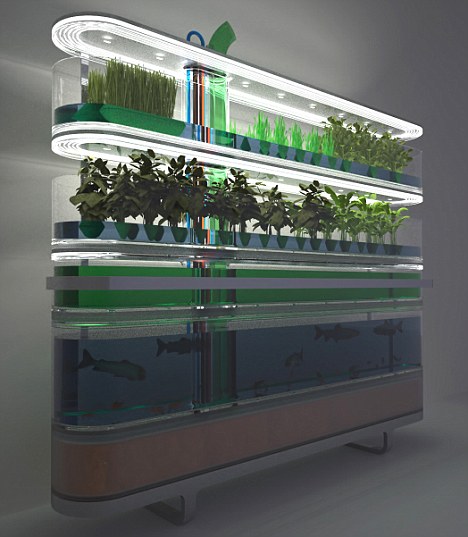
The Biosphere Farm by Philips

Going swimmingly: The Biosphere Farm by Philips houses fish, root vegetables, grasses, herbs, plants and algae under a common roof

A study produced to help buyers at John Lewis plan for changing lifestyles details how technology can preserve the quality of life while dramatically cutting energy and water use.

It highlights advances already in development such as washing machines and dishwashers which clean with sound waves.

There will also be 'frugal fridges' which will suggest recipes based on what is inside and even compact and recycle food waste.

But perhaps most dramatic is the self-contained biosphere farm, created by Philips, to provide fish and fresh produce 52 weeks a year.

It will also deliver fresh hydrogen, which can be used to power a car, and run on food waste from the kitchen.

The plants produce oxygen, which is fed into the fish tank to keep the occupants happy.

The tank is kept clean by shrimps, which can also be eaten.

Elsewhere in the house, showers will filter waste water through a bed of reeds, allowing it to be reused to flush the lavatory or even make a cup of tea using, of course, a low-energy kettle.

Architects already use 3D printers to create the models they use in building design.

However, the technology will be applied to a machine which can use waste plastic to manufacture goods ranging from cups and spoons to a pair of trainers.

Last week, the energy regulator Ofgem warned that power tariffs might need to rise by 60 per cent by 2016 to fund a new generation of wind farms, nuclear and clean coal power stations.

Against this background, John Lewis and experts at the Future Laboratory, who are looking ahead to 2030, say there will be a fundamental shift in lifestyles and products to minimise energy use.

The head of product sourcing at the store, Sean Allam, said there would be a big move away from throwaway household gadgets with the store looking at ten-year guarantees on some items.
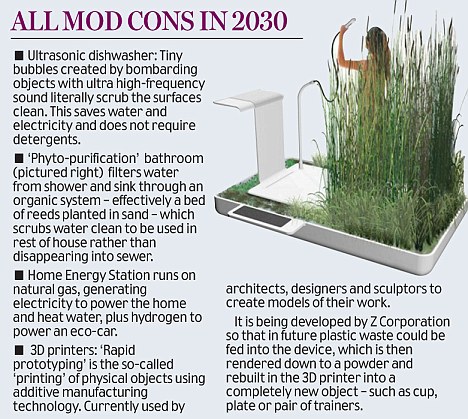
All Mod Cons in 2030

Monday, August 17, 2009

Is The Bike City An Alternate Universe, Or A Glimpse Of Your Urban Future?

  • Amsterdam is the future - if you think that cities devoted to bicycle transportation are the next step in urban evolution.

    Over the past two days I've been exploring Amsterdam, a city known for its unconventional transportation network. People get around scooters, motorized bicycles, cars, and even on canal boats, using canals mostly built during the city's great expansion in the 17th century. But most of all, they ride bicycles.

    In fact Amsterdam is truly a bicycle city, with every road containing bike lines – and even some with traffic lights aimed only at bicycle riders. Amsterdam has become a bike city for a couple of reasons: First, it's almost entirely flat; and second, many of the brick-paved roads and bridges are so narrow that they seem uniquely suited to bike and scooter traffic (though cars still zoom down most of them too).

    Amsterdam bike riders do not fetishize their rides. Bikes are cheap, heavy, and practical, with wide, comfortable seats. Chains are surrounded by metal guards so that you can ride in pants or skirts, and you'll often see people riding one-handed, cigarettes or umbrellas held in their free hands. There are no fixies here, and no ultra-expensive made-to-orders. People hack their bikes together, adding saddlebags to the back or baby chairs and carts to the front. Every intersection rings with the sounds of bells, the bicycle equivalent of honking. And every wall, pole, and bikerack is a crazy jumble of handlebars, wheels, and seats.

    Perhaps the most amazing bicycle structure in the city is the free bike parking lot outside the central train station, on the harbor in the old city. This is a touristy area, but most of the bikes belong to local commuters. From a distance, the three-story structure looks almost furry because so many small pieces of metal are sticking out all over it. Though built to hold about 1700 bikes, the place regularly packs in 7000-8000 bikes, according to a bike lot attendant I spoke to.

    Outside the bike lot, a white truck with an open bed lies in wait. It belongs to a group that enforces bike parking laws, cutting chains and confiscating bikes parked in illegal spots (chained to signs, for example) and putting warning stickers on bikes that have been parked for more than a few days in the parking lot. Impounded bikes are taken to an area at the edge of the city, and are released to their owners for 10 euros.

    For many of us, a bicycle parking lot like this is an unprecedented sight. We're used to multi-layer car parking lots which cost a tremendous amount per day. But a free parking lot packed with bikes? For people who dream of a bicycle-dominated future, this is like a glimpse of the future, or an alternate world.

    Click to view image1
    Click to view image2
    Click to view image3
    Click to view image4
    Click to view image5
    Click to view image6
    Click to view image7
    Click to view image8
    Click to view image9
    Click to view image10
    Click to view image11
    Click to view image12
    Click to view image13
    Click to view image14
    Click to view image15
    Click to view image16
    Click to view image17
    Click to view image18
    Click to view image19
    Click to view image20
    Click to view image21
    Click to view image22
    Click to view image23