Zazzle Shop

Screen printing
Showing posts with label Train. Show all posts

Wednesday, July 27, 2011

This Is What the Grand Central Apple Store Looks Like

From http://gizmodo.com/

NYC's Metropolitan Transit Authority has released a couple renderings of what the new Grand Central Apple Store will look like. Of course, it will look stunning. But anything in the Grand Central atrium looks stunning. Even Phil Schiller's underpants.
The aesthetic of Apple's usual minimalistic setup merges perfectly with the breathtaking beauty of the station. It's almost invisible. According to the MTA, it will be completed in four months, beginning now.
Extra bonus: Grand Central would be getting a Shake Shack too, the NYC chain that makes the best burgers in the world. Now hipsters would be able to get all those iPad 2's dirty with delicious burger juice. [The Next Web]

Related Stories

Monday, June 27, 2011

Stay a Night in a Bridge Made from Reclaimed Wood, Built Over a River-to-Be

by Alex Davies, Paris, France
from http://www.treehugger.com/

waiting-river-2.jpg
All Images Courtesy of Observatorium

Looking at the bridge, you wonder what it's doing there. It sits on dry, flat land. It doesn't connect anything to anything else. And its zig-zagging shape doesn't exactly scream practicality. That's because this is no ordinary bridge: it's also a hostel, a picnic site and an art project. And while the surrounding land is dry for the moment, it won't stay that way: a river is scheduled to arrive in 2020.

waiting-river-3.JPG

"Waiting for the River", a 2010 project by Rotterdam-based art group Observatorium, was part of that year's Emscherkunst, an annual arts festival in Germany's Ruhr region. The now awaited water has run here before: the Emscher River, a tributary of the Rhine, was used as an open waste canal in the 19th century and is now biologically dead.

But a project, in planning since the early 1990s, is aiming to rehabilitate the river and the once heavily industrial region. The river will be cleaned and re-naturalized to its former course, sometime in the next ten years. That's the raison d'etre of Waiting for the River, which Observatorium designed to encourage people to explore the area and learn about the project.

Observatorium describes the bridge as somewhere in the "gray area between art and architecture." Stretching 125 feet and made from wooden planks recovered from the Rotterdam port, it included sleeping and eating areas. Visitors were invited to spend a full 24 hours at the site, to fully appreciate what is there now, and imagine what things will look like in a decade.

Originally meant to be temporary, the bridge was in place from May through September 2010. But if you missed your chance to visit, don't worry: it was so popular that Observatorium has decided to rebuild it, permanently, in 2013. So if you stick around long enough, you may even be the first to fish off the side.

waiting-river-4.JPG

waiting-river-1.jpg

waiting-river-5.JPG

Tuesday, April 26, 2011

Thailand: All aboard the crazy train


Can you tell this wasn’t filmed in America?

Full Video here: http://www.youtube.com/watch?v=-IqUzkqUa64

Uploaded by on Aug 13, 2009

Tony visits a rural market in Thailand where the local train cuts right through the bustling crowd of anxious shoppers and food stalls. New episodes of Anthony Bourdain: No Reservations air Mondays at 10PM, only on Travel Channel. http://www.travelchannel.com/TV_Shows/Anthony_Bourdain

Friday, April 15, 2011

Train Ride Through Norway: from Finse where the scenes from Hoth in Star Wars Episode V: The Empire Strikes Back were filmed.


Slipstream Part XI: Travel by (non)Linear Observation from Nilz on Vimeo.

Slipstream Part XI: Travel by (non)Linear Observation

*This video is a loop, if you like right click the video to enable looping*

Slipstream Series: vimeo.com/​groups/​slipstream


This footage is used under a creative commons licence ( creativecommons.org/​licenses/​by-sa/​3.0/​ )

Source:
“Bergensbanen” – NRK
Click here for info on the film: nrkbeta.no/​2009/​12/​18/​bergensbanen-eng/​

Monday, October 18, 2010

Top 12 luxury train fares in the world


There are certainly choices you can make when you’re deciding on a way to get from Point A to Point B, or when you are planning a holiday away from the rat race of everyday life. Train travel is a popular means of travel, and booking Virgin trains is easy, but luxury train travel can be as different from “coach” as stand-by flights are to first class, on airlines. You can locate luxury train travel in many areas of the world. Many nations in Europe offer this travel option, as do some places in the United States. Canada has its share of luxury train trips, as well. If you want to travel the rails in luxury, you can choose from locations all over the world. Traveling in luxury on a train offers rooms to relax in, rather than simple seats. If you rent a full car, you may be surprised at the luxuries included. In addition, luxury train service offers gourmet dining, which is not at all the standard fare for regular train trips. Luxury trains may even offer professional chefs at your beck and call, and full kitchens. You will discover when traveling on a luxury train line, that there are sometimes luxury cars set up for entertainment, including feature films. Some may even have live shows. Some corporate executives are accustomed to traveling in these ways, but most people aren’t. You may wish to get travel insurance through Virgin money for your holiday.

1 – Pride of Africa £10,600 per person

1 Pride Africa 1 Top 12 luxury train fares in the world
This is a nature trip, exploring the majesty, beauty and grandeur of the Dark Continent. You will travel through Cape Town, Pretoria, Kimberley and Kruger National Park, among other stops. This is billed as the luxury train above all the rest.

2 – Eastern & Oriental Express £7100 per person

3 aestern Oriental Express Top 12 luxury train fares in the world
This trip goes from Singapore to Bangkok, through tropical forests that are lush and beautiful. The train is stylish, modern and ultra-comfortable.

3 – Royal Scotsman £6000 per person – The Grand North Western Journey (7 Nights)

4 Royal Scotsman train Top 12 luxury train fares in the world
The most expensive train ride on Planet Earth is the Royal Scotsman. A four-day trip on this train costs more than a nineteen-day first class ride on the Trans-Siberian railway. There are special cabins for dining and for other purposes.

4 – Danube Express £2,990 per person

5 Danube Express Top 12 luxury train fares in the world
This train is called a luxury hotel on wheels, and it’s a private train where you will have your own personal staff member to cater to all your needs throughout the whole trip through Central Europe.

5 – Trans-Siberian Railway £2,150 per person

6 Trans Siberian Railway Top 12 luxury train fares in the world
The grand-daddy of luxury train travel is the Trans-Siberian Railway. It travels 6000 miles through Russia, showing you vistas of vastness and brilliance.

6 – The Blue Train – £2,070 per person

8 The Blue Train Top 12 luxury train fares in the world
This is an exclusive train that carries only 84 passengers on each trip. Traveling from Pretoria to Cape Town, it will show you some of the most beautiful sights in Africa. Each compartment has its on bathroom, air conditioning, television and service with one press of a button.

7 – Venice Simplon-Orient-Express £1,755 per person

9 Venice Simplon Orient Express Top 12 luxury train fares in the world
This luxury train links many cities in Europe, including Venice, London, Budapest, Rome and Prague. This is a charming trip but not for the penny-pinchers. A three-day trip through Austria, Switzerland and France will run you more than 2000 Euros.

8 – California Zephyr £1,560.42 per person

10 California Zephyr Top 12 luxury train fares in the world
This classic route travels from the Pacific Ocean to the Great Lakes region. It almost follows the transcontinental railway’s first line. You can relive the Gilded Age travels.

9 – Glacier Express – £1375 per person

11 Glacier Express Top 12 luxury train fares in the world
180 miles of landscapes that take eight hours to see, this express train is not a speed train. The tracks link the two mountain resorts of Zermatt and St. Moritz, in the Swiss Alps.

10 – Great South Pacific Express, Australia £1,170 per person

12 Great South Pacific Express Top 12 luxury train fares in the world
The luxury train that zips along the eastern seaboard between Sydney and Cairns was launched in 1999. The trip is divided into two sections with an overnight stay in Brisbane. The more memorable leg is the lush Brisbane-Cairns one, which includes a helicopter trip to the Barrier Reef, where you’ll spend the day snorkelling from a pontoon

11 – Copper Canyon Railway 557.65 per person

13 Copper Canyon Railway Top 12 luxury train fares in the world
This Chepe train gives you amazing sounds and sights, and passes through rugged terrain in Mexico. Special luxury compartments give you excellent cuisine.

12 – The Hiram Bingham – £500 per person

14 The Hiram Bingham Top 12 luxury train fares in the world
This luxury train travels to Machu Picchu, with steep climbs and lush fields. You’ll sit in the lap of luxury through the Andes.

Thursday, March 4, 2010

Lost in Penn Station [pics]


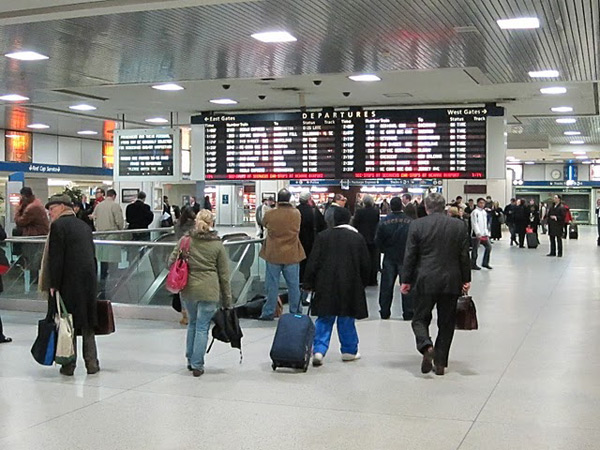
slate.com — Penn Station is the busiest train station in North America, crowded with around 200 million passengers a year. Plus there’s Madison Square Garden, squatting on top of it. So much of this activity occurs underground, in low-ceilinged tunnels devoid of sunlight and fresh air. Why are the signs at the nation's busiest train hub so confusing?

Click here to read this interesting study: Lost in Penn Station [pics]

Wednesday, February 24, 2010

Train VS Flood


This flood was no match for this train. Lets go surfing!

Video was uploaded with permission from- http://www.youtube.com/user...
This video footage was shot in Bueno Aires.

Tuesday, January 26, 2010

Superfast Bullet Trains Are Finally Coming to the U.S.


Illustration: Paul Rogers
Superfast Bullet Trains Are Finally Coming to the U.S.

Posted using ShareThis

Tuesday, October 20, 2009

Times Square without cars?

Advocates of a radical new plan want to create a pedestrian mall and light rail system in the heart of New York City.


ALL ABOARD: A proposed light rail system would bisect New York's Times Square. (Photo: Vision 42)
More than 356,000 people walk through the heart of New York City each day, but imagine how many more could traipse through if Times Square was closed to cars?

Advocates of a radical new plan want to close 42nd Street to car traffic and create a light rail system to run across the island of Manhattan, from the Hudson River on the west to the East River on the east. Such redevelopment would boost the local economy and improve transportation, according to Vision 42, a citizens’ group formed in 1999 by the Institute for Rational Urban Mobility. It would also offer a less polluting travel option than the exhaust-belching buses that currently take New Yorkers across town at a snail’s pace, The New York Times reported.

At a cost of $500 million, the light rail would stop at every avenue and run from one side of the city to the other in about 20 minutes, about half the time it currently takes to ride a bus across town.

So far, property owners along 42nd Street support the proposal — but the city isn’t so sure. But even though city officials aren’t rushing to embrace Vision 42’s idea, they have launched “Green Light for Midtown,” a project to alleviate congestion in Times Square, where traffic moves an average of 4.2 miles per hour. The city has created several pedestrian malls in midtown, and over Memorial Day weekend officials closed several blocks around Times Square to cars.

But proponents of Vision 42’s plan say the city needs a permanent solution.
Vision 42 advocates pointed out that light rail lines have stimulated economic growth and development in other cities, such as Dallas, Portland, Ore., and Phoenix. According to a study by the consulting firm Urbanomics of New York, closing 42nd Street to cars and adding a light rail line would boost the economy in Manhattan: Pedestrian volume would increase by 35, translating to some $380 million more in sales among the street’s 126 stores.
Indeed, proposals to expedite cross-town traffic in Manhattan have been kicked around for years. An older proposal, which lost steam in the 1990s, would have created a trolley line along the south side of 42nd Street, with the north side open to vehicular traffic. But New York City Mayor Michael Bloomberg favors extending an existing subway line – the No. 7 – to reach farther west.
“The real gain here is you could handle three times as many people with roughly the same cost,” said George Haikalis, an engineer and a co-chairman of Vision 42. “A lot of people have expressed interest in this, but have not signed on, because they’re awaiting interest from Mayor Bloomberg.”

Tuesday, September 15, 2009

Commuting 101, Riding the Train, Bus, Subway, Rail, & Metro


WTF!!

By Jason Robicheau


Warning: this list may offend you. Please don't read if you haven't got a sense of humor or can't appreciate angry tirades.

1. The Wedge


We all know this one. You can see them coming a mile away as the train pulls into the stop. They waddle in their muumuu over to the doors and into the train, wheezing and hawing, out of breath. You know exactly where they’re headed; right into the empty seat next to your own. You know those plastic luggage holders in the airport, used to ensure your carry-on meets the overhear requirements? I think we need those for chub-chub’s too. Repeat after me: If the seat don’t fit, you must not sit. It’s awful to experience someone’s rolls pushing against and over-spilling into your seat, compressing you into the next passenger. These McFatties are always the one’s to complain too when they’re charged double-fare for flights. What makes you think the subway should be any different? No one wants you to wedge your disgusting self into a seat that’s made for the normies. Don’t like it? Stand up for 10 minutes, at least that might burn 6 or 7 calories while the rest of us can ride in comfort.

2. The Cell Phone User


As if this person needs any introduction either. Yap, yap yap, all the way into the tunnel, where they suddenly get this perplexed look on themselves, as if they never realized you can’t make calls underneath 50ft. of concrete and pipes. Hello, asshole! Can you hear me now? We don’t want to hear your conversation any more than we want to talk with you. Have something important to discuss? Fine, keep your fucking voice down or get off at the next station. Yeah, the train is noisy … it’s a goddamn subway car! That doesn’t mean you can attempt to talk over it, which you can’t do anyways.

3. The Pushy Old Lady


I get it, you’re old and you feel entitled. You’ve lived on this Earth for millennia and now you want to sit down and rest your tired bones for a few minutes. I appreciate that and will gladly give up my seat to those who are in need. But when you push and shove your way into the front of the subway door entrance, elbows flying like a rugby pro from Manchester, I feel no empathy for you or your precambrian brethren. I love my grandma, but I’d tell her the same thing too. Show some manners or eat a spoonful of castor oil and get lost.

4. Children


Ahh, yes the screaming child. Who doesn’t love those? I’m not a breeder, so I’m sure some parents will cry foul on this one. You know what? I don’t care. Keep your annoying child in their seat, don’t give them liquids that will spill all over other people, and learn to discipline the rugrat. Oh, and leashes work too. I really like those. If all else fails, take a taxi or shove a pacifier in their mouth. Remember that old saying? Children should be seen and not heard.

5. The Bum


“Hey buddy, can you spare some change?” When this happens, you invariably catch a whiff of Listerine or Mad Dog 20/20 on their breath, and your own BAC just went up a notch thanks to them. You occasionally find them sprawled out across the seats on the Orange Line, sound asleep in their moving apartments, resting off the past months binder. Be forewarned, Homo Misellus will usually mark their territory by urinating in the corner of most subway cars or leave their shopping cart of possessions in a nearby place. Thankfully the Homo Sapiens has adapted an acute sense of smell to avoid these areas.

6. The Loud Conductor


When the speaker in the subway car blasts announcements at over 200 dB, human hearing can easily become damaged. I partially blame the MBTA on this one, but the loud-ass conductor shouting at everyone to step away from the platform certainly doesn’t help things much either. I’d like to take a baseball bat to the side of their head as it hangs out their window sometimes because of this. You know it’s bad when you can hear them through your headphones, resonating at the base of the skull. I smell a lawsuit on this one eventually.

7. Monkey in the Middle


Who hasn’t been the unfortunate victim of getting stuck in between two people conversing over you? I ain’t Casper the Fucking Ghost, so stop talking through me and show some respect to a fellow passenger. Perhaps you should swap seats with me so I don’t have to be party to your recap of last night’s team huddle or yesterdays episode of Guiding Light.

8. Mr. Headphones


This guy blares his headphones with a reckless audio level that would scare even the loud train conductor. You’ll hear the cheesy techno-beats through those oversized Bose headphones and wonder how the hell it all sounds so crisp and clear … nah, you’ll just want to rip ‘em off and bash the fucking iPod into his skull to the same beat as that DJ What’s-his-face that’s now stuck in your head for the day’s remainder. Please, for the sake of your fellow passengers (and your hearing) turn down the volume a bit. Mmm-kay?

9. The Tourists


I guess living in Boston you simply need to get used to these people. Hemming and hawing over the buildings, sights, etc. Always taking pictures, wearing those cheap-o Boston sweatshirts, wondering where they can find Cheers. I suppose it could be worse. Being a former citizen of Salem, I think Boston has it easy. Enough said here on tourists. They help support our economy, so I guess they ain’t too bad. Just stay the Hell out of my way and pay attention. People in Boston walk fast and have no patience for idiots. Fucking peepers.

10. The Hoodlums and Punks


One of the marks of adulthood is the transition to one who despises this riffraff. The homeys, hooligans, ghetto filth, and rabble-rousers, all of them are contributing factors to a shitty time using public transportation. These guys are usually characterized by the saggy pants, bad attitudes, 5th grade graffiti, and a look of contempt that requires a slap upside the head. If I ever require the use of a cane, I will be sure to use this for lads such as them.

11. The Drunk Sports Fan


Woo-hoo, go Redsox/Celtics/Bruins/etc. We get it, you love sports and you love booze. Those two don’t always mix well, though. Case in point: The Green Line. Anyone who rides it knows what I’m talking about. These asshats and their testosterone levels and belly full of beer can only lead to a miserable time on the train home. Packed like a sardine can, the train now becomes a roving sport bar … oh, and watch out for the projectile vomit.

12. The Smelly One / Tuna Breath


One word: Toothpaste. Another word: Deodorant. Want some more? Use less perfume and cologne. We don’t need to smell the Drakkar Noir or Axe that you tried to mask your B.O. with when there’s already an assault on the senses everywhere else. Remember, a little dab’ll do ya!

13. The Groper


This one goes out to all the ladies in the house. Although rare for men to get groped, there was this one time a little old Asian lady pulled a cockgrab on me, though for the most part, it’s the women who have to worry. Props to the signs on the MBTA cars and their efforts to nip this one in the bud. I myself have seen a creep or two cop a feel or pull the “oops, I tripped into your tits” trick, and I have only the deepest sympathy for the victims here. Kick the pedo in the balls. We won’t say anything.

14. The Lingering Stare


Some women refer to this guy as the Eye Rapist. But it’s not always about checking you out. Sometimes it’s just some sketchy MoFo grilling you for the entire ride. Maybe he’s got a crazy eye, botched lobotomy, or got the hots for you. Maybe be wants to pick a fight, or thinks you’re his long-lost high school buddy. Frankly, I don’t care. Put on some sunglasses if you like to play amateur sociologist. At least that will bring down the creep-o-meter in our guts.

15. The Suit / Crackberry Addict


This turd in his three-thousand dollar suit should come as no surprise to anyone when he walks into you because he’s too busy typing an email on his Blackbery to notice. The air fills with a sense of superiority when this guy enters the train car. He’s all business, and can generally be a nice guy who keeps to himself … just be sure to stay out of his way or carry a cell phone jammer.


Thursday, March 26, 2009

IBM hops aboard high-speed rail

by Martin LaMonica

Imagine traveling by rail at 200 miles per hour between cities, and then catching a local line to your final destination

IBM on Wednesday plans to announce details of three rail projects outside the U.S. that bring that vision of efficient and convenient rail travel closer to reality. Overall, the projects in China, Taiwan, and the Netherlands show how rail travel can reduce urban congestion and cut down on pollution from transportation, said IBM.

Investments in rail--and high-speed rail, in particular--are a significant portion of many of the government-sponsored stimulus spending programs around the world. The U.S. is poised to put about $8 billion in upgrading the rail network and developing high-speed rail "corridors."

But establishing an effective network of high-speed trains is more than building faster locomotives. A large portion of what makes a successful network is its computer technology, according to IBM, which is angling for government business in transportation and rail.

(Credit: Taiwan High Speed Rail Corporation)

"We're seeing a spike in projects and when you start moving people and trains at 350 kilometers an hour (218 mph), you need to start focusing on smarter trains and higher levels of safety to operate effectively," said Keith Dierkx, business development executive for travel and logistics at IBM's Global Technology Services consulting arm.

The U.S. rail network right now uses RFID tags to help railroad operators keep track of some inventory as trains roll past RFID readers. But a more sophisticated network of wireless sensors providing real-time updates will be increasingly important to the spread of high-speed rail, said Robert Goodwin, transportation industry analyst at Gartner. Amtrak's Acela line, which goes from Washington D.C. to Boston, tops out at 150 miles per hour, a speed that's limited by twisting tracks through most of the journey.

"These trains move so rapidly, you can't afford to have any errors so you need current feedback," Goodwin said. "There's a lot you can do based on what you didn't know 10 seconds ago. It gives you a chance to be more nimble."

Sensors could also ensure that hazardous materials aren't tampered with on rail cars and video scanners could automate safety checks on equipment, said IBM's Dierkx.

In the meantime, however, IBM's rail work has focused primarily on keeping the trains running on time. Its customers used a mix of IBM software and services to improve service and maintenance.

Netherlands Railways used software from Ilog, which IBM bought last year, to optimize its schedule to best match its equipment--5,000 trains, 390 stations, and 2,800 kilometers of track--with passenger travel. By fine-tuning this complex system, the rail authority lowered its operating costs between 5 and 10 percent, saving about 20 million euros a year, according to IBM.

The Taiwan High Speed Rail Corporation is using an "asset-management package," which IBM gained when it acquired MRO Software, to get trains running from the north side of the island to the south with a punctuality rate of 99.15 percent. The 90-minute trip replaces what would be a 4 1/2-hour trip by convention rail.

The Guangzhou Metro in China also used the Maximo asset-management to help operators manage cars, tracks, and signaling equipment for peaks in demand--like during soccer games--and stay on top of equipment maintenance.

Killing congestion
Part of the reason that rail travel is being promoted is that it's a relatively energy-efficient way to move both people and freight, said Dierkx.

On average, U.S. passenger trains emit less than half the global warming pollution per passenger mile than a typical car carrying a single person, according to the Union of Concerned Scientists. A train can move a ton of freight 436 miles on one gallon of fuel, almost four times better than truck transport, according to the Association of American Railroads.

Traffic jams are also responsible for billions of dollars in lost productivity, Dierkx said. Rail travel serves as at least a partial solution to the trend toward giant megacities around the world where traffic is a serious problem.

"As a mode of transportation, rail has always been efficient and effective. There hasn't been the urgency around the environment and congestion issues," he said. "Especially in these megacities, the ability to effectively move citizenry around the country by rail may be the only way to do it effectively. And it's a green way to do it as well."

Speeding to the U.S.?
In the U.S., the country's rail infrastructure is due for a significant upgrade and, potentially, new high-speed rails projects that France, Germany, and Japan have had for years. Dierkx predicted that in five years, China will have more high-speed rail lines than any other country.

The U.S. stimulus plan dedicated $8 billion of funding for rail. The Obama Administration's budget calls for an additional $5 billion for high-speed rail grants over the next five years, according to the Association of American Railroads.

The Federal Railroad Administration is scheduled to publish a strategic plan for spending the $8 billion in the stimulus plan, which is expected to include a vision for high-speed rail corridors. Already, $1.3 billion has been set aside for Amtrak for intercity travel and $450 million to upgrade the safety of existing rail infrastructure.

However, transportation experts point out there are at least 11 proposed high-speed rail corridors in the U.S., each of which would cost billions of dollars to install. A project to build a fast train between northern and southern California alone would cost $45 billion.

As a result, IBM considers government funding for high-speed rail is the equivalent of "seed money" for large projects, said Ken Donnelly, transportation strategy manager for IBM's Maximo asset-management product. As problems over traffic congestion and pollution become more acute, IBM's Dierkx expects interest in rail to gain steam.

"In an economic downturn, a lot of green initiatives can come under pressure if you don't have strategic foresight," he said.


Martin LaMonica is a senior writer for CNET's Green Tech blog. He started at CNET News in 2002, covering IT and Web development. Before that, he was executive editor at IT publication InfoWorld. E-mail Martin.

Thursday, March 19, 2009

$8 billion could help revive travel by train

A Sapsan high-speed train in St. Petersburg, Russia. It will be part of a shuttle service between St. Petersburg and Moscow. The trip is expected to take less than four hours and cost less than flying.
By Dmitry Lovetsky, AP
A Sapsan high-speed train in St. Petersburg, Russia. It will be part of a shuttle service between St. Petersburg and Moscow. The trip is expected to take less than four hours and cost less than flying.
Americans started falling out of love with trains 50 years ago, when thrilling silver airliners left locomotives far behind.

Now, President Obama and leaders in more than 30 states say it's time to embrace trains again — but newer, faster ones that can transport passengers past gridlocked airports and highways on electrified railroads at up to 200 mph.

They're betting billions of federal and state dollars that high-speed railroads can someday move travelers between major U.S. cities within two or three hours just as they do in Western Europe and Japan. And along the way, they argue, such systems can ease travel congestion, reduce the nation's dependence on oil, cut pollution and create jobs.

"For so long, Americans have viewed the automobile and the airplane as our transportation vehicles," says Anne Canby, a former transportation secretary for Delaware and train advocate. "Until now, rail hasn't been a major player in the discussion."

Driving the new-found interest in trains is $8 billion that was tucked into the president's economic stimulus legislation signed last month.

The Department of Transportation is to distribute the money to embryonic high-speed rail projects around the country and to Amtrak, the national passenger rail service, to develop high-speed technology.

The government isn't wasting time. By next month, Transportation Secretary Ray LaHood is required to issue a strategic plan detailing how DOT will use the $8 billion. By June, his department is required to tell states how to apply for grants.

Eleven proposed high-speed rail corridors on the West Coast, Texas, the Great Lakes states, the Southeast, Florida and the Northeast will be vying for a piece of the stimulus money.

Competition "is going to be pretty severe," Wisconsin Gov. Jim Doyle says.

Doyle just returned from Spain, where he rode that country's high-speed Talgo system linking its capital, Madrid, to other major Spanish cities.

Wisconsin, Illinois, Michigan, Missouri, Indiana and Ohio are pitching a high-speed rail network linking Chicago to big cities in those states, including Milwaukee, Minneapolis/St. Paul, St. Louis, Indianapolis, Cincinnati and Detroit — trips that could be made within a couple of hours.

"People in this country don't appreciate what modern rail travel is," says Doyle, referring to the 180 mph Talgo system. "It is as smooth as riding in an airplane without any turbulence."

He says the Midwestern states don't envision a true high-speed system immediately. The first priority is making upgrades that would allow trains between Chicago and Milwaukee, for example, to travel at least 80 mph.

Designing, engineering, construction, operation and maintenance of new rail systems could create many U.S. jobs, rail advocates say.

"This would create a completely new industry here," says Rod Diridon, a member of California's High-Speed Rail Authority.

Diridon says his system is a leading candidate for funding because it would be a true high-speed train, and the state already has won environmental approvals. California voters approved issuing $10 billion in bonds to help pay for the system.

California's proposed express from San Francisco to Los Angeles would take about 2½ hours at 220 mph. "It would be faster downtown to downtown than flying," Diridon says.

As large as it sounds, $8 billion wouldn't begin to design and construct a true high-speed system in which rails are dedicated to high-speed trains. The California system alone would cost about $50 billion to complete.

"I see this as us making a down payment," says Mark Yachmetz, a top official at the Federal Railroad Administration. "It's the beginning of the renaissance of rail in this country."

Ultimately, so-called trip time — the travel time door-to-door vs. an auto or plane — will be the standard by which rail proposals will be judged.

Amtrak's recent track record gives hope to high-speed rail enthusiasts. The railroad carried a record 10.9 million passengers along the densely populated Northeast corridor last year. It has become a serious competitor of airlines there because the major cities — including Boston, New York, Philadelphia and Washington — are relatively close together.

Last year, Amtrak data show it accounted for 63% of the combined air and rail passenger traffic between Washington, D.C., and New York City compared with 50% four years earlier. Between New York and Boston, Amtrak's share of the traffic was 49% last year vs. 39% in 2004.

Many riders in the Northeast chose Amtrak's electrified Acela — the closest thing to a high-speed train in the USA. It makes few stops and runs at speeds up to about 135 mph.

Acela has shown, "We can do high-speed rail and reduce the trip time enough to make rail competitive with air," Amtrak CEO Joe Boardman says.