Zazzle Shop

Screen printing
Showing posts with label Milky Way. Show all posts

Wednesday, June 1, 2011

Very Large Telescope, Very Stunning Time Lapse Video

 From:
Oh, what the heck. After posting the video earlier showing the Earth rotating around the sky, I might as well show you the original video, since it really is so beautiful. This time lapse shows the sky spinning over the Very Large Telescope observatory in Chile, one of the finest observatories in one of the darkest sites on the planet.

[Set the resolution to 720p to see it properly unenpixelated.]

A couple of things I want to point out: at 1:10 into the video, you see the Milky Way rising majestically over the mountains, and you can see a faint, whitish glow stretching diagonally across the field of view, at an angle to the galaxy. That’s called the zodiacal light, and is caused by the reflection of sunlight by dust in the plane of our solar system. It’s probably due to eons of collisions grinding asteroids into dust; they tend to orbit the Sun in the same plane as the planets. It’s actually a disk of dust, but since we’re in it, we see it as a line across the sky. It’s pretty faint, and you need dark skies to spot it.

I also love the shots of the observatories shooting orange lasers out their domes (here’s a gorgeous hi-res photo of it). They’re fending off attacks by the Goa’uld, Ori, and Wraith using those to help counteract atmospheric distortion; the laser hits a layer of sodium atoms high in the atmosphere and causes them to glow. This creates a bright artificial star in the telescope’s view, which jiggles and wiggles as the atmosphere roils. The way the "star" moves can be counteracted by the telescope, sharpening up the image it makes. This tech, called adaptive optics, has revolutionized high-resolution ground-based astronomy. It has also given the VLT the ability to make incredibly sharp and gorgeous images; see for yourself.

Don’t forget to watch the companion video to this, too. It’ll change your perspective. Literally.
Video credit: Stéphane Guisard and Jose Francisco Salgado/ESO.
Thursday, April 7, 2011

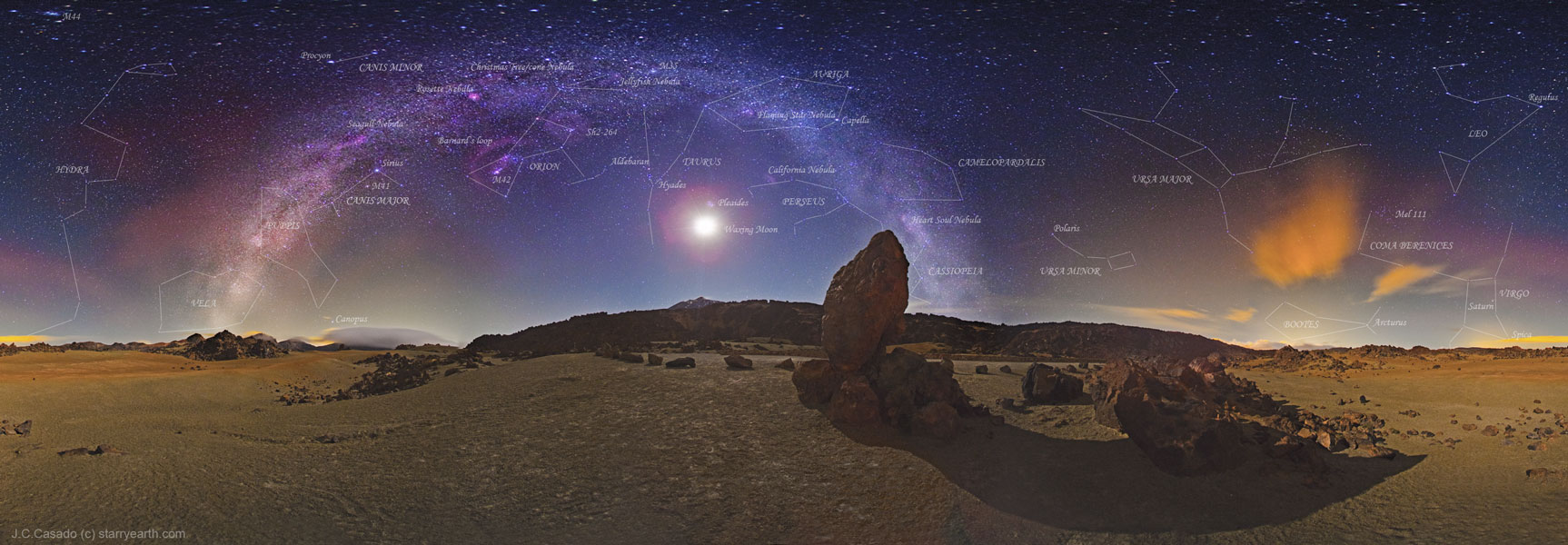
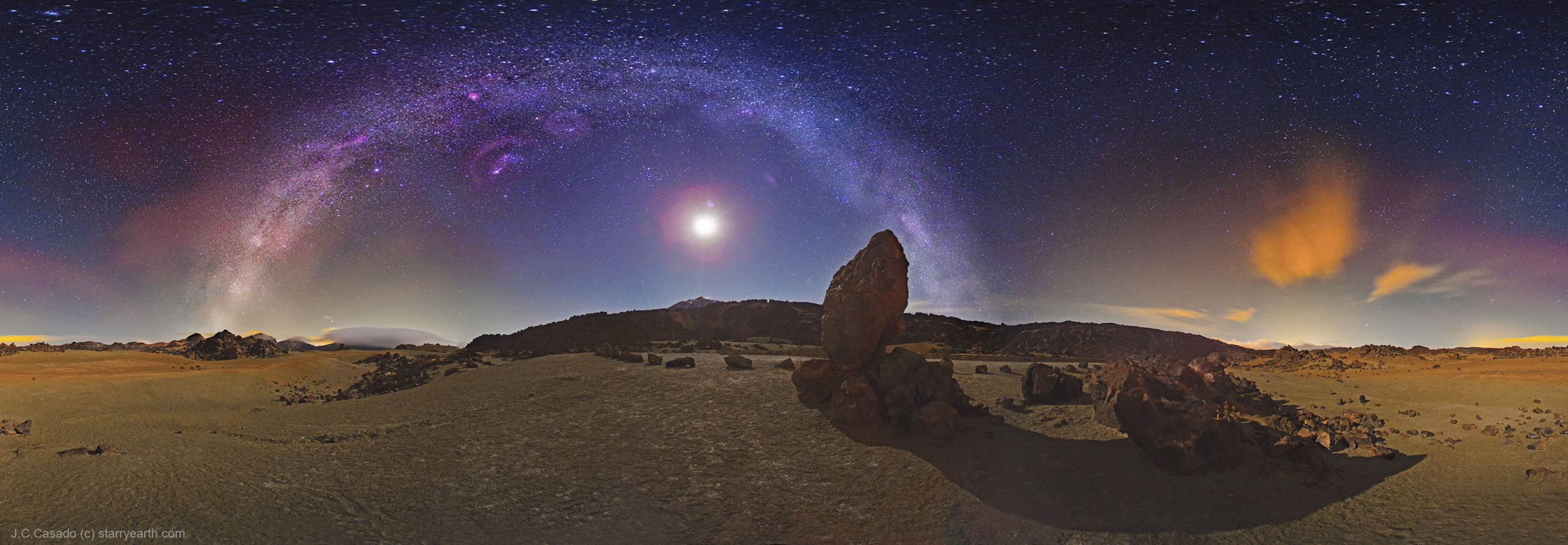
This is why our galaxy is called the Milky Way

From: http://ca.io9.com/

This is why our galaxy is called the Milky Way 
This absolutely stunning image was taken in Spain's Canary Islands by astrophotographer Juan Carlos Casado. The image combines nine different photos and reveals the band of our Milky Way galaxy in a way our unaided eyes never could.
A NASA astronomers explains how this photo reveals the full glory of the Milky Way:
In a clear sky from a dark location at the right time, a faint band of light is visible across the sky. This band is the disk of our spiral galaxy. Since we are inside this disk, the band appears to encircle the Earth. The above spectacular picture of the Milky Way arch, however, goes where the unaided eye cannot. The image is actually a deep digital fusion of nine photos that create a panorama fully 360 across. Taken recently in Teide National Park in Tenerife, Canary Islands, Spain, the image includes the Teide volcano, visible near the image center, behind a volcanic landscape that includes many large rocks. Far behind these Earthly structures are many sky wonders that are visible to the unaided eye, such as the band of the Milky Way, the bright waxing Moon inside the arch, and the Pleiades open star cluster.
Check out NASA's Astronomy Picture of the Day for an annotated guide to the various stars in the band, plus the original, full hi-res panorama. For more on Juan Carlos Casado's work, check out TWAN and the Spanish language site Starry Earth.
Via NASA. Check out even more amazing Milky Way imagery here, here, and here.
Send an email to Alasdair Wilkins, the author of this post, at alasdair@io9.com.

Friday, January 22, 2010

Space pictures taken from garden shed

An amateur stargazer has stunned astronomers around the world with his photographs of the universe – taken from his garden shed.


Amateur astronomer Peter Shah who has taken astonishing shots of the universe from his garden shed
Amateur astronomer Peter Shah who has taken astonishing shots of the universe from his garden shed Photo: WALES NEWS SERVICE
 
Peter Shah, 38, cut a hole in the roof of his wooden shed and set up his modest eight-inch telescope inside. After months of patiently waiting for the right moment he emerged with a series of striking images of the Milky Way.

His photographs of a vivid variety of star clusters light years from Earth have been compared to the images taken from the £2.5 billion Hubble space telescope.

But it cost Mr Shah just £20,000 to equip his garden shed with a telescope linked to his home computer. He said: "Most men like to potter about in their garden shed – but mine is a bit more high tech than most.

"I have fitted it with a sliding roof so I can sit in comfort and look at the heavens. I have a very modest set up but it just goes to show that a window to the universe is there for all of us – even with the smallest budgets.
"I had to be patient and take the images over a period of several months because the skies in Britain are often clouded over and you need clear conditions."

Office worker Mr Shah, who lives in a hillside bungalow at Meifod, near Welshpool, Powys, has been an avid astronomer since his mother bought him a £5 telescope when he was seven.

Images in his collection include the Monkey's head nebula, M33 Pinwheel Galaxy, Andromeda Galaxy and the Flaming Star Nebula.

The superb photos, each made up of about 30 frames, are being published in a new book entitled Mirror Image. Mr Shah’s wife Lisa has supported him through his long nights of stargazing – supplying endless cups of coffee.

His images have been brought together for the first time in a book called Mirror Image. Images from the book and other photographs can be viewed at http://www.astropix.co.uk

Wednesday, January 13, 2010

Milky Way over the Alps (Stunning Timelapse VID)


Timelapse movie: The Alps -- part II (night) from Michael Rissi on Vimeo.

Wednesday, May 27, 2009

Mega-Telescope Net To Stare Down Massive Black Hole At Center of Milky Way

6a00d8341bf7f753ef00e54f418f828834-800wi Scientists are setting up a super-telescope-network to study Sagittarius A*, the suspected black hole at the center of our galaxy. It's eight terra-yotta-kilograms , aka "so vast we don't even have prefixes that high", four million solar masses. So why is it so hard to see? Well, it's buried behind half a galaxy's worth of light-emitting stars, interstellar dust over thirty thousand light years kind of reduces the signal, and - minor issue - black holes eat light. Which makes things trickier.

Luckily astronomer Shep Doeleman of MIT remembers Voltron, and realized that if one telescope isn't enough, you just plug more of them together until it works. The technique is called Very Long Baseline Interferometry, VLBI, and it effectively creates a vast virtual dish as big as the distance between the telescopes - and he's using telescopes all over the planet.

The second part of his strategy is tuning the telescopes to 1 mm radiation, which is not as strongly absorbed by the half-a-galaxy's worth of junk between us and the action. And what action it is - if we can observe Sagittarius A*'s surroundings we can confirm once and for all whether it's a black hole - and prove Einstein right (or wrong!)

Relativity describes how large masses can bend space, and a black hole is where the mass is so large that space gives up altogether and becomes a singularity. Black holes are already well understood, we think, but we've only ever observed them at second hand - the behavior of orbiting objects or bent light rays. To actually view the shadow of a black hole, the cut-off point where light is swallowed and cannot escape, would be a massive advance - and only the beginning.

Detailed observation of the area around the Sag A* border would be a goldmine of information. The spin and rate of matter inflow into the central black hole will tell us about the Milky Way's creation, as well as providing further extreme tests of general relativity. We could even see frame dragging, which sounds like a video game hardware issue but is actually something that could happen to reality - where a spinning black hole grabs hold of space and literally pulls reality around after it.

Posted by Luke McKinney.

Thursday, December 11, 2008

Black hole confirmed in Milky Way

By Pallab Ghosh
Science correspondent, BBC News

Core of the Milky Way galaxy, taken with Nasa's Spitzer space telescope
The Milky Way was tracked from an observatory in Chile

There is a giant black hole at the centre of our galaxy, a 16-year study by German astronomers has confirmed.

They tracked the movement of 28 stars circling the centre of the Milky Way, using two telescopes in Chile.

The black hole, said to be 27,000 light years from Earth, is four million times bigger than the Sun, according to the paper in The Astrophysical Journal.

Black holes are objects whose gravity is so great that nothing - including light - can escape them.

According to Dr Robert Massey, of the Royal Astronomical Society (RAS), the results suggest that galaxies form around giant black holes in the way that a pearl forms around grit.

'The black pearl'

Dr Massey said: "Although we think of black holes as somehow threatening, in the sense that if you get too close to one you are in trouble, they may have had a role in helping galaxies to form - not just our own, but all galaxies.

The most spectacular aspect of our 16-year study, is that it has delivered what is now considered to be the best empirical evidence that super-massive black holes do exist
Professor Reinhard Genzel
Head of the research team

"They had a role in bringing matter together and if you had a high enough density of matter then you have the conditions in which stars could form.

"Thus the first generation of stars and galaxies could have come into existence".

The researchers from the Max Planck Institute for Extraterrestrial Physics in Germany said the black hole was 27,000 light years, or 158 thousand, million, million miles from the Earth.

"Undoubtedly the most spectacular aspect of our 16-year study, is that it has delivered what is now considered to be the best empirical evidence that super-massive black holes do really exist," said Professor Reinhard Genzel, head of the research team.

"The stellar orbits in the galactic centre show that the central mass concentration of four million solar masses must be a black hole, beyond any reasonable doubt."

Observations were made using the 3.5m New Technology Telescope and the 8.2m Very Large Telescope (VLT) in Chile. Both are operated by the European Southern Observatory (Eso).