Zazzle Shop

Screen printing
Showing posts with label Lenovo. Show all posts

Friday, March 11, 2011

The First Laptop To Be Controlled With The Eye

By:
From: http://www.geekwithlaptop.com/

Lenovo, the world’s fourth largest manufacturer of personal computers, a multinational corporation with principal operations based in China and Head Quarters in USA, has built the world’s first eye-controlled laptop, using eye tracking technology from Tobii. Tobii Technology is a manufacturer of hardware and software solutions for eye tracking.

The company was founded by three Swedish entrepreneurs; John Elvesjo, Henrik Eskilsson and Marten Skogo, in 2001 and has continuously shown very rapid year-to-year revenue growth -- in 2007, Tobii was awarded a prize as Sweden’s fastest growing technology company by Deloitte.

What exactly does this technology mean, in plain English? Tobii’s eye-control tech allows users to do things like select, point and scroll, these are things you’d traditionally do with a mouse or track pad. Even more, the developers say that there are already games that are available and which can be played with the eyes only.
Nonetheless, Lenovo and Tobii are on the edge of revolutionizing the notebooks market with this unthinkable product. As the company states: “The laptop is a fully functional conceptual prototype and an important breakthrough for Tobii in its mission to bring its eye tracking technology to serial production and consumer products.” Watch the video below to get a better understanding of what exactly an eye-control laptop really means.


Also, texts can be made to automatically scroll upwards or return downwards as the user reads them by using their eye movement. This is possible due to small infrared camera incorporated in the laptop that track eye’s positioning. But, there’s a fear that this technology will put our eyes to a higher stress. Will the Lenovo-Tobii partnership manage to pass over this issue?

The official representatives of the companies affirm that this technology isn’t very hard to understand and use, as it may seem at first sight. Even if the eye-tracking technology gives the user the chance to do with his eyes things he’d normally do with a mouse, this doesn’t mean that it totally replaces those devices.

“More than anything else, the Tobii laptop prototype is proof that our eye tracking technology is mature enough to be used in standard computer interfaces. To reach a state where the technology is part of the average computer, we need to make it smaller and cheaper. We believe that this can be realized in a couple of years by partnering with the right manufacturer,” comments Henrik Eskilsson, CEO of Tobii Technology.
“On the one hand, we have Lenovo, a great partner, representing industry-leading expertise in computer manufacturing and hardware development. Tobii, on the other hand, has the world’s leading eye tracking technology and unique expertise in eye tracking and eye control interfaces. We are very happy with the outcome of this collaboration,” Henrik Eskilsson concluded.
Wednesday, May 27, 2009

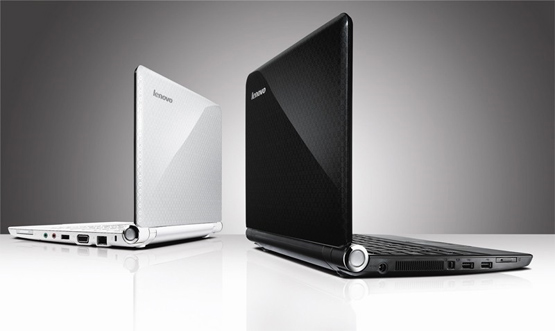
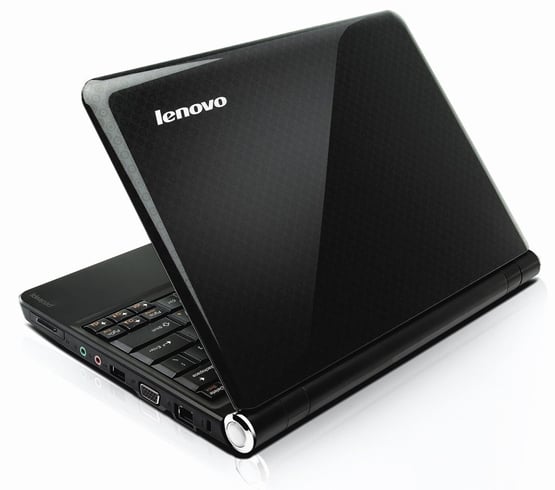
Lenovo Goes Ion With 12.1" IdeaPad S12 Netbook

It's shaping up to be quite the month for Lenovo. Just weeks after it unveiled a refreshed version of its IdeaPad S10 netbook (understandably deemed the S10-2), the company is dropping yet another new rig on the world. Today, the IdeaPad S12 came to light, bringing with it the title of world's first netbook with NVIDIA's Ion technology. How significant will this be in the netbook world? If we had to guess today, we'd say "very."


If you'll recall, NVIDIA's Ion is a new chipset that aims to provide 1080p capabilities to otherwise underpowered and low-cost machines. It's the same technology that launched in Acer's Aspire Revo nettop, and the same technology that recently shipped in a Zotac mainboard. Most netbooks today ship with lowly integrated graphics that can't handle multimedia at 720p or higher and cannot run any of the latest 3D gaming titles. Thus, most netbooks are stricken to handle only Office-type tasks and Web browsing.


Lenovo's IdeaPad S12 promises to be the first netbook that can seriously handle high-def tasks, with a 12.1" display and the ability to play back 1080p content (via the HDMI output, of course) in "silky smooth" fashion. As if that weren't enough, Lenovo also made sure to bless this machine with a 100% full size keyboard, something that's extraordinarily rare on netbooks. In fact, we'd say the tight, often misshaped keyboards are the worst attributes on netbooks. With this machine, it's just like typing on any standard 15.4" notebook. Nice touch, Lenovo.

The company hopes to begin shipping the S12 next month with prices starting at $449, though the Ion version (the flagship model) will cost $499. Still, for a netbook with a full size keyboard, Ion graphics and a six cell battery good for nearly six hours of life, that's not a lot to ask. Full specifications are below in the press release from Lenovo.


Specifications
  • Display: 12.1 WXGA (1280 X 800) LED 200 nit, 250g
  • Processor: Intel Atom N270
  • Graphics: Intel integrated GMA 950, Nvidia ION
  • Memory: Up to 1GB DDR2 533 MHz
  • Hard Drive: Up to 160 GB SATA (160, 250, 320)
  • Battery Life: 3 hours with 3-cell, 6 hours with 6-cell
  • Weight: 1.4kg with 3 cell, 1.55kg with 6 cell
  • Dimensions: 292 X 216 X 22-28.9mm
  • Connectivity: 10/100m Ethernet, Broadcom 578M, Intel WiFi Link 5150 1X2 AGN, Intel WiFi Link 5100 1X2 AGN, Non-Intel wireless b/g, Non-Intel wireless b/g/n, Bluetooth
  • Other: 3 USB, 1 Expresscard slot (Intel and VIA platforms), 4-in-1 card reader, VGA, RJA45, HDMI
  • Software: XP Home SP3 (32 bit)

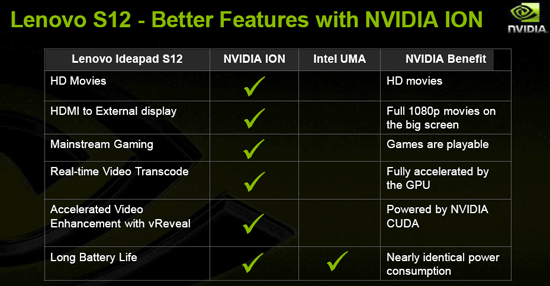
NVIDIA also took the opportunity to brief us on their proud new design win with Lenovo, underscoring the benefits of the platform over Intel chipset based solutions for the Atom processor.


And Lenovo's official press release came through over the wire this morning as well....


Lenovo Energizes Mini-Computing with its First 12-Inch Netbook Debuts World's First Netbook with NVIDIA's ION Graphics Processor

RESEARCH TRIANGLE PARK, NC – May 25, 2009: Lenovo today announced the IdeaPad S12, the company's first 12-inch netbook. The new netbook takes the best in connectivity, style and entertainment features in Lenovo's other netbooks and brings users the next level in netbook computing with improved usability and performance. These enhancements include a 12.1-inch screen, a 100 percent full-size keyboard and new graphics options with the NVIDIA ION™ platform.

"We've heard from consumers loud and clear about the need for affordable and extremely portable computing devices, and we've responded by introducing our third netbook with a completely new form factor, making mini-computing more usable and redefining value in today's market," said Dion Weisler, vice president, Business Operations, Idea Product Group, Lenovo. "We are pioneering new territory in the developing netbook arena by being the first vendor to give customers high quality video and entertainment capabilities in a netbook with optional NVIDIA ION graphics."

Elevating Power and Performance
Whether it's looking at photos, playing music, emailing or cruising online, consumers want smaller and more portable PCs. The Lenovo IdeaPad S12 netbook is raising the bar for higher levels of netbook computing with choices of the Intel Atom processor with Intel integrated graphics or the Intel Atom processor with NVIDIA ION graphics. Also, for the first time on a netbook with NVIDIA's ION graphics platform, users will be able to enjoy brilliant 1080p high definition video with silky smooth playback.
"NVIDIA ION graphics help deliver the same features found in premium PCs at lower price points and new form factors," said Rene Haas, general manager, Notebook GPUs, NVIDIA. "With enhanced graphics, the Lenovo IdeaPad S12 netbook is perfect for watching movies, playing popular games like Spore, flipping through vacation pictures or enhancing family videos."

The IdeaPad S12 netbook offers plenty of up and running time with up to six hours of battery life to support the mobile demands of netbook users1. Because netbook users need to stay connected wirelessly, the netbook comes with WiFi connectivity and ready for 3G with an ExpressCard slot to enable connectivity2. To hold the photos, music and videos users keep on their netbooks, the IdeaPad S12 netbook offers ample hard drive storage and memory with up to 160 GB of storage and 1 GB of memory. For peace of mind in case data becomes corrupted, Lenovo's OneKey™ Rescue System can help recover user data or device settings.

Loaded with Style and Entertainment
In addition to the netbook's sleek and sophisticated ring pattern design in black or white, users can make the netbook their one-stop entertainment device, starting from the moment they turn it on. Lenovo's expanded VeriFace facial recognition technology makes logging in a snap by recognizing the user's face. If users want "on demand" functionality, they can go into the Lenovo Quick Start environment and check email, browse the Internet and more without waiting for the full operating system to boot. They can also don any set of headphones and enjoy surround sound audio with Dolby Headphone technology. If opting to watch video on an external monitor, they can easily connect through the netbook's VGA port or HDMI port on select models. They can also choose among several multimedia formats to upload through the 4-in-1 multicard reader.

An Improved Computing Experience
Lenovo designed the IdeaPad S12 netbook for consumers looking for a super thin, portable and affordable device that offered a familiar, computing experience. Lenovo enlarged the netbook's WXGA screen from 10.1 inches to 12.1 inches for better viewing and made the keyboard 100 percent the size of a full-size laptop to make typing easier and less cramped. And when it comes to portability, by measuring less than an inch thick4, the netbook leads the industry for thinness compared to other 12-inch netbooks. The lightweight IdeaPad S12 netbook weighs in at just three pounds5.

Pricing and Availability
The IdeaPad S12 netbook will be available in June through business partners and www.lenovo.com. Pricing for models starts at $449. Models with the NVIDIA ION graphics will be available later this summer.


Wednesday, March 25, 2009

Lenovo steals Apple's iPhone design for "oPhone"


China leads the world in intellectual property theft, and Apple's IP is a juicy target. But usually rip-off counterfeits are produced by disreputable, back-room shops and illicit factories nobody's ever heard of. Now, it appears, that international computing giant Lenovo is getting into the act. The company's new Android handset is called the oPhone, and the software interface looks a LOT like the iPhone's.

Saturday, March 21, 2009

Did Lenovo invent Apple's netbook?

Apple rumor predicts netbook. Lenovo 'leaks' old prototype. Coincidence?
Mike Elgan

March 21, 2009 (Computerworld) In Silicon Valley's clash of innovation and ego, it's hard to remember who invented what. Oftentimes a company invents something it's not ready to ship. Another company ships something it didn't invent. Both companies jockey for the credit.

The iPhone is a perfect example. Back in 2006, it became clear that several handset makers were ready to embrace a new idea for cell phones. Instead of devices with small screens and numeric or alphabetic keypads, these companies planned to ship cell phones that were all screen and no keypad. The buttons would be mere software pressed on-screen.

Apple Inc. was one of those companies, but its product would be beat to market by handsets from Asian manufacturers. So Apple did something unusual. CEO Steve Jobs fully unveiled the iPhone in January 2007, nearly six months before it would ship. The resulting hype suffocated awareness of the Asian handsets.

Now everybody associates all-screen, touch-screen cell phones with Apple and the iPhone. Most casual observers assume Apple invented that type of device, and that everyone else is copying the iPhone.

Here comes the ultimate netbook

In the run-up to Apple's big iPhone 3.0 announcement this week, rumors about an Apple netbook reached fever pitch. Would the company ship one? If so, would it be a clamshell or a tablet? Would it run Mac OS or the iPhone operating system?

Some rumor-mongers speculated about a midyear launch, but others suggested that Apple would employ the old "one more thing" shtick to surprise the industry with its new netbook during this week's iPhone 3.0 rollout. It didn't happen, but many thought it would.

During this frenzy of speculation, photos "leaked" of a truly breathtaking netbook from Lenovo Group Ltd., the Chinese company that acquired the ThinkPad division of IBM.

Initially, the Lenovo netbook, called the Pocket Yoga, was reported as a soon-to-be-shipping product. Then it emerged (on my blog, among other places) that the Pocket Yoga was nothing more than a two-year-old concept that Lenovo had no plans to build.

Lenovo Pocket Yoga
Lenovo's Pocket Yoga is a two-year-old concept device that could be set up as a netbook or a tablet.
Lenovo Pocket Yoga

Why leak this? Why now? Why after two years would detailed photos of a concept netbook be leaked just before many people thought Apple was about to launch its first netbook?

I think it's possible that Apple's netbook will be just like the Lenovo Pocket Yoga concept. I think Lenovo found out about it and wanted to assert itself as the inventor of a new form factor that otherwise would be credited to Apple.

The Lenovo Pocket Yoga

The Lenovo Pocket Yoga concept features three types of innovations. First, rather than optimize the form factor for the screen, as most netbooks do, it optimized for the keyboard. Most netbooks have keyboards that are too narrow and have wasted real-estate below the keyboard because the screen is conventional in its dimensions. Like the Sony Vaio P, which would ship nearly two years after Lenovo claims to have conceptualized its Pocket Yoga, the Yoga's keyboard was wide enough for comfortable and fast touch-typing, and the screen was equally wide, but short. The resulting device would fit width-wise into a pocket, although its length would cause it to stick out quite a bit.

Second, a tricky lid hinge enabled the Pocket Yoga to convert into a tablet device. Lenovo envisioned pen-based input, making the Pocket Yoga similar in concept to many convertible tablet laptops on the market, just smaller.

Third, the Pocket Yoga had a weird strap that doubled as a wireless mouse.

The Apple netbook

It's almost certain that Lenovo never shipped the Pocket Yoga because such a device would be too small to run Windows Vista, or because it would be too expensive to manufacture -- or both. Other similarly tiny Vista-based devices have failed in the market, in part, because of bad performance and high price.

But such a device running the iPhone 3.0 operating system, rather than a full-fledged desktop operating system, would offer acceptable performance and price. And it would be an extremely desirable gadget.

Imagine the Pocket Yoga, but thinner. No USB ports, but supporting Bluetooth and Wi-Fi. The keys would be little rounded squares like the keys on MacBooks. The screen would flip around, and you'd use it exactly like an iPhone or iPod Touch -- no pen, but multitouch and all the rest. The device wouldn't run desktop Mac apps, but instead would run iPhone apps from the iTunes App Store. It would connect to the Internet via Wi-Fi or it could be tethered to an iPhone for mobile broadband.

The netbook I'm describing would make perfect sense for Apple. It would thrill the devoted Apple fanboys and iPhone enthusiasts, sure. But it would also open up entirely new markets -- including the one made up of people who can't be on AT&T (and therefore can't use an unlocked iPhone). Compared to any PC on the market, the iPhone is spectacularly easy to use. So an iPhone-like netbook would be ideal for children, seniors, traveling executives, Hollywood types, cheapskates, students -- OK, just about everybody. It would steal netbook business away from Microsoft, HP, Dell and others. It would drive App Store sales and iPhone App development. It would be the ideal platform for Apple's new HD movies and other Apple content.

Companies like Apple and Lenovo know what their competitors are doing before the rest of us do. They share suppliers and manufacturers. They hire their competitors' former employees, and those employees have friends and contacts across company lines.

I think there's a good chance that Lenovo knows exactly what Apple plans to ship, and therefore asserted its innovation in the netbook arena. Will there be patent lawsuits? Charges of intellectual property theft? Or is Lenovo just establishing its ideas in advance of actually shipping some variant of the Pocket Yoga that will compete with Apple's netbook?

Time will tell. But I think Lenovo's Pocket Yoga leaks could be giving us a preview of a big Apple announcement this summer.

I hope so. Because I already want one.

Wednesday, January 7, 2009

Lenovo IdeaCentre 600: Thinnest (Hottest?) All-in-One PC on the Block

Lenovo's IdeaCentre 600 is a pretty splashy debut: Its first ever all-in-one is a simple curved slab that's supposedly the thinnest all-in-one in the industry.

Beyond the form factor—which borrows liberally from the new Star Trek and the iMac (the frameless black bezel looks like it was copy and pasted)—it's actually a disappointingly standard all-in-one affair, with a smallish 21.5-inch screen and nothing you can't get on the new Vaio LV. And it's missing, at least from the spec sheet, one of the Vaio's killer features—HDMI in, which would let it be a total bedroom TV replacement. Still, it does have an awesome Swiss Army knife of a remote—it's an air mouse, accelerometer controller for games and Skype VOIP handset (it acts like a cordless phone).

It starts at $999, but all the cool stuff (like Blu-ray) is add-ons, so it'll probably get pricey pretty fast.

IdeaCentre A600 All-in-One Desktop

Lenovo brings consumers the next generation of desktop computing with the IdeaCentre A600 – Lenovo’s first all-in-one desktop. The new, sleek IdeaCentre A600 all-in-one features a 21.5-inch frameless screen, and provides discerning space-conscious and style-conscious users a modern design that measures only one inch at its slimmest point, making it the slimmest all-in-one in the industry2.

For the entertainment enthusiast, the all-in-one offers a true Hi-Def experience featuring a 16:9 aspect ratio screen for cinema-like viewing and support for 1920x1080 full HD resolution delivering outstanding image quality. The integrated speaker system includes a bass sub-woofer and Dolby® Home Theatre™ audio certification, while the optional Blu-ray player completes the home cinema experience. Users can also take advantage of a digital TV tuner for watching and recording their favorite TV programs. Users can opt to include the Microsoft Vista Media Center for easy recording of TV programs and interactive navigation between videos, music and TV programs.

For gaming enthusiasts, Lenovo developed the first-of-its-kind 4-in-1 optional remote controller. It is the first to bring PC users the ability to play games using the remote control’s ‘motion drive’ feature, which controls on-screen objects according to the movement of the remote.

Unlike competitor’s remotes, the Lenovo 4-in-1 remote controller can also be used as a VOIP handset3 to make and receive phone calls over the Internet, similar to a typical cordless telephone. The remote also serves as a media center/TV remote, and with Microsoft Vista Media Center users can use the controller to operate DVDs, movies and TV. Additionally, the remote also functions as an “air mouse” so it can be used to operate the cursor on the screen, eliminating the inconvenience of using a wired mouse.

At the core of the all-in-one is a powerful desktop computer with choices of Intel® Core™2 Duo processors, optional ATI Radeon™ graphics card technology with DirectX10 support, up to 4GB of fast DDR3 memory for improved multitasking, and up to 1TB (1000GB) of hard drive space for storing hundreds of videos, music and other documents. Equipped with the latest high-performance mobile processor technology, the all-in-one runs whisper-quiet even when performing intensive tasks.

The IdeaCentre A600 all-in-one offers several connectivity options including high-speed WiFi, a 6-in-1 media card reader, side-mounted USB and FireWire ports with additional USB ports on the rear of the panel. The all-in-one also features VeriFace™ facial recognition technology which allows users to use his/her facial image as the logon password.

IdeaCentre A600

21.5-inch frameless screen, full HD resolution 1920 X 1080 resolution

Intel Pentium Dual Core & Intel Core 2 Duo mobile processors

Intel G45M Chipset

DDR3 1066MHz, 1GB-4GB and up to 1 TB (1,000 GB) of HD space

Integrated graphics with support for DirectX10 , Optional DX10 256M OR 512M OR ATI graphics

Connectivity – Intel a/b/g Optional a/b/g/n, Ethernet

VeriFace 3.5 facial recognition

Dolby Home Theatre

Optional Blu-Ray DVD player

Optional hybrid analogue/digital TV tuner

Touch sensitive controls

Optional 4-in-1 remote control

6-in-1 card reader

6 USB 2.0 ports and 1 firewire (1394)

1.3 or 2 megapixel camera

Vista Premium, Vista Basic

WinDVD (for Blu-ray ODD), Motion drive games, Veri-face 3.5, PC Care 1.1, Rescue System 2.0 (OKR5.7), Live tool bar, Power2Go, Windows Home Premium SP1 32 , Home Basic SP 1 32bit


Monday, December 22, 2008

Lenovo's new ThinkPad has 2 LCD screens

We've all done it — had two tabs or screens open, wishing we could have two screens on our laptop so we didn't have to keep switching back and forth between windows. Enter Lenovo Group Ltd. The company's next ThinkPad laptop is more of a "desktop replacement" than ever. ThinkPad W700ds (a follow-on to the standard W700 model we evaluated for you here) will have a 17-inch main screen and a 10.6-inch secondary. The former is a bit larger than the a mainstream 15.4" laptop and the latter about the same size as the average netbook today.


It's far heavier than the norm, too — 11 pounds — and will be a bit pricier than we've come to expect from laptops — starting $3,600 when it goes up for sale in January. But check out its specs, according to ComputerWorld:
The souped-up "mobile workstation," as Lenovo calls it, also comes with customers' choice of quad-core Intel Core 2 processors and Nvidia Quadro mobile graphics CPU with as many as 128 cores. It also comes with as much as 8GB of DDR3 memory and a pair of hard drive/solid-state drive bays for up to 960GB of storage.
And know how you always reach for the separate numeric keyboard when you sit down with your laptop, then curse its non-existence? This one has it.

More tidbits:
• The secondary screen can be tiled up to 30 degrees.
• The main screen is rated at 400 nits of brightness.
• The ThinkPad has dual fans and dual heat-reduction systems.
• The whole thing measures 16 by 12 inches and is 2.1 inches thick.