September 16th, 2010 Sit back, relax, and take in the official design and specifications for the Kestrel, the hemp-bodied EV engineered by Canadian firm Motive Industries. We looked at the benefits of the environmentally friendly hemp construction last month, an avenue Lotus have also explored with their 2008 Eco Elise concept. Now we can see what the lightweight EV will look like. The swooping arches and modern features hide a 16 kilowatt-hour lithium-ion battery pack offering a range of 100 miles and a top speed around 84 miles per hour. Both these figures better the 2011 Smart Electric Drive we tested a few weeks back (on paper, at least) though Motive will only have running production prototypes in 2011. The light weight of 850 kilograms (1874 lb) no doubt helps the range and performance though, one of the benefits of the lightweight hemp bio-fiber body panels. The car should seat four passengers, though the interior design is yet to be revealed. Also yet to be revealed are Motive Industries' technology and manufacturing partners, though the consortium of 11 companies, coming under the banner of 'Project Eve', aims to 'bring together Canadian skills for the purpose of producing and supporting Canadian electric vehicles and components'. The project aims to take a holistic approach, designing technology that gives information back to the grid when the cars are recharged. As well as the Kestrel, the consortium is already testing a two-passenger EV, and intend to release a one-passenger three wheel vehicle, a small SUV and a delivery van. There's no word on whether the Kestrel has a future in the United States as of yet - the first sales will be to corporate or government fleets in Canada for beta testing, and public sales will depend on the success of these tests. If all goes to plan, production should begin in 2012. The company plans to seek foreign partners with whom they can licence the technology, so the Kestrel could become an international EV. [Motive Industries via Green Car Reports]
Sit back, relax, and take in the official design and specifications for the Kestrel, the hemp-bodied EV engineered by Canadian firm Motive Industries.
We looked at the benefits of the environmentally friendly hemp construction last month, an avenue Lotus have also explored with their 2008 Eco Elise concept. Now we can see what the lightweight EV will look like.
The swooping arches and modern features hide a 16 kilowatt-hour lithium-ion battery pack offering a range of 100 miles and a top speed around 84 miles per hour. Both these figures better the 2011 Smart Electric Drivewe tested a few weeks back (on paper, at least) though Motive will only have running production prototypes in 2011.
The light weight of 850 kilograms (1874 lb) no doubt helps the range and performance though, one of the benefits of the lightweight hemp bio-fiber body panels. The car should seat four passengers, though the interior design is yet to be revealed.
Also yet to be revealed are Motive Industries' technology and manufacturing partners, though the consortium of 11 companies, coming under the banner of 'Project Eve', aims to 'bring together Canadian skills for the purpose of producing and supporting Canadian electric vehicles and components'.
The project aims to take a holistic approach, designing technology that gives information back to the grid when the cars
are recharged. As well as the Kestrel, the consortium is already testing a two-passenger EV, and intend to release a one-passenger three wheel vehicle, a small SUV and a delivery van.
There's no word on whether the Kestrel has a future in the United States as of yet - the first sales will be to corporate or government fleets in Canada for beta testing, and public sales will depend on the success of these tests.
If all goes to plan, production should begin in 2012. The company plans to seek foreign partners with whom they can licence the technology, so the Kestrel could become an international EV.
In much of the world, hemp is thought of as a useful building material; Warren recently showed us an interesting house from Australia and it is common in the UK. But in America, it is still the butt of hippie jokes; Matt Hickman of the Mother Nature Networks describes a new house in Asheville, North Carolina with references to Tommy Chong and describes the interior: "there's not a blacklight poster, hanging spider plant, or crumpled up Cheetos bag in sight." Discovery News says "Put aside old visions of burlap-like shirts that belong with hacky sacks." Even the owner tells CNN ""We heard that we could have a really great neighborhood party if it ever caught on fire."
It's a shame that everyone is focusing on that, because it is just one interesting product in a fascinating house that is full of surprises.
Forming the walls- the black is formwork, on both sides of the structural wood frame
Push Design is a "Design firm with a focus on non-toxic/chemical free + clean air; living and working environments," and Anthony Breener appears to have looked at, and questioned, every single material in the house, from the foundations up.
Better Than Zero Carbon
The exterior walls that are getting all the sniggers are made from Hemcrete, a mix of British hemp stems that is grown without agrichemicals, and processed without a lot of energy and no toxic products. It it is chopped and graded and mixed with a binder made from hydrated lime. It sequesters 110 kilograms of carbon dioxide per cubic meter of material. The supplier, American Lime Technology, explains that industrial hemp won't get you high:
Henry VIII passed a law requiring all farms over 60 acres to grow hemp to satify his naval requirements. However by the mid 20th century the growing of hemp was outlawed because of its narcotic content (cannabis). The narcotic content has been selectively bred out of the industrial crop and the first licences for industrial grade hemp farming were issued by the UK Government in 1993.
Interior of exposed hemcrete
The stuff isn't structural, so the house has a wood frame, but it is a great insulator and sound absorbent, and will give a complete seal. It's neat stuff; it is a shame that it has to be imported from the UK because American attitudes to hemp are so silly. That is why all the sniggering and bad jokes make me so cranky; it deserves better.
More at Push House and more on other neat green features of the house tomorrow.
Not to overly play into the stereotype of the TreeHugger moniker, but today is 4/20 so a quick review of all the great uses for industrial hemp--you know, that non-psychoactive relative of marijuana that for myriad moronic reasons is more or less illegal* to cultivate in the United States but not work with and sell--seemed apropos. From clothing, to food, to fuel, to a whole host of consumer and building products, not to mention helping in cleaning up soil pollution, it's only slightly hyperbole to call hemp a wonder crop:
Hemp's been used for textiles since time immemorial--samples of hemp fabric in China date back to 8,000 BC--though it has certainly had a renaissance of late. Shedding the slightly rough and tough image it once had hemp has broken into the realms of high fashion, has been mixed with silk for lingerie, as well as being applied to more obvious applications where it's durability is used to best advantage: Providing material for shoes, jeans, and other tough sport clothing.
About one third of hemp seed's weight comes from hemp oil, which is both edible but highly nutritious, containing essential fatty acids. The whole seed is about 25% protein, and is a a good source of calcium and iron, as well as having more omega-3 than walnuts--all of which point to hemp's potential for food and as a dietary supplement. But hemp also can be put to good use in iced tea and brewed into beer, fermented into wine, and distilled into other alcoholic beverages. Oh, and there's hemp milk too.
3. Paper
Hemp has been used for paper for at least 2,000 years, even though today hemp paper accounts for about only 0.05% of world paper production. Even though hemp is a far more quickly renewable and sustainable source of pulp for paper, because of the small number and relatively old age of processing equipment for hemp paper, help pulp ends up being several times more expensive than wood pulp.
4. Building Supplies
Of all the uses for hemp, even if you only have a cursory knowledge of the subject you're probably away of hemp fabric, clothing and paper, but here's one that's an eye-opener: Hemp provides all sorts of good building materials. You can make it into insulation as companies in the Netherlands and fiberboard and pressboard, and even be used to make 'hempcrete', a stronger, lighter, and more environmentally friendly version of concrete.
5. Plastics
Hemp is also a viable feedstock for plastics production. Indeed Ford famously produced a prototype car made out of hemp & soy plastic in the early 1940s. Though it never went into production, with undue influence from chemical giant DuPont playing at least a part, as the photo above, of Henry Ford taking an axe to the car to prove its durability, shows hemp plastic can be strong stuff. More recently hemp has been made into shower curtain liners, CD & DVD cases, and all sorts of other products.
6. Fuel
Yes, you can make biofuel from hemp! Like pretty much any vegetable oil you can take hemp oil and process it into biodiesel. You still have all the concerns about conversion of land that could be used for food production into land used to fuel vehicles, but the biodiesel process is certainly solid. As cellulosic ethanol technology becomes more commercial viable--something seemingly just over the horizon for a couple of years now--there's no reason why you couldn't utilize hemp stalks or other leftovers as a feedstock. Considering all that, it stands to reason that hemp could also be utilized to make liquid fuels that are chemically identical to petroleum-based gasoline or diesel as well. But since the US doesn't want anyone cultivating hemp, the potential of hemp for fuel remains untapped.
One of the most intriguing uses for hemp is in cleaning up soil contamination. In the late 1990s industrial hemp was tested at the site of the Chernobyl nuclear disaster in Ukraine to help heal the soil. Because of its fast rate of growing each season, up to 250-400 plants per square meter each up to 15 feet tall, hemp shows goof potential in cleaning up land contaminated with fly ash, sewage sludge, or other heavy metals--though hemp's use in phytoremediation on any scale is in its infancy.
*
On to that asterisk above: As Vote Hemp points out, it's technically not illegal to grow industrial hemp in the United States, it's just that you need a permit from the DEA and they're not eager to give them out.
Growing hemp is kind of like driving, you can't drive without a license and you can't grow hemp without a permit. The difference is that it is almost impossible to get a permit from DEA to grow hemp.
Hemp isn't only TreeHugger approved. It's won this green yogini over in the health department with its number of nutritional benefits. It's an animal-free source of essential fatty acid omegas, proteins and amino acids--all-important for heart, brain and skin health.
Who knew that a spoonful of hemp powder wouldn't only find its way into my morning smoothie, or its fibers in my cute Sanuk sidewalk surfers, but possibly built into a future set of electric wheels?
Let's introduce Canada's non-smokable (industrial hemp produces very little THC) though totally cool, Kestrel electric hemp vehicle...
Hemp-bodied cars aren't new. The famous Henry Ford started experimenting with hemp and resin-based fibers way back in the day. The exploration of hemp ended however when other energy-heavy car body materials like steel and more recently, fiberglass and carbon fiber were favored for their lightness.
High on Hemp We 'Huggers should be happy hemp is back on the scene. Unlike glass or carbon, which requires intense heating and chemical processes, hemp can grow in the sun with minimal water and pesticide use.
Three cheers to Project Eve who is spearheading the hemp-shelled car project, and to the polytechnic schools in Alberta, Quebec and Toronto who will actually build the compact, 4-passenger cars. And ten cheers to Canada for waking up and permitting the cultivation of hemp. Most of the hemp products we enjoy come from Canada or Asia.
Let's hope US follows suit and that these cars look cute! (The car's complete design will be released after Vancouver's EV 2010 VÉ Conference and Trade Show in September.)
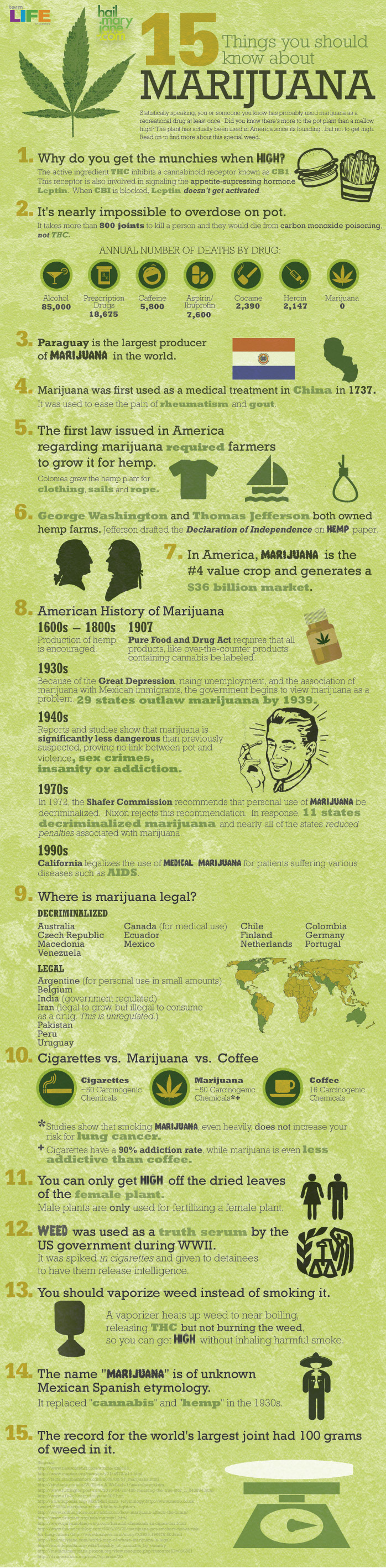
If you are anything like me, you love infographics because they make lots of information extremely easy to read and digest. So when the team at Term Life Insurance came to me with the opportunity to work with them on a marijuana infographic I HAD to take the opportunity. So after lots of research and blunts smoked, here is an awesome marijuana infographic that shows some facts about marijuana that you probably didn’t know yet. I even learned a thing or two, this plant is even more amazing than I thought. Enjoy.
The modern day car owes much of its history to Henry Ford, who dreamed of “producing an automobile that was reasonably priced, reliable, and efficient…” Many of Ford’s dreams have not come to fruition since Ford Motor Company was founded in 1903. It is debatable how affordable and reliable today’s autos are, and the average car’s fuel efficiency leaves much to be desired. Today’s auto industry is not what Ford envisioned, especially considering he predicted cars would be constructed of hemp and run on biofuels.
In fact, in 1941 Ford constructed a vehicle made from biodegradable cellulose fibers derived from hemp, sisal, and wheat straw. The car was even fueled by hemp ethanol. In 1925, Ford told the New York Times:
The fuel of the future is going to come from fruit like that sumach out by the road, or from apples, weeds, sawdust — almost anything. There is fuel in every bit of vegetable matter that can be fermented. There’s enough alcohol in one year’s yield of an acre of potatoes to drive the machinery necessary to cultivate the fields for a hundred years.
In this case, fuel technology developed in a direction that was a matter of policy choice and not predetermined by any clear advantage of one technology over another. For different reasons, Henry Ford and Charles Kettering both saw the fuel of the future as a blend of ethyl alcohol and gasoline leading to pure alcohol from cellulose. A dedicated agrarian, Ford thought new markets for fuel feedstocks would help create a rural renaissance. On the other hand, Kettering, as a scientist, was worried about the long term problem of the automotive industry’s need for oil, a resource with rapidly declining domestic reserves. Clearly, the shortage of domestic oil that was feared in the 1920s has occurred in the late 20th century, although it has hardly been noticed because of the abundance of foreign oil. Whether the oil substitute envisioned by the scientists and agrarians of the first half of the century would be appropriate in the latter half remains an open question.
Although the merits of ethanol are debatable, its share of the fuel market has grown from one to seven percent in recent years. In addition, Ford’s biomaterials team have invented seats made from hemp and soy. Almost 75 years later, Ford Motor Company may actually be moving in the direction its founding father predicted.
Buildings account forthirty-eight percentof the CO2 emissions in the U.S., according to theU.S. Green Building Council, and demand forcarbon neutraland/orzero footprint buildingsis at an all-time high. Now there is a new building material that is not just carbon neutral, but is actually carbon negative. Developed by U.K.-based Lhoist Group,Tradical® Hemcrete®is a concrete substitute made from hemp, lime and water. What makes it carbon negative? There is more CO2 locked-up in the process of growing and harvesting of the hemp than is released in the production of the lime binder. Of course the equation is more complicated than that, butHemcrete®is still an amazing new technology that could change the building industry.
Good looking, environmentally friendly and 100% recyclable,Hemcrete®is as versatile as it is sustainable. It can be used in a mind-boggling array of applications from roof insulation to wall construction to flooring. It is seven times stronger than concrete, weighs half as much, and is less prone to cracking.Hemcrete®is also waterproof, fireproof, insulates well, does not rot and is completely recyclable. In fact, the manufacturers say that demolishedHemcrete®walls can actually be used as fertilizer!
Available for years in the U.K.,Hemcrete®is only now finding its way into North America. The species of hemp used to manufactureHemcrete®is illegal to grow in the U.S., makingHemcrete®an expensive option for U.S. builders for now. As pressure for more sustainable building materials grows, lawmakers are certain to revisit this and other similarly restrictive statutes, particularly if there is money to be made. And judging from the success ofHemcrete®in Europe and elsewhere, there is plenty to be made; it is so profitable overseas that Hemp Technologies, one of the biggest manufacturers of hemp products in the UK, is actively recruiting as many new growers as it can.
Boulder, Colorado: I have every reason to believe that ‘4/20′ in 2009 will be the biggest and most momentous one to date as NORML launches 7,770 nationwide TV ads that advocate for cannabis law reform; NORML expects record numbers of supporters to join the organization for the celebratory one-day price of $4.20 because, I believe, there is a palpable zeitgeist in America right now favoring reform; the Obama administration appears amenable to some cannabis law reforms in ways that no prior president since Jimmy Carter has embraced; and lastly, with NORML’s nearly 600,000 ‘friends’ on Facebook and nearly 67,000 MySpace, more Americans than ever before who are keen on cannabis can create a viral effect that benefits reform.
Here in Boulder between 10,000-15,000 students and activists are expected to celebrate in what has become the biggest 4/20 event in the world.
Heck, the New York Times has already posted a profile of 4/20 for today’s paper, where they came yesterday for interview and photos to the University of Colorado at Boulder’s National Marijuana Forum. This portends well to what will be an insane day in the media for pro-reform groups like NORML (I’ve already got 35 interviews scheduled…) as I was also asked to pen an essay for National Public Radio’s All Things Considered that I assume will be published today. (UPDATE! Read and comment on Allen’s essay here.)
I dare say we as a country are finally ‘getting it’ regarding the clear and obvious need to reform our misguided cannabis laws.
Thanks to the hundreds of NORML supporters who donated what they could to buy ad time to launch a timely 4/20 ad campaign, you’re the green that keeps NORML all grassroots, all of the time!
Have an enjoyable and safe 4/20 from the staff of NORML!
Legalization: Yes We Can - Jason Druss
[UPDATE: Yes, the part at the end where the young lady giggles has been edited out for the airing on TV. I will work to find a copy to place on our site. -- Russ Belville, National Outreach Coordinator]
Marijuana Advocacy Group Launches TV Campaign on ‘4/20’
The National Organization for the Reform of Marijuana Laws Foundation (NORML Foundation) a Washington, D.C.-based advocacy organization, established in 1997, is purchasing advertising time on selective cable outlets to underscore the urgency of decriminalizing cannabis.
The NORML Foundation launched this pro-marijuana ad campaign to create further political pressure on the federal government to recognize 1) the ever-increasing support of Americans who favor cannabis legalization, 2) the clear sea change of cannabis laws that’s been happening at the state level since Californians voted in favor of medicinal access to cannabis in 1996, and 3) to rally cannabis consumers and anti-prohibitionists on April 20, a date on the calendar that has organically become a national day to both publicly celebrate cannabis as well as protest 70 years of prohibition.
The featured ad is the winner of NORML’s recent user-generated-content contest that asks NORML supporters: ‘What would you say to President Obama about legalizing marijuana?’
New Jersey college student and up and coming filmmaker Jason Druss created the winning submission and is the recipient of the contest’s $3,500 cash grand prize after 6500 votes were cast on NORML’s webpage. “It’s time for President Obama to endorse cannabis law reform where it is legally controlled and taxed like alcohol and tobacco products,” stated Jason Druss. “It’s shocking that students can lose out from federal student loans for possessing a few joints, when pot’s been part of the college culture for decades.’
Marijuana, By the Numbers… Thirteen states (with a population base of 115 million Americans) have decriminalized cannabis possession; thirteen states (with a population base of 75 million Americans) now have medical cannabis laws. Additionally, more states than ever before are debating cannabis law reform, including California and Massachusetts where legalization legislation have been introduced.
Since 1965, over 20 million Americans have been arrested on cannabis-related charges—90% for possession-only; over 900,000 cannabis arrests are expected again this year.
According to numerous survey and polls, approximately 75% of Americans support medical access to cannabis; 73% favor decriminalizing cannabis possession for adults and 42% of Americans support legalizing cannabis.
7,700 NORML Foundation ads are appearing on cable outlets nationwide (with a strong media buy in Ohio) on CNN, CNBC, Fox News Channel, Fuse, FX Networks, G4, MSNBC, CNN’s Headline News and Spike TV.
BC's illegal marijuana trade industry has evolved into a business giant, dubbed by some involved as 'The Union', Commanding upwards of $7 billion Canadian annually. With up to 85% of 'BC Bud' being exported to the United States, the trade has become an international issue. Follow filmmaker Adam Scorgie as he demystifies the underground market and brings to light how an industry can function while remaining illegal. Through growers, police officers, criminologists, economists, doctors, politicians and pop culture icons, Scorgie examines the cause and effect nature of the business - an industry that may be profiting more by being illegal. Written by Brett Harvey
The Union: The Business Behind Getting High is a movie about the big industry that creates and selling illegal Cannabis.Cannabis is still illegal most parts of the world,despite that cigarettes and Alcohol is taking more life's then Cannabis. Written by Feltherre
.
All you art collectors out there. Here is a chance to get a Giclee copy of some of Ian M Sherwin work. Ian is planning on doing a whole series of Marblehead, Massachusetts paintings. His work is amazing.






 .
.

 Posts
Posts

