Zazzle Shop

Screen printing
Showing posts with label Fossil. Show all posts

Friday, February 5, 2010

Dinosaur Fossil Reveals True Feather Colors

dinosaur_feathers2
Another week, another colorful feathered dinosaur. Hot on the heels of a recent report identifying pigments in fossilized dino feathers and filaments (SN Online: 1/27/10), a different team of scientists says that it has mapped the full pattern of plumage sported by the oldest known feathered dinosaur.

sciencenews
Paleontologists first described Anchiornis huxleyi, which lived in what is now northeastern China between 151 million and 161 million years ago, in September (SN: 10/24/09, p. 8). Reports of the lithe, peacock-sized dinosaur caused quite a stir, not least because the feathered creature was older than Archaeopteryx, which is considered by many scientists to be the oldest known bird.
Now, analyses of fossil feathers from all parts of A. huxleyi’s body — reported online Feb. 4 and in an upcoming Science — provide a detailed look at the dino’s color scheme. The new findings also bolster the notion that feathers first evolved for a purpose other than flying, scientists say.
A. huxleyi had black and gray body plumage, the team’s investigations suggest. And while the long feathers on the front and side of the creature’s crest were gray, those sprouting from the top and back of its head were reddish-brown. Along with reddish-brown spots on its head and neck, A. huxleyi sported white racing stripes on its legs and its winglike forelimbs.

dinosaur_feathers_fossil
Paleobiologist Jakob Vinther of Yale University and his colleagues took a microscopic look at fossilized feathers at 29 sites on a specimen of A. huxleyi unearthed early last year. Some analyses focused on the small, simple feathers that covered the creature’s body and skull, and others targeted the longer, more complex feathers that adorned its forelimbs, legs and feet. “There was hardly any part of the creature that wasn’t feathered,” Vinther notes.
Almost all of the feathers the team scrutinized contained well-preserved remnants of pigment-bearing structures called melanosomes. Feathers lacking melanosomes were probably white, the researchers note. By comparing the size, shape, density and arrangement of melanosomes in each fossil feather with those in variously colored feathers of modern birds, the team then sketched out what A. huxleyi looked like. “Using those comparisons, we can reliably predict [the creature’s] color and map the whole animal,” Vinther says.
The team’s analyses “reveal an enormous array of information,” says Michael Benton, a paleontologist at the University of Bristol in England. The black-and-white bars on A. huxleyi’s forelimbs, as well as its colorful crest, are reminiscent of similar features in modern birds, he adds.
Knowing when color appeared in feathers or filaments may help solve the conundrum of why those structures evolved in the first place, Benton says. After all, he notes, A. huxleyi’s feathered forelimbs weren’t sufficiently large enough to carry the creature’s weight in flight. “What’s the function of half a wing?” he asks. The fact that feathers appear in the fossil record long before flight-capable birds suggests that feathers initially served a behavioral function, possibly one related to sending visual signals, and only later began to serve an aerodynamic function.
Philip J. Currie, a paleontologist at the University of Alberta in Edmonton, Canada, agrees: “Ancient creatures didn’t just sprout feathers and start flying. The feathers were there for another reason first.” Fossils reveal that dinosaurs often had very large eyes and sizable optic lobes in their brains. “Dinosaurs were very visual animals, just like birds are,” he adds.
Bold patterns of plumage, such as those seen in A. huxleyi, could have served any of a number of functions, Vinther and his colleagues speculate. Besides communicating to members of its own species — a “come here, cutie” to members of the opposite sex, say, or a “back off” message to rival suitors — a quick flash of boldly colored plumage could startle an attacking predator or flush prey out of hiding, the researchers say.
dinosaur_feathers_fossil2
Images: 1) © 2010 National Geographic. 2) Jakob Vinther/National Geographic. 3) Jakob Vinther/National Geographic.

Read More http://www.wired.com/wiredscience/2010/02/dinosaur-fossil-reveals-true-feather-colors/#ixzz0egATJva0

Monday, June 8, 2009

Prehistoric Whale Discovered On The West Coast Of Sweden


The discovery of the whale bone. (Credit: Svevia)

ScienceDaily (June 8, 2009) — The skeleton of a whale that died around 10,000 years ago has been found in connection with the extension of the E6 motorway in Strömstad. The whale bones are now being examined by researchers at the University of Gothenburg who, among other things, want to ascertain whether the find is the mystical "Swedenborg whale".


Similar to the "Swedenborg whale"

There are currently four species of right whale. What is particularly interesting is that the size and shape of the whale bones resemble those of a fifth species: the mystical "Swedenborg whale", first described by the scientist Emmanuel Swedenborg in the 18th century.

"Bones from what is believed to be Swedenborg's right whale have previously been found in western Sweden. However, determining the species of whale bones found in earth is complicated and there is no definitive conclusion on whether the whale actually existed, it could equally well be a myth," says zoologist Thomas Dahlgren and his colleague Leif Jonsson.

DNA tests conducted

To determine the species of whale that has been found Thomas Dahlgren has conducted DNA tests that are to be analysed in conjunction with researchers at the Natural History Museum in London. The whale bones are interesting in several respects. The fragments of bone were collected in a clay deposit and remains of marine organisms that today are also endangered species were found around them.

"The hunt for the large whale species, which led to the extinction of the Atlantic grey whale and perhaps the Swedenborg whale, may also have caused the extinction of a large number of species that are dependent on whale carcasses for their survival," says Thomas Dahlgren.

Preserved in clay

The whale bones are thought to be around 10,000 years old and were found 75 metres above sea level, but in a site that at that time was located out on the coast. It is conjectured that the bones have been preserved for such a long time as they were surrounded by fine, oxygen-free clay. The largest whale bone, approximately 2.5 metres long, is part of a jawbone. Among the smaller bones is a vertebra. Discussions are underway on whether the bones can be put in order and potentially put on public display.

Facts about the Swedenborg whale (Balaena swedenbo´rgii)

The whale species is believed to have existed in the North Sea from the period when the inland ice melted until about 8,000 years ago, and subsequently to have died out. Ten collections of bones from the species have been found in the west of Sweden. However, there is speculation that the bones have been mistaken for other species, and that the Swedenborg whale never existed. Source: Swedish National Encyclopedia


University of Gothenburg (2009, June 8). Prehistoric Whale Discovered On The West Coast Of Sweden. ScienceDaily. Retrieved June 8, 2009, from http://www.sciencedaily.com­ /releases/2009/06/090605110420.htm

Thursday, May 21, 2009

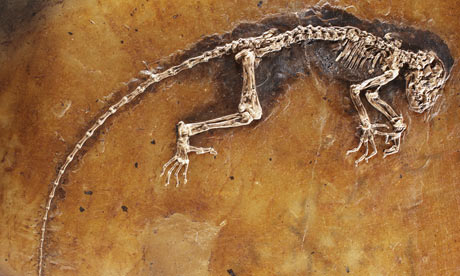
Fossil Ida: extraordinary find is 'missing link' in human evolution

Perfectly preserved fossil Ida, unveiled in New York today, provides unprecedented insight into our ancestry

Ida the missing link primate fossil - whole skeleton

Ida, one of the most complete primate fossils ever found, a 47-million-year-old human ancestor. Photograph: Atlantic Productions Ltd

Link to this audio

Scientists have discovered an exquisitely preserved ancient primate fossil that they believe forms a crucial "missing link" between our own evolutionary branch of life and the rest of the animal kingdom.

The 47m-year-old primate – named Ida – has been hailed as the fossil equivalent of a "Rosetta Stone" for understanding the critical early stages of primate evolution.

The top-level international research team, who have studied her in secret for the past two years, believe she is the most complete and best preserved primate fossil ever uncovered. The skeleton is 95% complete and thanks to the unique location where she died, it is possible to see individual hairs covering her body and even the make-up of her final meal – a last vegetarian snack.

"This little creature is going to show us our connection with the rest of all the mammals; with cows and sheep, and elephants and anteaters," said Sir David Attenborough who is narrating a BBC documentary on the find. "The more you look at Ida, the more you can see, as it were, the primate in embryo."

"This will be the one pictured in the textbooks for the next hundred years," said Dr Jørn Hurum, the palaeontologist from Oslo University's Natural History Museum who assembled the scientific team to study the fossil. "It tells a part of our evolution that's been hidden so far. It's been hidden because the only [other] specimens are so incomplete and so broken there's nothing almost to study." The fossil has been formally named Darwinius masillae in honour of Darwin's 200th birthday year.

It has been shipped across the Atlantic for an unveiling ceremony hosted by the mayor of New York Michael Bloomberg today. There is even talk of Ida being the first non-living thing to feature on the front cover of People magazine.

She will then be transported back to Oslo, via a brief stop at the Natural History Museum in London on Tuesday, 26 May, when Attenborough will host a press conference.

Ida was originally discovered by an amateur fossil hunter in the summer of 1983 at Messel pit, a world renowned fossil site near Darmstadt in Germany. He kept it under wraps for over 20 years before deciding to sell it via a German fossil dealer called Thomas Perner. It was Perner who approached Hurum two years ago.

"My heart started beating extremely fast," said Hurum, "I knew that the dealer had a world sensation in his hands. I could not sleep for 2 nights. I was just thinking about how to get this to an official museum so that it could be described and published for science." Hurum would not reveal what the university museum paid for the fossil, but the original asking price was $1m. He did not see the fossil before buying it – just three photographs, representing a huge gamble.

But it appears to have paid off. "You need an icon or two in a museum to drag people in," said Hurum, "this is our Mona Lisa and it will be our Mona Lisa for the next 100 years."

Hurum chose Ida's nickname because the diminutive creature is at the equivalent stage of development as his six-year-old daughter. Hurum said Ida is very excited about her namesake. "She says, 'there are two Idas now, there's me I'm living and then there's the dead one.'"

"It's caught at a really very interesting moment [in the animal's life] when it fortunately has all its baby teeth and is in the process of forming all its permanent teeth," said Dr Holly Smith, an expert in primate development at the University of Michigan in Ann Arbor, who was part of the team. "So you have more information in it than almost any fossil you could think of."

The fossil's amazing preservation means that the scientific team has managed to glean a huge amount of information from it, although this required new X-ray techniques that had not previously been applied to any other specimens.

The researchers believe it comes from the time when the primate lineage, that diversified into monkeys, apes and ultimately humans, split from a separate group that went on to become lemurs and other less well known species.

Crucially though, Ida is not on the lemur line because she lacks two key characteristics shared by lemurs – a grooming claw on her second toe and a fused set of teeth called a tooth comb. Also, a bone in her ankle called the talus is shaped like members of our branch of the primates. So the researchers believe she may be on our evolutionary line dating from just after the split with the lemurs.

According to the team's published description of the skeleton in the journal PLoS ONE, Ida was 53cm long and a juvenile around six to nine months old. The team can be sure Ida is a girl because she does not have a penis bone.

"She was at this vulnerable age where you are no longer right with your mother," said Smith, "Just as you leave weaning you are not full grown, but you are on your own."

The unprecedented preservation of Ida meant working out how she died was more like a modern day crime scene investigation than the informed guess-work that palaeontologists usually make do with. The team noticed that she had a broken wrist that had begun to partially heal. The injury did not kill her, but they speculate that it contributed to her premature demise.

"It might be that her mother dropped her once or that she fell down from a tree earlier in her life," Smith said. She survived the accident, but her climbing abilities would have been impaired. Unable to drink from water trapped by tree leaves, she would have had to venture down to the lake to drink. This would have proved to be a fateful decision.

The huge range of magnificently preserved fossils at Messel suggest that the volcanic lake was a death trap. Scientists believe that it sporadically let forth giant belches of poisonous volcanic gases that would have immediately suffocated anything in, around and even over the water. Ida would then have fallen into the water and been preserved in the sediment deep at the bottom.

• Atlantic productions' programme, Uncovering Our Earliest Ancestor: The Link, will be broadcast in the UK on Tuesday, 26 May at 9pm on BBC1 (revealingthelink.com). Colin Tudge's book, The Link, is published on 20 May by Little Brown.

Thursday, March 19, 2009

Rare fossil octopuses found

MSN Tracking Image
Image: Keuppia levante
Keuppia levante is one of three newly-discovered species of 95 million-year-old octopuses. Octopus fossils are among the rarest and unlikeliest of fossils.
Dirk Fuchs / LiveScience.com


Rare fossil octopuses found
Researchers surprised at how similar specimens are to modern octopus
LiveScience
updated 2:24 p.m. ET, Wed., March. 18, 2009

It's hard enough to find fossils of hard things like dinosaur bones. Now scientists have found evidence of 95 million-year-old octopuses, among the rarest and unlikeliest of fossils, complete with ink and suckers.

The body of an octopus is composed almost entirely of muscle and skin. When an octopus dies, it quickly decays and liquefies into a slimy blob. After just a few days there will be nothing left at all. And that assumes that the fresh carcass is not consumed almost immediately by scavengers.

The result is that preservation of an octopus as a fossil is about as unlikely as finding a fossil sneeze, and none of the 200 to 300 species of octopus known today had ever been found in fossilized form, said Dirk Fuchs of the Freie University Berlin, lead author of the report.

Fuchs and his colleagues now have identified three new species of octopuses (Styletoctopus annae, Keuppia hyperbolaris and Keuppia levante) based on five specimens discovered in Cretaceous Period rocks in Lebanon. The specimens, described in the January 2009 issue of the journal Palaeontology, preserve the octopuses' eight arms with traces of muscles and rows of suckers. Even traces of the ink and internal gills are present in some specimens.

"The luck was that the corpse landed untouched on the sea floor," Fuchs told LiveScience. "The sea floor was free of oxygen and therefore free of scavengers. Both the anoxy [absence of oxygen] and a rapid sedimentation rate prevented decay."

Prior to this discovery only a single fossil species was known, and from fewer specimens than octopuses have legs, Fuchs said.

What most surprised Fuchs and his colleagues Giacomo Bracchi and Robert Weis was how similar the specimens are to modern octopus. "These things are 95 million years old, yet one of the fossils is almost indistinguishable from living species," Fuchs said.

This provides important evolutionary information, revealing much earlier origins of modern octopuses and their characteristic eight-legged body-plan, Fuchs said.

Unlike vertebrate animals, octopuses lack a well-developed skeleton, which allows them to squeeze into spaces that a more robust animal could not.

"The more primitive relatives of octopuses had fleshy fins along their bodies. The new fossils are so well preserved that they show, like living octopus, that they didn't have these structures," Fuchs said.

This insight pushes back the origins of the modern octopus by tens of millions of years, he said.

URL: http://www.msnbc.msn.com/id/29757659/


© 2009 MSNBC.com

Thursday, November 20, 2008

Big cat fossil found in North Sea

By Paul Rincon
Science Reporter, BBC News

Sabre tooth reconstruction (Dick Mol)
Sabre-tooths roamed an ancient landscape now subsumed by the North Sea

The partial leg bone of a sabre-toothed cat has been dredged from the seabed by a trawler in the North Sea.

The rare fossil, which is between one and two million years old and was found near the UK coast, is from a type of sabre-tooth called a scimitar cat.

According to palaeontologist Dick Mol, it belonged to an animal that was as heavy as a small horse.

It is the furthest north this species has ever been found, and the first time remains have come from the North Sea.

The dry steppe landscape, criss-crossed by rivers, where animals such as the scimitar cat once roamed was flooded at the end of the last Ice Age.

It was like the Serengeti, but in our back garden
Dick Mol, Natural History Museum in Rotterdam
The fossil remains of more common extinct beasts such as the mammoth are routinely recovered from the sea by trawlers.

Beam trawlers use special gear to touch the sea bed, capturing flatfish lying in the sand. But this also stirs up shallow, buried fossil remains which can end up in the nets.

In the Netherlands, trawlermen are paid up to 100 euros for such discoveries.

Mr Mol, who is based at the Natural History Museum in Rotterdam, said the partial humerus belonged to a "huge" (probably male) cat that weighed about 400kg (881lbs).

Homotherium fossil (Natural History Museum Rotterdam)
Two views of the fossil, netted by a trawler in the North Sea

The fossil, which was encrusted with tiny, coral-like sea creatures called bryozoans, was brought ashore by the owner of the Dutch trawler TX 1.

He then handed it to a collector, who passed it on to Mr Mol for identification.

It had been netted in the southern bend of the North Sea, an area known to yield fossils from every period of the Pleistocene. This epoch lasted either from 2.6 or 1.8 million years ago (depending on which expert you ask) until 10,000 years ago.

Warm spell

Dick Mol said the weight of the bone was an immediate indication that much of its organic matter had been converted to minerals.

Mammoth bone (Hans (J.J.) Wildschut)
The remains of Ice Age animals are routinely netted by Dutch trawlers
The heavy mineralisation suggested it dated to the early part of the Pleistocene.

Other Early Pleistocene animals recovered from this part of the North Sea include elephant-like mastodon, southern mammoth, hippopotamus, horses, bears and giant deer.

Mr Mol and his colleague Wilrie van Logchem compared the big cat with specimens from the site of Untermassfeld in Germany, where a very similar complement of Early Pleistocene animals has been found.

They identified the find as a fragment of front leg from the scimitar cat Homotherium crenatidens.

The Rotterdam-based researcher said the sabre-tooth could have inhabited this part of North-West Europe during a warm spell between glaciations.

Top predator

"The fauna we are dealing with - the southern mammoth, the hippo, the giant deer and this sabre-toothed cat - were adapted to a savannah-like environment," Mr Mol told BBC News.

"[The cat] was probably living in the forest that bordered on the river banks."

He added: "It was like the Serengeti, but in our back garden."

Homotherium fossil (Natural History Museum Rotterdam)
The researchers compared the fossil with others from the Early Pleistocene
Analysis of the North Sea fossil suggested it was probably bigger than other H. crenatidens specimens known from Untermassfeld and from the Massif Central in southern France.

Mr Mol explained: "If we look at the bone, we can see that it was a huge animal - probably a male individual."

"We have to understand that sabre-toothed cats are specialised hunters at the top of the food chain. So they are already very rare."

The remains of only one other sabre-toothed cat - a much younger species called Homotherium latidens - have previously been recovered from the North Sea.

Scientists think the huge canines that characterise these cats were remarkably fragile. So the animals probably sank their "sabre-teeth" into the fleshy necks of their prey, avoiding bones that might crack these delicate mouth ornaments.

The big cats would then wait for the unlucky animal to die from blood loss.

Paul.Rincon-INTERNET@bbc.co.uk