Zazzle Shop

Screen printing
Showing posts with label Extrasolar Planets. Show all posts

Wednesday, May 18, 2011

SETI Turns Radio Telescopes Toward Kepler Candidate Planets, Listening for Signs of Life

Listening to places where conditions are right for life

Is There Anybody Out There? The Robert C. Byrd Green Bank Telescope, the world's largest fully steerable radio telescope, is listening to 86 Kepler candidate Earth-like planets in the hopes of hearing from alien life. Wikimedia Commons

A gigantic radio telescope in Virginia has started listening to 86 Earth-like planet candidates identified by the Kepler Space Telescope, hoping to hear signs of alien life. Astronomers aren’t even sure the stars to which they are listening actually harbor planets, let alone radio-communicating extraterrestrials, but hey, we might as well bend an ear, right?

The SETI Institute is looking at Earth-like (rocky) planets with a focus on those with temperatures between 0 and 100 °C (32° and 212 °F), where liquid water can exist. As far as our Earth-biased science can tell us, that’s a crucial ingredient for life.SETI has been listening to parts of the sky for decades, but pointing directly at Kepler findings stands among the project’s best-informed attempts yet. The Arecibo telescope in Puerto Rico looks at stars like the sun, hoping they might have planets around them.

“But we’ve never had a list of planets like this before,” said physicist Dan Werthimer, director of the SETI project at Arecibo, in an interview with AFP.

In February, Kepler scientists announced they had found 1,235 potential planets orbiting sun-like stars in the Milky Way, including 68 approximately Earth-size and 288 super-Earth-size. Scientists have been verifying and refining the measurements in the months since.

The Robert C. Byrd Green Bank Telescope will gather 24 hours of data on each of 86 planets identified this spring by the Kepler space telescope science team as potential Earth-like planets in “Goldilocks” orbits, where conditions are neither too hot nor too cold for liquid water.

SETI has its own telescopes, too, but apparently they’ve gone dark for a lack of funding, according to the AFP — SETI announced last month it was shutting down its 42-dish Allen Telescope Array because of a budget shortfall, AFP reports. While the 4-year-old, $50 million project is on hiatus, the Green Bank telescope will assume its responsibilities.

While Arecibo will also keep listening, Green Bank can hear a lot more — it scans 300 times the range of frequencies that Arecibo can, so it can collect as much data in one day as Arecibo could in one year.

The Kepler listening project will take about a year, AFP reports. SETI@home users will help crunch the data; the program uses small bits of unused processing power from idle Internet-connected computers to run calculations. You can find out more, and sign up to help, by clicking here.

[AFP]

Thursday, December 2, 2010

NASA Finds New Life (Updated with Pictures)

From: http://gizmodo.com/5704158/nasa-finds-new-life

NASA Finds New Life (Updated with Pictures)
Hours before their special news conference today, the cat is out of the bag: NASA has discovered a completely new life form that doesn't share the biological building blocks of anything currently living in planet Earth. This changes everything. Updated.

At their conference today, NASA scientist Felisa Wolfe Simon will announce that they have found a bacteria whose DNA is completely alien to what we know today. Instead of using phosphorus, the bacteria uses arsenic. All life on Earth is made of six components: carbon, hydrogen, nitrogen, oxygen, phosphorus and sulfur. Every being, from the smallest amoeba to the largest whale, share the same life stream. Our DNA blocks are all the same.

NASA Finds New Life (Updated with Pictures) 
The new life forms up close, at five micrometers.

But not this one. This one is completely different. We knew that there were microorganisms that processed arsenic, but this bacteria—discovered in the poisonous Mono Lake, California—is actually made of arsenic, with phosphorus absent from its DNA. The implications of this discovery are enormous to our understanding of life itself and the possibility of finding beings in other planets that don't have to be like planet Earth.

NASA Finds New Life (Updated with Pictures) 
Even closer, showing their internal structure.
No details have been disclosed about the origin or nature of this new life form. We will know more today at 2pm EST but, while this life hasn't been found in another planet, this discovery does indeed change everything we know about biology. I don't know about you but I've not been so excited about a bacteria since my STD tests came back clean. And that's without counting yesterday's announcement on the discovery of a massive number of red dwarf stars, which may harbor a trillion Earths, dramatically increasing our chances of finding extraterrestrial life. [NOS—In Dutch]
Mono Lake photography by Sathish J — Creative Commons

Wednesday, June 30, 2010

First Direct Photo of Alien Planet Finally Confirmed

By Denise Chow
SPACE.com Staff Writer


A planet outside of our solar system, said to be the first ever directly photographed by telescopes on Earth, has been officially confirmed to be orbiting a sun-like star, according to follow-up observations.

The alien planet is eight times the mass of Jupiter and orbits at an unusually great distance from its host star — more than 300 times farther from the star than our Earth is from the sun.

Astronomers first discovered the planet in 2008 using visible light observations from telescopes on Earth, making it the first direct photo of an extrasolar world. But at the time there was still the remote chance that it only looked like it was orbiting the star, from the perspective of Earth, due to a lucky alignment of object, star and observer.

"Our new observations rule out this chance alignment possibility, and thus confirms that the planet and the star are related to each other," said astronomer David Lafreniere, who led the research team that discovered the planet.

The new observations that confirm the planet circles its parent star were made using high-resolution adaptive optics technology at the Gemini Observatory. The observatory is an international collaboration with two identical 8-meter telescopes, located at Mauna Kea, Hawaii and Cerro Pachon in northern Chile.

Planet around young star

The host star, which has an estimated mass of about 85 percent that of our sun, is located approximately 500 light-years away in a group of young stars called the Upper Scorpius Association that formed about 5 million years ago.

The planet has an estimated temperature of over 2,700 degrees Fahrenheit (about 1,500 degrees Celsius). This makes the planet much hotter than Jupiter, which has an atmospheric cloud-top temperature of approximately minus 166 degrees Fahrenheit (minus 110 degrees Celsius).

The relatively young age of the system — our solar system is 4.6 billion years old — explains the high temperature of the planet, according to the researchers. [The Strangest Alien Planets]

The contraction of the planet under its own gravity during its formation quickly raised its temperature to thousands of degrees. But, once this contraction phase is over, the planet will slowly cool down by radiating infrared light. Within billions of years, the planet will eventually reach a temperature that is much more similar to that of Jupiter.

Tale of a planet find

Lafreniere and his research team firstannounced their planet's discovery in September 2008. At the time he was at the University of Toronto, but is now at the University of Montreal and Center for Research in Astrophysics of Quebec.

In 2008, the researchers claimed that the discovery also represented thefirst picture of a planet that orbits around a star similar to our sun. Other astronomers have also made similar claims, including a 2004 discovery of an object that could be a planet or a type of failed star called a brown dwarf.

"Back in 2008 what we knew for sure was that there was this young planetary mass object sitting right next to a young sun-like star on the sky," Lafreniere said.

The close proximity of the two cosmic objects seemed to suggest that they were associated with each other, but there was a possibility — albeit unlikely — that they were unrelated and had only aligned in the sky by chance. One of the objects might have been closer or farther by considerable distance. So more observations were required to confirm the cosmic find.

The results of the study will be published in an upcoming issue of The Astrophysical Journal.

The system, known as 1RXS J160929.1-210524 (or 1RXS 1609 for short), will give scientists a unique example to study, as its extreme separation from the star seems to challenge common planetary formation theories.

"The unlikely locale of this alien world could be telling us that nature has more than one way of making planets," said the study's co-author Ray Jayawardhana of the University of Toronto. "Or, it could be hinting at a violent youth when close encounters between newborn planets hurl some siblings out to the hinterlands."

The team of astronomers initially detected the exoplanet using the Gemini Observatory in April 2008, which made it the first likely planet known to orbit a sun-like star that was revealed by direct imaging. At the time, the researchers also obtained a spectrum of the planet and were able to determine many of its characteristics, which are confirmed in the new study.

"In retrospect, this makes our initial data the first spectrum of a confirmed exoplanet ever!," Lafreniere said.

The spectrum illustrates absorption features due to water vapor, carbon monoxide and molecular hydrogen in the planet's atmosphere.

Other distant planets photographed

This is not the only exoplanet to be discovered using direct imaging.

Since initially observing 1RXS 1609, several other alien worlds have also been found, including a system of three planets that orbit around the star HR 8799. This discovery was also made using the Gemini Observatory.

The latest exoplanet confirmation is unique, however, because the planets around HR 8799 orbit much closer to their host star.

The study of 1RXS 1609 also verified that no additional large planets (between one and eight times the mass of Jupiter) are present in the system that are closer to the star.

Future observations may reveal evidence on the origin of thestrangely far-out planet. In fact, within a few years, it should be possible to detect a slight difference in the motion of the planet and its star, due to their mutual orbits.

This difference, however, will be "very small," said the study's co-author Marten van Kerkwijk of the University of Toronto, since the fastest possible orbital period is more than one thousand years.

Clocking alien planet's speed

But, using Gemini, it is possible to precisely measure the velocity of the planet relative to its host star.

This can help astronomers determine whether the planet is following a roughly circular orbit — as would be expected if it really formed far from its host star — or whether it is in a very non-circular or even unbound orbit. The latter could be the case if it formed closer to the star but was kicked out as a result of an encounter with another alien planet, researchers said.

The adaptive optics system on the Gemini telescopes were crucial to making the observations of 1RXS 1609.

"Without adaptive optics, we would simply have been unable to see this planet," Lafreniere said. "The atmosphere blurs the image of a star so much that it extends over and is much brighter than the image of a faint planet around it, rendering the planet undetectable. Adaptive optics removes this blurring and provides a better view of faint objects very close to stars."


Thursday, June 11, 2009

See the original image at universetoday.com — First Extra-Galactic Planet May Have Been Detected

Written by Nancy Atkinson

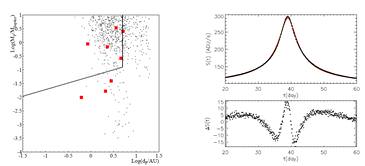
Panel on the right shows The upper panel shows the simulated light curve (black dots) of a planetary event in M31. Credit: Ingrosso, et al.

Panel on the right shows The upper panel shows the simulated light curve (black dots) of a planetary event in M31. Credit: Ingrosso, et al.


Using a technique called Pixel-lensing, a group of astronomers in Italy may have detected a planet orbiting another star. But this planet is unique among the 300-plus exoplanets discovered so far, as it and its parent star are in another galaxy. The Andromeda Galaxy, to be exact. Technically, the star in M31 was found to have a companion about 6 times the mass of Jupiter, so it could be either a brown dwarf or a planet. But either way, this is a remarkable feat, to find an object of that size in another galaxy.

Pixel-lensing, or gravitational microlensing was developed to look for MAssive Compact Halo Objects MACHOs in the galactic halo of the Milky Way. Because light rays are bent when they pass close to a massive object, the gravity of a nearby star focuses the light from a distant star towards Earth. This method is sensitive to finding planets in our own galaxy, ranging is sizes from Jupiter-like planets to Earth-sized ones. And recently, astronomers used gravitational microlensing to be able to see about a dozen or so stars in M31, an extraordinary accomplishment in itself.

The advantage of microlensing is that it works best for more distant objects, therefore in theory it would seem to be ideal for planet hunting in other galaxies. So, the researchers from the National Institute of Nuclear Physics in Italy, led by Gabriele Ingrosso decided to see if this method would work to detect planets orbiting the stars seen in Andromeda. They used a Monte Carlo approach, where they selected the physical parameters of the binary lens system –a star hosting a planet– and calculated the pixel-lensing light curve, taking into account the finite source effects. The team thought they should be able to detect a planet with about 2 Jupiter masses.

The light from one of the stars they studied in Andromeda showed a distinct variability, most likely from a companion, which could be an orbiting planet based on the object’s mass.

One disadvantage to microlensing is that exposures are available for a few days at most, so the team is hoping for another chance to follow up on their discovery.

The team notes in their paper that perhaps an extrasolar planet in M31 might have already been detected since an anomaly in a pixel-lensing light curve was previously reported by another research team in 2004, who claimed that a possible binary system in M31 was responsible for an observed anomaly in an observed light curve.

Read the team’s paper here.