

Showing posts with label Dental Care. Show all posts
Showing posts with label Dental Care. Show all posts
Thursday, July 8, 2010
Tuesday, June 29, 2010
Tooth Regeneration Gel Could Replace Painful Fillings
Could this new gel be the biggest dental breakthrough since the introduction of fluoride?


Treating cavities without drilling could mean less apprehensive patients at the dentist's office. Click to enlarge this image.
Getty Images
Dentists could soon hang up their drills. A new peptide, embedded in a soft gel or a thin, flexible film and placed next to a cavity, encourages cells inside teeth to regenerate in about a month, according to a new study in the journal ACS Nano. This technology is the first of its kind.
The new gel or thin film could eliminate the need to fill painful cavities or drill deep into the root canal of an infected tooth.
"It's not like toothpaste," which prevent cavities, said Nadia Benkirane-Jessel, a scientist at the Institut National de la Sante et de la Recherche Medicale and a co-author of a recent paper. "Here we are really trying to control cavities (after they develop)."
Drilling teeth and filling them is safe and effective. Dentists fill millions of cavities each year across the United States. However, though dentists numb the tooth, many patients still rue the sound of that drill.
The new research could make a trip to the dentist's office more pleasant, said Berkirane-Jessel. Instead of a drill, a quick dab of gel or a thin film against an infected tooth could heal teeth from within.
Cavities are bacteria and pus-filled holes on or in teeth which can lead to discomfort, pain and even tooth loss. When people eat acidic foods, consume sugary snacks or simply don't maintain proper oral hygiene, bacteria begin to eat away at the protective enamel and other minerals inside teeth.
The causes of cavities are varied. But for most cavities, the treatment is the same: drilling into a tooth, removing the decay and filling in the hole to prevent further damage.
The gel or thin film contains a peptide known as MSH, or melanocyte-stimulating hormone. Previous experiments, reported in the Proceedings of the National Academy of Sciences, showed that MSH encourages bone regeneration.
Bone and teeth are fairly similar, so the French scientists reasoned that if the MSH were applied to teeth, it should help healing as well.
To test their theory, the French scientists applied either a film or gel, both of which contained MSH, to cavity-filled mice teeth. After about one month, the cavities had disappeared, said Benkirane-Jessel.
Benkirane-Jessel cautions that the MSH-containing films or gels only treat cavities; they don't prevent them. People will still need to brush, floss and use mouthwash to help prevent cavities from forming in the first place.
Treating cavities without drilling "would have its advantages," said Hom-Lay Wang, a dentist at the University of Michigan. Cavities and drilling can destroy the nerves and blood vessels inside a tooth, making it more brittle and likely to fracture. Regenerating a tooth could help avoid crowns after a cavity has been filled.
That said, regenerating a tooth from within would only be useful in a relatively small number of cases. Most cavities would still need to be drilled and filled.
In the meantime, patients can't slacken their oral hygiene either. Numerous clinical trials over several years will have to be completed before the MSH-containing gels or films are available to treat cavities in humans.
Friday, March 13, 2009
Monkeys teach offspring to floss their teeth
Monkeys are able to teach their offspring how to floss their teeth, according to a new Japanese study.

Thailand's long tailed macaque (L) displaying how to floss her teeth in fornt of her baby in LopBuri Photo: GETTY
Female monkeys living in a 250-strong colony were observed by scientists teaching their young how to use strands of hair to clean between their teeth.
The theory that primates are able to teach offspring how to use tools was confirmed by the discovery, according to Professor Nobuo Masataka of Kyoto University's Primate Research Institute, who conducted the study.
"I was surprised because teaching techniques on using tools properly to a third party are said to be an activity carried out only by humans," he said.
The study focused on the observation of seven female long-tailed macaques and interaction with their off spring at a colony of monkeys near Bangkok in Thailand.
The practice of teeth flossing doubled and became significantly more elaborate when they were in the presence of infant monkeys, suggesting that they were attempting to teach the technique to the young.
"The study is still at the hypothesis stage," said Professor Masataka.
"We would like to shift our focus to the baby monkeys to check whether the mothers' actions are effectively helping them learn how to clean their teeth."
Monday, March 2, 2009
The Wisdom on Wisdom Teeth
Surgeons favor pre-emptive action; others might wait and see.
By Lindsay Lyon, U.S. News & World Report
"You know the old colloquialism, let sleeping dogs lie? Well these dogs are not sleeping," warns Richard Haug, executive associate dean at the University of Kentucky College of Dentistry, as he refers to wisdom teeth. An ongoing study links even pain-free wisdom teeth to early gum disease that worsens over time, sometimes causing havoc far beyond the mouth. Indeed, pregnant women with gum disease around their wisdom teeth appear to be much more likely to give birth prematurely than unaffected pregnant women. The latest data suggest that as many as 80 percent of people will develop problems with their wisdom teeth.
But controversy lingers about when to take action. Most experts no longer believe that crowding is a concern, but the American Association of Oral and Maxillofacial Surgeons typically recommends pre-emptive pulling in young adulthood, before symptoms arise, when roots haven't yet fully formed and surgical risks are lowest. "If you have to have them out when you're 45, you will not enjoy that," promises Tony Pogrel, chair of the department of oral and maxillofacial surgery at the University of California-San Francisco.
Andrew Ziolkowski, 59, can attest to that. A dental checkup a couple of years ago revealed that cysts had formed around his impacted wisdom teeth and damaged his jawbone—a surprise to Ziolkowski, who hadn't experienced any pain. The necessary surgery required that his jaw be wired shut for weeks afterward and resulted in some nerve damage, a rare complication. "To this day I have no sensation in my lower lip and chin," says the architect from Germantown, Md.
Nonsurgeons are less gung-ho about preventive pulling. "If they're not causing pain or infection, and they're coming in straight, I usually take a wait-and-see approach," says Cynthia Sherwood, a general dentist and national spokesperson for the Academy of General Dentistry. Those who wait are advised to have their wisdom teeth checked yearly, since they are tough to keep clean and may get infected or shift position. "You're committed to that treatment plan until you die," says Thomas Dodson, associate professor of oral and maxillofacial surgery at Massachusetts General Hospital.
Because wisdom teeth don't form until around age 5, Anthony Silvestri, director of dental anatomy and occlusion at Tufts University's dental school, foresees a day when lasers will be used to prevent that from happening. He and colleagues have had success in animals. "It doesn't make sense," he says, "that everyone should be having surgery for a useless tooth."
Friday, February 27, 2009
10 Secrets to Brighter, Whiter Teeth
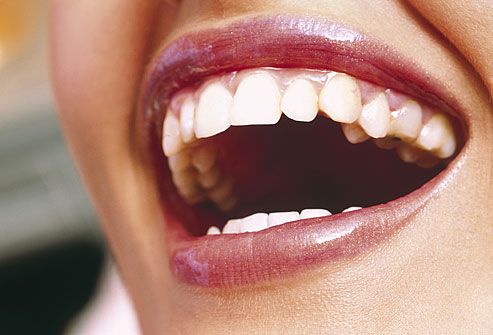
Want brighter, whiter teeth? Know what to do – and what to avoid.
read more | digg story
Subscribe to:
Posts (Atom)
 .
.

 Posts
Posts

