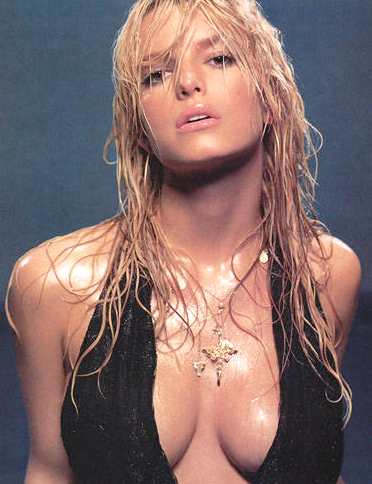
A holiday is a great excuse to run an overusedconcept into the ground. That's why the Fourth of July is a perfect opportunity for a Boob War Special Edition (cue percussive theme music) that takes a historical look at the pioneering woman--and their breasts--responsible for making our country great.
Must be an American citizen, either born or naturalized.
Must be considered a sex symbol, whether it was only during her lifetime or continues to this day.
Body of work must have been revolutionary. This also means that size isn't the only thing; it's what she did with them.
Now, as we celebrate the independence of the 13 original colonies from the British, let's salute these 13 original trailblazers.
1. Marilyn Monroe
Why she's on the list Is there really any question? Marilyn has been the gold standard for more than half a century. She influenced contemporaries like Jayne Mansfield and Mamie Van Doren and later on, models like Anna Nicole Smith. Her chest x-ray recently sold for $45,000 at auction. Although this list is compiled in no particular order, Marilyn deserves to sit at the top spot.
2. Bettie Page
Why she's on the list She wasn't the first pinup girl, but she became synonymous with the artform, becoming more well-known after her 1950s heyday (thanks in part to Dave Stevens' Rocketeer).
3. Josephine Baker
Why she's on the list Singer. Dancer. Actress. Muse. Spy. Civil rights activist. Josephine Baker epitomized beauty with substance. American-born, Baker made her name in France during the 1930s and 1940s as a singer and dancer who entranced the likes of Ernest Hemingway and Picasso. She starred in three films, and when World War II broke out, she worked with the French resistance and entertained Allied troops in North Africa. In the 1960s, she spoke at the March of Washington and refused to perform before segregated audiences as part of her participation in the U.S. Civil Rights Movement. So what have you done lately with your machine gun tits, Lady Gaga?
4. Mae West
Why she's on the list Smart and business savvy, actress/singer/writer Mae West had the mouth of Sarah Silverman on the body of Pamela Anderson. Considered an early feminist, she was one of the highest paid people in the country (second behind William Randolph Hearst in 1935) thanks to her wicked and racy charm that got her censored more than once. And ladies, if you don't think you owe anything to Mae West consider these two things:
She uttered the line "A hard man is good to find," without which you would have one less gag gift for your sorority sister's bachelorette party.
5. Lynda Carter
Why she's on the list Lynda Carter made boys--and their fathers--think Wonder Woman really existed. Of course, once they saw Bobbie Joe and the Outlaw, they were glad to find out Wonder Woman wasn't a prude or a goody-goody (link NSFW).
6. Phoebe Cates
Why she's on the list I might be breaking my rule here by including someone on the basis of a single movie scene (NSFW). But when that movie scene defined the masturbation fantasies for an untold generation, I think it's foolish to dismiss Phoebe Cates.
7. Raquel Welch
Why she's on the list Her prehistoric bikini in One Million Years B.C. caught everyone's attention. But Raquel Welch showed that she had staying power, remaining a vital sex symbol up through the 1980s.
8. Dolly Parton
Why she's on the list Do I really need to explain this to anyone?
9. Dorothy Dandridge
Why she's on the list Although not considered a traditional sex symbol, Dandridge, the first African-American nominated for an Oscar [EDIT: Specifically, the best actress Oscar, which I totally knew in my head, but I couldn't make come out of my fingers. Thanks for the catch, Anonymous], had a sultry onscreen elegance that complemented her sultry voice as a singer.
Why she's on the list As a pinup and an actress, Rita Hayworth was the sex symbol of the 1940s and blazed the way for Marilyn Monroe. Boob War fun fact: Lynda Carter played Hayworth in a TV biopic.
12. Lauren Bacall
Why she's on the list Even today, if you can watch Bacall's "You know how to whistle" scene in To Have and Have Not and not become turned on, you're probably asexual. Because even if you're homosexual, you can appreciate the smoldering sexuality coming off of Bacall's lithe, young body.
13. Elizabeth Taylor
Why she's on the list The years might not have been kind to Liz, but in her day, she defined glamour and forbidden sexuality.
That's my list. Who do you think should have made the cut?
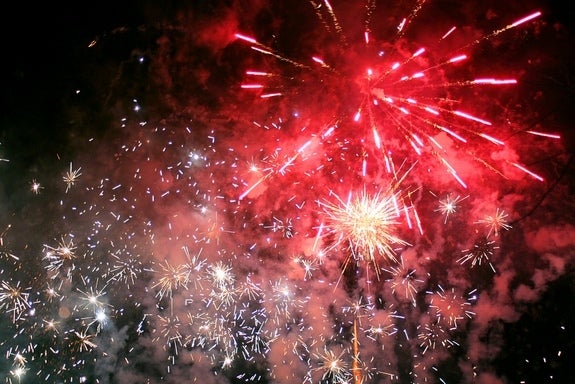
Here's what you need to know to capture the excitement of a summer fireworks display.
Dave Johnson, PC World
For the photographer, winter certainly has its share of iconic subjects, such as Christmas trees, snowmen, and icicles hanging from a roof. But there's nothing quite like the excitement of shooting summertime fireworks. Done right, fireworks photos are dynamic and colorful, and they convey a sense of action better than almost any other kind of still image. Read on to learn how to capture some exciting fireworks photos of your own this summer.
Though photos of fireworks look impressive, you don't need specialized gear to get good results. You can use almost any digital camera to capture fireworks, as long as it offers either some degree of manual exposure control (so that you can dial in the right ISO, aperture, and shutter speed settings) or a fireworks scene mode designed to do the work for you.
Even compact digital cameras can meet the challenge. The Fujifilm Finepix F200 EXR shown here, for example, hits the sweet spot for portability and simplicity--it's a superb compact point-and-shoot that, when set to fireworks mode and stabilized to minimize image shake, can take some excellent fireworks shots.
...But a Digital SLR Is Best
Compact cameras eschew features for portability, however. If you like to tinker with your exposure settings, consider an advanced point-and-shoot like the Canon PowerShot SX10 IS. It has a convenient swiveling LCD for shooting unusual angles, such as over the top of a crowd or low down on the ground. A wealth of exposure options let you dial in the one-touch fireworks mode or take more control with shutter priority, aperture priority, and manual exposure settings.
If you have a choice, though, I recommend enlisting a true digital SLR. Digital SLRs tend to generate less noise in the lengthy exposures you'll need to capture fireworks, and they have advanced features such as manual exposure control and external shutter release to minimize shake when you're taking the photo. The Nikon D90 (pictured here), for example, is a favorite not just because it was the first digital SLR to incorporate high-definition video recording, but also because it provides excellent image quality, Live View mode, and face detection for those times when you’re not shooting fireworks.
Stabilize Your Camera
The most important rule for shooting fireworks: Use a slow shutter speed so that you can record those dramatic, colorful light trails as they explode through the sky. But no matter whether you're using a point-and-shoot or a high-end digital SLR, you'll need some sort of support to capture a sharp image, free from the blur that results when you hold a camera in your hands.
A simple, inexpensive, and lightweight tripod is all you need. Keep the tripod head loose so that you can quickly move it around to frame the exploding fireworks, while the tripod legs prevent jiggling.
If you don't want to haul even a compact tripod around, consider using a monopod--since it has just one leg instead of three, it won't be as steady as a tripod, but it can be a reasonable compromise. You could also prop your camera on a solid surface. Some photographers like gadgets such as The Pod (essentially a bean bag with a tripod mount in the top) for steadying the camera on rocks, fences, and other platforms.
Hands Off
You should also avoid touching the camera when the exposure starts, so you don't jiggle it and blur the photo. You could try to use the camera's self-timer to trigger the exposure, but you would have to trigger your exposure in advance to anticipate the best fireworks moment. A better solution is to invest in a wireless remote or a shutter release cable, both of which let you take the photo without touching the camera.
Go Automatic
If your compact camera or advanced point-and-shoot has a fireworks mode, enable it. This mode automatically adjusts the camera's settings for a nighttime exposure. Want to know what's going on behind the scenes? On most cameras, the fireworks mode will turn the flash off, set focus to infinity, disable exposure compensation, and lower the ISO. For the most part, I find that a preset fireworks mode achieves good results for simple shots.
No Fireworks Mode? No Problem
Some point-and-shoots that lack a fireworks mode may still permit you to adjust the settings. Here are some good settings to try, if your camera allows.
Low ISO: Set the camera to its lowest ISO setting to minimize digital noise.
Focus on infinity: Turn off automatic focus and set the camera's focus to infinity so that it doesn't search helplessly for a subject in the dark. Don't have a manual focus control? Use the camera's landscape mode, which also sets the focus to infinity; the low light will encourage the camera to shoot at a slow shutter speed and capture the light trails.
Set the aperture: Dial in an f/stop somewhere between f/8 and f/16. That will help prevent overexposing the scene and avoid light "blooms" coming from the explosions in the sky.
Slow down the shutter: Pick a value between 1 second and 16 seconds for your shutter speed. The longer the exposure, the more fireworks you'll capture in the same frame, and the longer your light trails will be. For really long exposures try covering the lens with your hand or the lens cap between bursts to avoid overexposing the picture.
If you have a digital SLR, you'll have an easier time--and more options--when setting up your camera for fireworks.
In a nutshell, you'll want to dial in the lowest ISO, throw the camera into full manual mode, choose a small aperture opening (try starting at f/8), and pick a slow shutter speed with an exposure time of between 1 and 4 seconds. After you take your first few pictures, review them to see if you're getting realistic color. If the bright blue, orange, and red fireworks all look kind of white, you should use the same exposure time but close the aperture a bit and try again. That means changing your f/8 setting to f/11 or perhaps f/16. If the fireworks are too dim, open the aperture to f/5.6 or f/4.
Most SLRs have a bulb mode that leaves the shutter open for as long as you hold down the shutter release, giving you total control over the exposure. When the fireworks launch, press the shutter release to start the exposure. Hold the button down until after the fireworks have bloomed, several seconds later. If you go for superlong exposures, you should cover the lens between fireworks.
While you might be tempted to zoom in to get close-ups of the action, I recommend that you use the wider end of your lens's range--or, if you're using a digital SLR, switch to your wide-angle lens. You'll be able to capture more fireworks in a shot and even frame the action against a skyline or other recognizable objects in the foreground.
Of course, you can experiment by changing your zoom range throughout the evening. Just remember that if you zoom in too tightly, you'll have trouble knowing exactly when and where the fireworks are going to do their thing, and you'll end up missing the action.
As you prepare for summer fireworks, remember that capturing the action is often more art than science. Experiment with a range of shutter speeds and aperture settings over the course of the event. If the weather is uncooperative, take advantage by incorporating umbrella-covered spectators into the scene. And don't forget that your photo editing program's cropping tool can sometimes bring a distant fireworks blast front and center, turning a mediocre shot into a keeper.
(For more expert advice on digital photography, cameras, and image editing, see our Digital Focus blog.)
.
All you art collectors out there. Here is a chance to get a Giclee copy of some of Ian M Sherwin work. Ian is planning on doing a whole series of Marblehead, Massachusetts paintings. His work is amazing.