Zazzle Shop

Screen printing

Saturday, March 7, 2009

Modern Bath Tubs and Whirlpool Tubs by Kos of Italy

In a previous post Furniture Fashion reviewed three awesome saunas and steam showers from Kos who received design guidance from the well seasoned team of Roberto and Ludovica Palomba. Here are some equally stylish bath tub and whirlpool offerings that have style and comfort in mind, and I'm sure one of them just may be the perfect compliment to the Kos selection of saunas. The line of bath tubs can be used in a free standing application or built in as desired, and are available in round, rectangular and even triangle shapes allowing your room to be outfitted with the best option to compliment your floor plan. My favorite tub is the round Geo 180 that combines a whirlpool option with a cascading ceiling mounted shower head that doubles as a soothing mood light. As you can see Kos is on the forefront of modern hydrotherapy design for those who value their private time.

KOS GRANDE BATH TUB MODERN BATHROOM ACCESSORIES

KOS ITALAIN BATH TUBS AND MODERN SHOWER HEADS

GEO 180 ROUND BATH TUB AND SHOWER HEAD

KOS BATH TUB AND WHIRLPOOL MODERN BATHROOM ACCESSORIES

KOS GRANDE ANGOLO CORNER BATH TUB

15 of the World’s Most Fabulous and Funky Furniture Sets

funky-furniture-sets-main

Who says furniture has to be strictly utilitarian? Some furniture designers think outside the box, creating innovative, funky and sometimes strange sets that are just as eye-catching as they are functional. From tables with hidden compartments to compact dining sets that unfold like the petals of a flower, here are 15 incredibly creative sets of furniture.

Café Furniture with Compartments for Your Stuff

compartment-cafe-furniture

(image via: Crib Candy)

Don’t you hate it when you get to a café and have no place to put your handbag, umbrella, coat or other personal belongings? Kaman Tung designed this smart set of café furniture with compartments that hold your stuff, so you’ll never have to put it on the floor again. One chair has a compartment behind the seat, another has space for a laptop or briefcase in the arm and the third has a hook for coats. The table even has a shelf below the glass surface for items like keys and gloves.

Space-Saving Teak Bathroom Furniture

space-saving-teak-furniture

(images via: Trendir)

Anyone who has lived in tight quarters knows that space can sometimes come at a premium, making innovative space-saving solutions all the more important. This minimalist teak bathroom furniture set from Bristol and Bath may not look like it offers much in the way of storage upon first glance, but hidden within the wooden supports are pull-out drawers roomy enough to hold all of your toiletries.

‘Stay at My Home’ Sleep Set for Guests

stay-at-home-sleep-set

stay-at-home-sleep-set-2

(image via: DesignASYL)

With the ‘Stay at My Home’ sleep set, what looks like an ordinary side table with a blanket rolled up beneath it transforms into a full set of furniture for guests. The mattress, made of soft foam, unrolls into a comfortable bed and stored within the drawer of the table are bed linens, a pillow and a bedside lamp. The light weight of the objects gives the user freedom to move them around as desired.

KEWB Multi-Functional Living Room Set

kewb

(images via: PopGadget)

KEWB furniture is the perfect solution for rooms that you occasionally need to transform into bedrooms for guests. This compact little set turns from a side table and chair into a shelf unit, a bed or a dining table and floor cushions. It’s simple, multifunctional and inexpensive at about £319– ideal for dorms, as well.

Kraft Paper SoftSeating

kraft-paper-softseating

(images via: Unica Home)

This kraft paper ‘softseating’ furniture set by Molo uses a flexible honeycomb structure made entirely of 50% recycled kraft paper to fan into stools, benches and loungers. And, when you’re not using it, it can easily be compressed flat and stored on a shelf. This unusual set of eco-friendly, fold-up furniture was recently acquired by the Museum of Modern Art in New York for their permanent collection.

Livable Patio Set Livens Up Stone

stone-1

stone-2

(images via: Trendir)

How do you make a cold, stark stone patio feel cozy? With soft, welcoming textiles that warm up the space and make it feel inviting. This patio furniture by Paola Lenti comes in buff and beige to blend in with its surroundings, or in deep eggplant to provide a striking contrast.

Stackable Furniture for Small Spaces

stackable-furniture

(images via: The Design Blog)

With large homes getting less popular in favor of smaller, energy-efficient living spaces, stackable furniture is becoming more common – and it doesn’t have to be cheap, dorm-room quality stuff. These two sets of stacking furniture – Capsule Stacking and Golf Stacking – each transform into a set of chairs and a small table. When not in use, just stack them up again and they hardly take up any space at all.

M-cube Mobile, Modular, Multi-Functional Seating

mcube-1

mcube-2

(images via: Student Design Awards)

The M-cube is a multi-functional seating unit designed for people living in high-density housing. It adapts to irregular, narrow and small floor spaces to reduce clutter, increase spatial efficiency and furniture function. It’s super lightweight and has removable upholstery so it can be used in all different ways.

Stanislav Katz’ Brilliantly Bright Furniture Designs

stanislav-katz-1

stanislav-katz-2

stanislav-katz-3

(images via: Stanislav Katz)

These wild and colorful furniture designs by Stanislav Katz look like they could easily have come from a movie set with their unusual shapes and proportions. The curvy bookshelf with a built-in spot for lounging and reading is pure brilliance.

Kure Pod Dining Table & Chairs

kure-pod-1

kure-pod-2

(images via: Furniture Store Blog)

For those who lean toward extreme minimalism, the Kure table and chair set may be your ultimate dining furniture. When not in use, the Kure dining set is a giant white sphere, but when you’re ready to eat, it opens to reveal four seats, a tabletop, a lit central pillar and an umbrella-like roof with built-in lights. This design, by Fatih Can Sar?öz, is still in concept phase – but it’s an interesting one.

Wave Chaise Teenage Bedroom Set

wave-chaise

wave-chaise-2

(image via: Design Boom)

In the words of designer Roberta Rammê of Brazil, the Wave Chaise is meant to “unify beauty, comfort, and functionality” through innovative ergonomic design, intense colors and the appeal of modern technology. The chaise has built-in media storage for books and CDs, and a place to hang a flat-screen television as well as a built-in desk. Rammê says, “This concept is inspired by the values and personality of a today’s teenager and the standards generated by a global hi-tech culture of facilities, where the access to technology is cheap and easy.”

Poufman Living Room Set

pacman-furniture-set

(images via: Thread Mad)

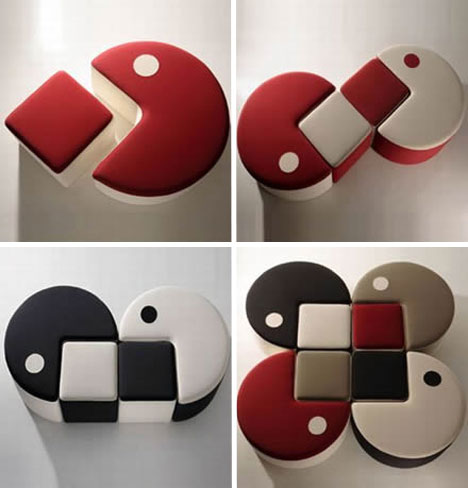
The Poufman living room set by Italian company Qayot uses the retro imagery of Pac-Man video games to create seats and ottomans that fit together in various configurations. Designed as a tribute to pop culture, the Poufman set will be a favorite of nostalgic geeks.

Illuminated LED Furniture

led-furniture-1

led-furniture-2

(images via: Dvice)

The ‘Stardust’ series by Italian furniture company Meritalia uses the glow of built-in low-voltage LED lights to illuminate these sofas, pillows, armchairs and footstools. It’s extremely lightweight thanks to the packing materials-inspired design. While the set may not be most people’s cup of tea for the living room, it could be very cool for nighttime pool parties.

Furniture That Grows With Your Child

furniture-grows-child

furniture-grows-child-2

(images via: Yanko Design)

Ilo is a collection of furniture made to fit a child’s needs from infancy to the teenage years simply by rearranging its parts. Designed by Carmela Niederhauser & Nadine Grau, this bedroom set features a crib/bed as well as parts that can be transformed into desks, armoires, bookcases and more. The pieces easily snap together, making it easy to change the setup according to your child’s development.

Blooming Furniture Set

blooming-furniture

blooming-furniture-2

(images via: Design Launches)

The blooming flower dining table set is another concept design by Fatih Can Sar?öz. Six green chairs surrounding a simple green-and-white table gracefully open and close like the petals of a flower to unveil seating when needed and disguise it otherwise.

Woman Calls Cops on Burger King


Woman calls 9-1-1 after Burger King gets her order wrong.

Quote

9-1-1: "Crash department how can I help you?"
Lady: "Yeah, i'm over here at burger king right here in s---, no not s--- i live in San Clemente, I'm in ---. I'm at a drive... More »

12 "Dead Technology" Advertisements

It is interesting to look back at the various ways that technology has been advertised to consumers over the past several decades. It is particularly interesting to look back at these advertisements when the featured products have been made obsolete. From the BetaMax to the HD DVD the following are a list of the ads from technology that are either in dead or dying format, or those which are no longer in production.

Dial Up Internet


source

Perhaps the most important technological innovation since the television was the consumer availability of the internet and its subsequent online community. Most people remember what it was like to access the internet back in the early 1990s: you were required to dial up, hope that a connection would be established, and then log onto a network that moved at a snail’s pace. In short, it was slow computers and even slower connections. But, it was impressive at the time nonetheless.

Portable CD Player


source

In retrospect, early personal CD players were a joke – they didn’t have the ball-bearings that firmly held the discs in place. This meant that CDs were prone to shift around within the unit, which proved difficult for the disc to be read. As a result, the music would constantly skip; basically you had to be sitting perfectly still with the CD on a desk in order to listen to music. This meant that the early CD players weren’t usable for road trips, or for running, or anything really...for that matter.

Personal Cassette Player


source

Ohh, the personal cassette player. The cassette tape was the easy-to-reproduce, durable and relatively cheap alternative to records when first introduced. As a result, they became the music format of choice in the 1980s and into the early 1990s. It’s hard to believe that cassettes were still produced by major record labels up until 2000. Memories of having to rewind these tapes with pencils should haunt most people over 25 from time to time.

Laserdisc


source

The laserdisc was an obvious precursor to the DVD, which more closely resembled an LP. The laserdisc never really took off in the U.S., while its success was relatively greater in Asia. The most likely reason for Laserdic's widespread failure was price: the average Laserdisc player cost about 5x the price of a VCR. The laserdisc enjoyed the status of a luxury item at one point, and within five years it became the source of many jokes – mostly those citing its irrelevancy.

Projection Box Television


source

These huge monstrosities were usually accessorized with a few hundred pounds of fake wood, metal and wires. The point was to make the TV look as if it were somehow part of a much larger cabinet, that complimented a room's greater interior design motif. Aesthetically a fail, these huge television sets were the crowning jewel of a middle class family’s living room for at least a generation. It is most likely tied to the fact that, at one time it was extremely popular to put up fake plastic wood paneling in your home.

BetaMax


source

BetaMax is the most frequently referenced dead technology. This is because as a format it did not last very long. Having launched in 1975 in the U.S., the BetaMax format would - at the height of it's popularity - account for only 30% of the market. A the same time, VHS, which launched in 1976 was able to capture 70% within a year. After losing the format war with VHS, BetaMax has resigned itself to operational obscurity. But it holds a special part in the heart of many – maybe hundreds of thousands – and is known colloquially as the epitome of irrelevance.

NeoGeo


source

Neo Geo was a flash in the pan. On one hand, they revolutionized gaming with far 'superior' graphics at the time -32 bits were quite a step up from 16. The games however, were questionable: with horrible graphics, stolen story lines, and miserable translations. The best bet for people that still own a NeoGeo is to hold onto it; maybe there will be a movement in the future among gamers wishing to own vintage consoles to revisit the sub-par gaming experience of yesteryear.

Polaroid


source

Polaroid instant cameras were a very popular consumer product with both commercial, and cult appeal for decades. Only in 2008 did Polaroid announce that it would discontinue manufacturing the instant film format; The affordability and popularity of digital cameras are presumed to be the primary reason for the declining relative popularity of Polaroid.

MiniDisc


source

Somewhat popular among musicians, and somewhat popular in Japan, the MiniDisc never fared well as a consumer product. Introduced in the early 1990s in most global markets, it lasted only with mild success until all but disappearing by the late 1990s. Most people attribute the increased popularity of compact discs, and (re)writable compact discs as a reason for the MiniDisc’s lack of success. It could also be that most record labels never fully pursued this technology, and as a result only produced limited pre-recorded albums.

VCR


source

When the VCR format was launched in 1976, it quickly became the dominant market leader. VCR remained in this position throughout the 1980s and most of the 1990s, until eventually losing ground to the DVD format by 2000. Since then, the VCR format has been on the decline, culminating in a 2007 FCC mandate that no longer shall stand-alone VCR players be produced for the U.S. Market.

HD DVD


source

The first HD DVD players were released in March 2006 in Japan, and in April 2008 in the US. By 2008, Netflix, Best Buy and Wal Mart had stated that they would openly support the competing BluRay format. In February 2008, Toshiba, the largest supporter of the format, soon followed suit. In less than two years, the format was all but dead. Currently, there are millions of unsold HD DVDs in American markets; some retailers (as noted above) are even giving them away with drastically price-reduced HD DVD players. HD DVD could rightly be perceived tas the modern day BetaMax.

The Pager


source

Pagers were popular among doctors and professionals by the late 1970s, but as a consumer product they were not widespread until the early 1990s. To those not old enough to remember, it consisted of a small device worn on the belt (or in the case above on the wrist). If someone called the number, then it would send the number to the pager recipient, who then in turn could respond by calling back. The pager was most popular during the initial rise of the cellular phone, when for most people, the former presented a more cost-efficient alternative. As cell phone prices reduced, so did the widespread use of pagers. The pager left a lasting impression on society, however with the introduction of “pager code”, which could be interpreted as a precursor to text messaging.

Friday, March 6, 2009

MacBook Pro 17-inch unibody review


There's not much that can be said about the 17-inch version of the MacBook Pro that hasn't already been said about the 15-incher (and to some extent, the MacBook). Still, the big, big brother of the family has a few key differences that make it stand out from the rest of the gang. The first being its non-removable battery, built out of tech which Apple claims will result in groundbreaking lengths between charges. The second difference, available only as an option, is a non-glossy display -- an addition which many have pined for since Apple's full throttle decision to move to extremely high-glare screens. Are these changes compelling enough to induce users to upgrade? Will previous 17-inch fans find a slam dunk or a dud underneath the unibody exterior? Read on for the full scoop.


There's no point in going as in-depth on this model of MacBook Pro as we did on the 15-inch version. In terms of hardware, build quality, and general patchwork inside, this is the same computer (albeit somewhat more gigantic). The same unibody construction is used here, and Apple calls the laptop the "world's thinnest and lightest 17-inch notebook." We won't argue -- it compares favorably to the smaller entry in the family, and besides it's obviously larger footprint, we didn't feel it was excessively heavy for a device of this size (it actually weighs 6.6 pounds, just a little over a pound heavier than the 15-inch version).


All of the other details, like the glass trackpad and new keyboards are completely intact. Actually, if you saw one of these from a distance, it might not be immediately obvious that it was the 17-incher (save for how tiny the human using it would look in comparison).

Hardware

The version we received was the fully kitted out iteration of the laptop. The base configuration (a not-super-cheap $2,799) is outfitted with a 2.66GHz CPU, 4GB of RAM, a 320GB hard drive, and the switchable NVIDIA GeForce 9400M / 9600M GT GPUs. The version we have came fully loaded with a 2.93GHz CPU, 8GB of RAM, a 256GB SSD, and (yes) an anti-glare display. Needless to say, performance wasn't much of an issue -- but the final cost ($4,899) might be a little extreme for most.

In terms of day to day tasks, this computer is simply overkill. If you're working on even somewhat graphically intensive projects, you can probably get by just fine with one of the smaller models. It's not as if the GPU is more super-charged than any other system in the line. The real advantage here is the massive screen real estate, matte display, and the supposedly gargantuan battery life. The 17-inchers do seem suited to those working in the video or photography fields, and Apple clearly isn't too interested in trying to shill these to the mainstream. The company is actually touting features like a 60 percent greater color gamut in the display panel (which incidentally is the same in both the gloss and non-gloss versions).


Performance on our system was insanely fast, though. From cold boot to active desktop took roughly 30 seconds, which is blazing (at least to us). Jumping from app to app, dealing with huge images / editing, multiple tabs of CPU intensive websites, and having scores of projects open at once didn't faze the Pro. The biggest performance gains were in disk access, and obviously the SSD is a major player here, but even general UI elements seemed snappier and more responsive than on our other computers. Of course, none of that should come as a surprise, this is -- after all -- Apple's top of the line laptop.

So let's talk about that display for a moment. Our biggest gripe about the other new unibody Macs was the lack of a matte option for the screens. In our review, we noted that the glare on the new LED displays is so intense that it's actually quite distracting in anything other than a lowly lit room. Apple chose to solve the problem on the bigger versions by introducing an anti-glare option (for an additional $50, of course). Interestingly, the company prefers the term "anti-glare" to "matte," which is odd, since "anti-glare" quite obviously suggests the other option is, well... "glare."


MacBook Pro 15-inch vs. MacBook Pro 17-inch

Regardless, the new display is stunning. Not only is the thing massive in terms of resolution (going back to the 15-incher made us feel like we were working on an OLPC XO), but the color depth and contrast are stunning. Apple seems to have really honed the art of light sensing, and we found the display accurately adjusting itself to a room's light. When cranked up to full brightness, the screen beams -- it's crisp, clear, and colors pop. We're not designers, and we're not professional photographers, but as far as we can tell, this display would be pure win for folks in those lines of work.


Of course, the big question on the hearts and minds of gadget fans everywhere is: does the battery deliver on Apple's promises? First, a little background.

As you likely know, the battery in the 17-incher is the non-removable type, much like the MacBook Air... with one major difference. Phil Schiller went on and on at Macworld this year about the lengths the company went to in developing a battery which is not only built into the system, but extends life far beyond that of a typical unit. The result was a The claim from Apple is that the 40 percent larger, lithium-polymer-based bricks they came up with can provide up to eight (yes, 8) hours of use on a single full charge, and can be re-juiced 1000 times before needing to be replaced. Once you need said replacement, the packs can be swapped out by Apple for a low, low fee of $179.

So, the claim: up to eight hours with the on-board graphics, and seven hours with the discrete GPU switched on -- how did they fare?


In our tests, under normal use (image editing, heavy web surfing, blogging all over the internet, YouTube / Viddler video watching, really serious AIM sessions), the laptop nabbed an average of 4:40 on a single charge with the low-power GPU, and, surprisingly, just under four hours (about 3:50) with the discrete chip. Those numbers fall right in line with other reviews we've seen of the laptop, and our feeling was that they're fairly consistent across the board. So, we're dealing almost four hours discrepancy with what Apple claims -- but what does that mean? According to the company, they tested a 2.66GHz model with the screen at half brightness while browsing the web over WiFi and editing a text document to achieve that eight hour number. We put the system to a more average and complete test, and frankly, we're impressed with the results. The new battery bests the typical lifespan of a MacBook Pro removable by almost double. Having seen what it's capable of, we could get comfortable with Apple adding batteries of this variety into other new laptops they produce, but let's revisit this again in a year or two -- we still have no idea what the long term experience would be like with one of these. Will it live up to the promise of a 1000 charges? We have our doubts.

Still, if we had to choose a swappable scenario over this, it would be hard to choose. From experience, being able to quickly swap to a new battery is a huge benefit when you're on the move and don't have a second to recharge. On the other hand, the huge stretches of time between charges we saw on the new 17-incher are extremely encouraging, and likely long enough to make the system viable for field use.

Wrap up

Ultimately, the decision about whether to buy the bigger MacBook Pro is probably already made -- if you're a power user who needs the real estate, there's little to deter you from making this purchase. Apple has cleaned up the design in all the right ways, improved the display and guts considerably, and proved that it can milk a substantial amount of time from a non-removable battery. The cost may still be a major barrier here for most, but something tells us if you really need a computer of this size, you'll find a way to pay for it. Our actual gripe comes not in the form of problems with this particular system, but in Apple's methodology of rolling out options for their laptops. Unlike competitors such as Dell, if you want a 15-inch Apple laptop, you're stuck with one type of display (the same resolution and same obnoxious glossy finish), and your options for other components aren't much better. Apple: you've proven that you can turn in a beautiful, clear LED display without resorting to the reflective sheen of the current models -- why not extend that kindness to the rest of your users?