Zazzle Shop

Screen printing

Tuesday, January 15, 2008

Chismillionaire Detroit Auto Show Report- Audi R8 V12 TDI


What's special about it?
Yes, that's TDI, as in "diesel." This R8 is powered by a diesel. Not just any diesel, but a twin-turbocharged 6.0-liter V12 diesel generating 500 horsepower. It's the same engine featured in the Audi Q7 V12 TDI, a 60-degree V12 that is somewhat related to the one that has powered Audi's R10 endurance racecar to two outright victories at the 24 Hours of Le Mans. We're pretty sure that the R8 V12 TDI represents the first time a diesel V12 has been placed in a midengine all-wheel-drive two-seater. Feel free to correct us if we're wrong.

Raiding the corporate parts bin in order to create a showcar is not an unusual practice, but we believe that the R8 V12 TDI has more than bits of double-sided tape holding it together. The clues lie in the bodywork and the transmission.

Bespoke visual cues include larger front and side intakes, a deeper front spoiler and a new rear valance that artfully integrates four reshaped tailpipe tips and twin diffusers. Rocker-sill extensions are also new, as are the blistered fenders and movable rear wing. The NACA duct on the glass roof feeds intake air to two variable-geometry turbos, which generate a peak boost pressure of 38 psi. Inside the cockpit, aluminum and carbon fiber have been applied liberally.

It all smacks of window dressing for an off-the-rack R8 just for the sake of differentiation, but then you realize that the body add-ons are functional elements that generate real downforce. Concept cars don't go into the wind tunnel to determine how effective their aero bits are.

Considering that the R8 V12 TDI thumps out 738 pound-feet of torque from 1,750 to 3,000 rpm, the need to shift gears is probably an academic exercise. Nevertheless, Audi has fitted a six-speed manual gearbox to the R8 V12 TDI, which is one gear more than the R10 racecar has. You don't design new gearboxes for showcars, but we're surprised that Audi's dual-clutch automated manual hasn't been used here.

Larger brakes of the carbon-ceramic variety help keep a total of 44 pounds of unsprung mass out of the wheelwells and are said to last the life of the car. We're certain there's still not enough braking power to offset the weight increase incurred by dropping the iron-block V12 diesel engine in place of the R8's featherweight, all-aluminum V8, though Audi is mum on the actual weight difference. At just less than 27 inches long, the V12 is reasonably compact, however.

The R8 V12 TDI, like all modern diesels, produces few pollutants. It complies with Euro 6 emissions standards that take effect in 2014 thanks to the use of a 2,000-bar common-rail fuel system, piezo injectors, particulate filters in the exhaust and a urea injection system that keeps NOx emissions in check.

Chismillionaire Detroit Auto Show Report- Volkswagen Passat CC


What's special about it?
Volkswagen insists on referring to the 2008 Passat CC as a "four-door coupe." This contradiction in terms is akin to calling a pickup truck a "four-wheeled motorcycle." It's a nasty habit that originated with the introduction of the Mercedes-Benz CLS, a car with which the Passat CC bears more than a passing resemblance.

All whining about vehicle classifications notwithstanding, the Passat CC is one elegant sedan. Its graceful roof line is accompanied by a 0.29 drag coefficient and significant dimensional changes compared to the workaday Passat. The CC grows 1.2 inches longer and 1.4 inches wider, sits nearly 2 inches lower and introduces front and rear track measurements that have increased fractionally.

The CC is intended to move the Passat nameplate upmarket among midsize sedans and will be introduced in Europe this summer and then the U.S. market in late 2008.

Two direct-injection gasoline engines will be offered Stateside. The 200-horsepower turbo 1.8-liter inline-4 currently found in the GTI takes residence in the base CC and is mated to a six-speed manual or six-speed automatic gearbox. A 280-horsepower 3.6-liter V6 power plant paired with a six-speed automatic will also be offered. Volkswagen's twin-clutch DSG gearbox won't be available on U.S.-spec models, which is a shame. All-wheel drive will be standard on V6 models.

Chismillionaire Detroit Auto Show Report- Cadillac CTS Coupe


What's special about it?
It's so special that Clay Dean, Cadillac's global design director, calls the CTS coupe concept the breakthrough design of the decade. "The CTS coupe concept is the next great design, carrying the baton from the Evoq concept that ushered in the Art and Science era in 1999," he says.

Well, the Evoq turned into the XLR, a sales disaster, but this CTS coupe should fare much better when it eventually goes into production. For one, its CTS roots are solid and it doesn't stray too far from them. The CTS coupe rides on the same wheelbase as the sedan, yet it's 2 inches shorter in both height and overall length. The windshield has been laid back a few degrees, while the B-pillar has been eliminated to further clean up the profile as well. Unfortunately, the C-pillars seem to have grown abnormally large in response, giving the CTS coupe an almost hatchback-style profile.

Surprisingly, most of the sheet metal is new, as the grille, headlights and front fenders are the only direct sedan carryovers. According to John Manoogian, director of exterior design for Cadillac, typical exterior bodywork enhancements like extended moldings and a spoiler were kept out of the mix to maintain the purity of the overall design. Instead, only smaller details have been changed, like slimmer side mirrors, revised quarter-panel vents and hidden door handles.

Chismillionaire's post Storm deal of the week

$699.99

HP DV9627CL Laptop Computer - 1.9 GHz Turion 64 x 2 Dual Core TL-58, 2048MB, 200GB, 802.11b/g wireless LAN, DVD+/-RW w/LightScribe, 17" True Bright Wide Screen, Web Cam, NVIDIA GeForce Go 7150M Graphics Card, Microsoft Vista Home Premium


Monday, January 14, 2008

UFO over San Diego 1-1-08

Google Ads Gone Bad!

Astronomy Picture of the Day

Discover the cosmos! Each day a different image or photograph of our fascinating universe is featured, along with a brief explanation written by a professional astronomer.

2007 February 5
See Explanation.  Clicking on the picture will download  the highest resolution version available.

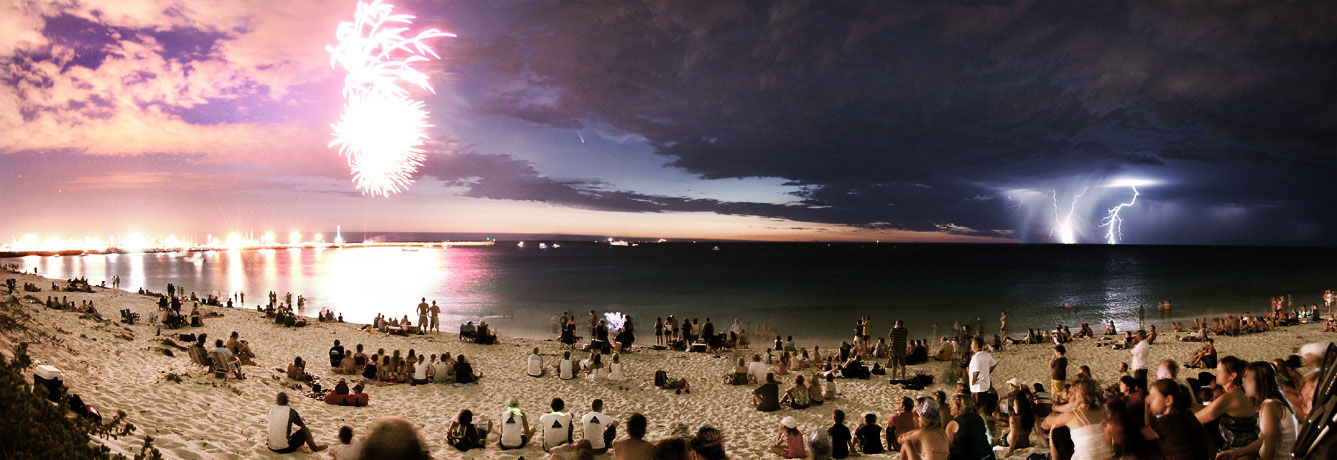
Comet Between Fireworks and Lightning
Credit & Copyright: Antti Kemppainen

Explanation: Sometimes the sky itself is the best show in town. On January 26, people from Perth, Australia gathered on a local beach to watch a sky light up with delights near and far. Nearby, fireworks exploded as part of Australia Day celebrations. On the far right, lightning from a thunderstorm flashed in the distance. Near the image center, though, seen through clouds, was the most unusual sight of all: Comet McNaught. The photogenic comet was so bright that it even remained visible though the din of Earthly flashes. Comet McNaught continues to move out from the Sun and dim, but should remain visible in southern skies with binoculars through the end of this month. The above image is actually a three photograph panorama digitally processed to reduce red reflections from the exploding firework.

15 Unexpected Store Names

Published on Yesterday 1/13/2008


"Fart" store in Poland


"Ass" store in Brazil


"Niggaz", in Turkey


"WTF Mac Store", in Seattle


"Google" shop in Brazil


"Google Fashion" store in China


Can you spot the subtle message?


"Coffee Annan", in Israel


"My Space", a real estate office in São Paulo, Brazil


"Austin Flowers", in London


BONUS (thanks Ryan!)...


WEZA Foot-Powered Portable Energy Source

by Emily

FreePlay Weza, weza foot pump, portable energy charger, green gadget, portable energy, weza charger, green energy, human-powered energy, Freeplay Kinetic Energy, motion powered energy

What’s a more renewable form of energy than human energy? We’ve seen it before with the human-powered gyms in Hong Kong, and here’s a portable energy source that’s powered by the spring in your step. We just discovered this amazingly useful gadget at CES, and can’t wait to get our hands on one. The Weza Portable Energy Source from Freeplay can produce enough power from a few footpumps to jump-start a boat or automobile battery and power a laptop, light or a variety of other electronics. If you were stuck out in the middle of nowhere, you could even use to charge your cellphone!

FreePlay Weza, weza foot pump, portable energy charger, green gadget, portable energy, weza charger, green energy, human-powered energy,  Freeplay Kinetic Energy, motion powered energy

Weza is a Swahili word that means “power,” and how fitting of a title. The small device provides power to products via a 12 V DC cigarette lighter adapter, saving your butt in emergency situations and bringing renewable power to all your gadgets. Weza has an LED display bar to show battery and input effort levels, and the battery is a safe non-spill, 7 amp-hour lead-acid gel battery. Depending on the effort applied, this creates electrical energy of 25 to 40 Watts. It even comes with a 2 year warranty. Here’s a great individual solution to creating usable energy, off-the-grid, and using your own blood, sweat, and tears. Well, maybe just sweat.

+ WEZA - $299 from Freeplay

FreePlay Weza, weza foot pump, portable energy charger, green gadget, portable energy, weza charger, green energy, human-powered energy

Rela

Andy Roddick - Now that's an ACE!

Mysterious $100 supernote counterfeit bills appear across world

By KEVIN G. HALL
McClatchy Newspapers
The only way to distinguish some of the "supernotes," experts say, is to compare photographically blown-up sections with magnifying instruments, as these craftworkers did recently in Tokyo. About $50 million of the mystery money has been seized since 1989.

DANDONG, China | The currency changer, brazenly plying his illegal trade in the Bank of China lobby, pulled out a thick wad of cash from around the world and carefully removed a bill.

The 2003 series U.S. $100 bill was a fake, but not just any fake. It was a “supernote,” a counterfeit so perfect it’s an international whodunit.

It had come from a North Korean businessman, the changer said, getting angry looks from his confederates. He stank of alcohol, but his story was plausible. The impoverished hermit nation sat just across the Yalu River from Dandong.

The Bush administration and members of Congress two years ago loudly accused North Korean leaders of being behind the counterfeiting of U.S. currency, but a 10-month McClatchy Newspapers investigation raises questions about those charges.

As the currency changer tPublish Postold a reporter, “The ones from Europe are much better.”

Whatever the origin of the bills, “it’s by far the most sophisticated counterfeiting operation in the world,” said James Kolbe, a former congressman from Arizona who oversaw funding for the Secret Service. “We are not certain as to how this is being done or how it’s happening.”

•The paper appears to be made from the same cotton and linen mix that distinguishes U.S. currency from others. It includes the watermarks visible from the other side of the bill, colored microfibers woven into the substrate of the banknote and an embedded strip, barely visible, that reads USA 100 and glows red under ultraviolet light.

•The bills include tiny microprint that appears as a line to the naked eye, but under magnification is actually lettering around the coat of Benjamin Franklin or hidden in the number 100 that reads either USA 100 or The United States of America.

•The same optically variable ink, or OVI, is used on the number 100 on the bottom right side of the bill. Exclusively made for, and sold to, the United States, this OVI ink gives the appearance of changing color when a banknote is viewed from different angles.

•At least 19 different versions have been printed, each corresponding to a tiny change in U.S. engraving plates — an odd thing for any counterfeiter to do. Also, they show practically invisible but intriguing additions.

•Stranger yet, the number of supernotes found indicates that whoever is printing them isn’t doing so in large quantities. Only $50 million worth of them have been seized since 1989, an average of $2.8 million per year and not even enough to pay for the sophisticated equipment and supplies needed to make them.

Industry experts such as Thomas Ferguson, former director of the Bureau of Engraving and Printing, said the supernotes are so good that they appear to have been made by someone with access to some government’s printing equipment.

Some experts think North Korea does not have the sophistication to make the bills; others suspect Iran and others speak of criminal gangs in Russia or China.

Klaus Bender, the author of Moneymakers: The Secret World of Banknote Printing, said the phony $100 bill is “not a fake anymore. It’s an illegal parallel print of a genuine note.” He claims that the supernotes are of such high quality and are updated so frequently that they could be produced only by a U.S. government agency such as the CIA.

As unsubstantiated as the allegation is, there is a precedent. An expert on the CIA, journalist Tim Weiner, has written how the agency tried to undermine the Soviet Union’s economy by counterfeiting its currency.

Making limited quantities of sophisticated counterfeit notes also could help intelligence and law enforcement agencies follow payments or illicit activities or track the movement of funds among unsavory regimes, terrorist groups and others.

“As a matter of course, we don’t comment on such claims, regardless of how ridiculous they might be,” said CIA spokesman Mark Mansfield.

The lead U.S. agency in combating counterfeiting, the Secret Service, declined repeated requests for interviews for this story, as did the Federal Reserve Board and the Treasury Department.

The case against Korea

Two years ago, as the administration’s campaign to isolate and financially cripple North Korea’s dictatorship was heating up, President Bush insisted, “We are aggressively saying to the North Koreans … don’t counterfeit our money.”

Asked about his claim last summer, Bush told McClatchy Newspapers, “I’m not at liberty to speak about intelligence matters.”

Many of the administration’s public allegations about North Korean counterfeiting trace to South Korea-based “experts” on North Korea who arranged interviews with North Korean defectors for U.S. and foreign newspapers. The resulting news reports were quoted by members of Congress, researchers and Bush administration officials who were seeking to pressure North Korea.

The McClatchy investigation, which stretched across three continents, found that one source for several stories, a self-described chemist named Kim Dong-shik, has gone into hiding. A former roommate, Moon Kook-han, said Kim is a liar out for cash who knew so little about American currency that he didn’t know whose image is printed on the $100 bill.

The international police agency Interpol issued in March 2005 an orange alert — at America’s request — calling on member nations to prohibit the sale of banknote equipment, paper or ink to North Korea.

A joint Secret Service–Federal Reserve report to Congress in 2006 said the notes were being “produced and distributed with the full consent and control” of the North Korean government.

That July, at the request of the Bush administration, Interpol assembled central bankers, police agencies and banknote industry officials in Lyon, France, to make the U.S. case against North Korea. But the Secret Service never provided any details of the evidence it said it had, instead citing “intelligence” and asking those assembled to accept the administration’s claims on faith.

Interpol’s secretary general is an American, Ronald K. Noble, a veteran of the Secret Service from 1993 to 1996. He declined to discuss the supernotes in detail, but recalled the Secret Service made clear it was “not at liberty to share all of the information” to which it had access.

In the late 1990s, North Korean diplomats were caught passing supernotes in Asian capitals; diplomatic immunity prevents prosecution.

The hardest evidence to surface so far is the 2004 indictment of Sean Garland, a leader of an Irish Republican Army splinter group, who about the same time allegedly ferried more than $1 million in supernotes to Europe, mostly from the North Korean Embassy in Moscow. Garland is now in the Republic of Ireland, but the Irish Embassy said the U.S. hasn’t sought his extradition.

More recently, in August 2005, the Secret Service announced two separate sting operations — Royal Charm and Smoking Dragon, in which Chinese crime gangs were accused of smuggling supernotes into New Jersey and Los Angeles.

David Asher, who was coordinator of a working group at the State Department that collected details on North Korean criminal activities, said his group turned up evidence of the counterfeiting and didn’t rely on “intelligence” to make its case. Asher, now a researcher at the Heritage Foundation, a conservative Washington policy organization, declined to provide any details.

John Bolton, former U.S. ambassador to the United Nations and a hardliner on North Korea, told McClatchy that he never saw hard evidence that Pyongyang was making the supernotes. But he said the evidence that the North Koreans distributed them is sufficient proof of bad behavior.

The questions

“I never really saw the intelligence myself to make an independent judgment,” said Carl Ford, who quit as head of the State Department’s intelligence bureau in 2003 because he challenged the administration’s phony claim, based largely on defectors, that Iraq had weapons of mass destruction. The administration’s reluctance to disclose details on North Korea “doesn’t pass the smell test,” he said.

In May 2007, the Swiss federal criminal police, which is on the lookout for counterfeit currency and has worked closely with U.S. financial authorities, called on Washington to present more evidence. The Bundeskriminalpolizei said it doubted that North Korea was behind the supernotes.

“Using its printing presses dating back to the 1970s, North Korea is today printing its own currency in such poor quality that one automatically wonders whether this country would even be in a position to manufacture the high-quality supernotes,’” the Swiss agency reported.

The setting for the counterfeiting charges was the effort to pressure the regime of Kim Jong-il to abandon its nuclear weapons programs.

Washington accused a tiny bank in the Chinese enclave of Macau of helping North Korea launder counterfeit notes. The U.S. Treasury blacklisted the Banco Delta Asia and issued a ruling in March 2007 that effectively shut the bank down and froze $25 million in North Korean funds.

When the U.S. relented, Macau lifted its sanctions against the bank and allowed the bank to transfer $25 million back to North Korea, although the Treasury Department, citing “intelligence,” maintains the bank’s blacklisting.

Meanwhile, the Bush administration is no longer publicly accusing North Korea of producing the supernotes and has dropped the subject from talks on halting North Korea’s nuclear weapons program, according to State Department officials.

McClatchy obtained an audit by the international accounting firm Ernst & Young on behalf of the Macau government that indicated only a single case of counterfeit notes was found at Banco Delta Asia. This was in 1994, when the bank found the notes and alerted authorities.

And those fakes did not originate in North Korea.

The details

Banks around the world are still seizing supernotes. The first one was spotted by a sharp-eyed banker in the Philippines in 1989.

Since then, about $50 million worth have been found. “The seizures are not necessarily indicative of the amount in circulation,” noted Bolton, who accuses the Bush administration of going soft on North Korea.

The oddities do not stop there. Whoever is making them seemed to deliberately add minuscule extra strokes, as if trying to flag the phony bills, the Swiss noted. For example, at the very tip of the steeple of Philadelphia’s Independence Hall, the counterfeit bills have a line along the left vertical edge that is not on the real bills.

One other interesting difference: The fakes lack microscopic ink splotches that appear on real U.S. currency, which is made in large press runs and stacked one sheet on another.

The ink’s maker, a Swiss firm named Sicpa, mixes the ink at a secure U.S. government facility. The highly specialized and regulated tint also is used on the space shuttle’s windows. A Sicpa spokeswoman declined to discuss the supernotes, but offered an important fact: “We ceased all OVI deliveries (to North Korea) in early 2001, and later in the year all security ink supplies.”

Ferguson, who ran the Bureau of Engraving and Printing from 1998 to 2005, said: “They are not using somebody else’s paper or bleaching the ink off of genuine notes. Someone specifically made paper, which is a pretty big commitment.”

The supernotes incorporate at least 19 running changes that the United States has made to its engraving plates since 1989, from the names of Treasury secretaries and treasurers to blowing up the image of Ben Franklin on the $100 — something that most counterfeiters can’t or don’t bother to do.

In 1996, the Bureau of Engraving and Printing redesigned the $100 bill, adding security features and an off-center, larger Franklin portrait. In less than a year, new supernotes appeared.

“It goes way beyond what normal counterfeiters are able to do,” said Bender, whose book first spotlighted the improbability of North Korean supernotes. “And it is so elaborate it doesn’t pay for the counterfeiting anymore.”


28 places the Smithsonian Bucket List

The Smithsonian Life List

Keeping our readers' interests in mind, we've traveled the globe in search of destinations certain to inspire

  • Smithsonian magazine, January 2008

"We are all of us resigned to death: it's life we aren't resigned to," novelist Graham Greene once wrote. A growing number of Americans of all ages are embracing that idea by renewing a resolve to live life to its fullest.

Exhibit A is the recent popularity of "life lists"—itineraries of things to do and places to go before taking the ultimate trip to the Great Beyond. Bookstores brim with titles such as 1,000 Places to See Before You Die, 1001 Paintings You Must See Before You Die and—for the high-minded—Fifty Places to Go Birding Before You Die. A cottage industry of Web sites has also popped up, enabling life list enthusiasts to exchange ideas ranging from learning Japanese to getting a tattoo. Now even Hollywood has gotten into the act, with the release this month of the film The Bucket List, in which two cancer patients, played by Jack Nicholson and Morgan Freeman, break out of their medical ward and embark on a life list road trip that includes dining on expensive caviar and gambling in Monte Carlo.

Life list experts (yes, there are such beings) advise people not to set themselves up for disappointment by trying to accomplish too much. (When's the last time you completed your daily to-do list?) With the entire world to choose from, the maxim "so much to do, so little time" takes on added meaning.

To that end, the staff of Smithsonian—as diverse a group of travelers as you're likely to meet—put their heads together to come up with an exclusive list of 28 places the Smithsonian reader might wish to visit before ...it's too late. Some of the sites are portals into the past—ancient cities so well preserved that visiting them is like stepping into a previous century. Others feature feats of engineering or sublime works of art—or, in the cases of the Taj Mahal and Frank Lloyd Wright's Fallingwater, both. Travelers can visit temples and churches so breathtaking they must have been built with divine inspiration. For the more adventurous, we offer rewards beyond mere sightseeing—from a three-day hike across the Grand Canyon to a ride along China's Yangtze River.

While all of these destinations beckon year-round, there are places where timing matters: many travelers are at a loss for words after witnessing the sun rise over Machu Picchu or seeing Iguazu Falls by the light of a full moon. And, appropriately, some of our sites now confront their own mortality—endangered by pollution or just worn down, like a few of us, by the passage of time.

Whether you visit only a couple of these destinations or all 28, your life will be enriched by the experience. And if along the way you want to gorge on caviar or get a tattoo, that's entirely up to you.

Portals into the Past
Walk the timeless streets and byways of ancient cities on three continents

– Mesa Verde
– Pompeii
– Tikal
– Petra

Feats of Engineering
The world's surviving architectural wonders hewed from stone and mortar beckon as ever

– Pyramids of Giza
– Taj Mahal
– Easter Island
– The Great Wall

A Matter of Timing
Choosing the right year, month or even moment can make all the difference

– Aurora Borealis
– Serengeti
– Iguazu Falls
– Machu Picchu

Triumphs of Vision
Come face to face with history's finest works of art and design

– The Louvre
– Zen Garden of Kyoto
– Uffizi Gallery
– Fallingwater

Scale New Heights
Don't just see nature's most spectacular sites—experience them

– Yangtze River
– Antarctica
– Mount Kilimanjaro
– Grand Canyon

In the Presence of Gods
Encounter temples so magnificent then could only have been built by divine inspiration

– Pagan
– Parthenon
– Angkor Wat
– Ephesus

Here Today, Gone Tomorrow?
Visit these deteriorating or threatened destinations before they disappear

– Venice
– Amazon Rain Forest
– Great Barrier Reef
– Galápagos Islands

Friday, January 11, 2008

Come up with your own caption- I'll have the Spicy Beef

Chismillionare's Recipe of the Week- Rice Pudding


INGREDIENTS

  • 1/2 gallon milk
  • 1 cup white sugar
  • 1 cup uncooked long-grain white rice
  • 3 eggs, lightly beaten
  • 1/4 cup milk
  • 1/4 teaspoon salt
  • 2 teaspoons vanilla extract
  • ground cinnamon to taste


  1. In a large saucepan over medium-low heat, combine 1/2 gallon milk, sugar and rice. Simmer, covered, 1 hour, stirring frequently. Remove pan from heat and let rest 10 minutes.
  2. In a small bowl, combine eggs, 1/4 cup milk, salt and vanilla. Stir into rice mixture and return pot to low heat, stirring constantly, for 2 minutes. Pour into a 9x13 inch dish and cover with plastic wrap, folding back the corners to allow the steam to escape.
  3. When pudding has cooled to room temperature, remove plastic wrap and sprinkle surface of pudding with cinnamon. Cover tightly (with fresh wrap) and refrigerate 8 hours or overnight before serving.

Fitzy's Playoff Preview - Pats/Jags

Audi R8 diesel coming


The firm will make the R8 available with its new 4.2-litre V8 TDI unit late next year. Currently powering the Q7 SUV, the oil-burner produces 322bhp and 760Nm of torque. How-ever, it is likely to be tuned further for the R8, pumping out more than 350bhp and 800Nm of torque.

Hooked up to either the R8’s six-speed manual or six-speed R tronic transmissions, the four-wheel-drive supercar should be capable of going from 0-60mph in around five seconds, with a top speed of 160mph. And it will return around 30mpg.

The engine will be the final unit to go in the R8, after the 5.0-litre V10 model arrives in early 2008, priced around £85,000. The diesel version should cost about £70,000.

Parted-at-birth twins 'married'


A pair of twins who were adopted by separate families as babies got married without knowing they were brother and sister, a peer told the House of Lords.

A court annulled the British couple's union after they discovered their true relationship, Lord Alton said.

The peer - who was told of the case by a High Court judge involved - said the twins felt an "inevitable attraction".

He said the case showed how important it was for children to be able to find out about their biological parents.

Details of the identities of the twins involved have been kept secret, but Lord Alton said the pair did not realise they were related until after their marriage.

'Truth will out'

The former Liberal Democrat MP raised the couple's case during a House of Lords debate on the Human Fertility and Embryology Bill in December.

"They were never told that they were twins," he told the Lords.

"They met later in life and felt an inevitable attraction, and the judge had to deal with the consequences of the marriage that they entered into and all the issues of their separation."

He told the BBC News website that their story raises the wider issue of the importance of strengthening the rights of children to know the identities of their biological parents.


We are naturally drawn to people who are quite similar to ourselves
Pam Hodgkins
Adults Affected by Adoption

"If you start trying to conceal someone's identity, sooner or later the truth will out," he said.

"And if you don't know you are biologically related to someone, you may become attracted to them and tragedies like this may occur."

Pam Hodgkins, chief executive officer of the charity Adults Affected by Adoption (NORCAP) said there had been previous cases of separated siblings being attracted to each other.

"We have a resistance, a very strong incest taboo where we are aware that someone is a biological relative," she said.

"But when we are unaware of that relationship, we are naturally drawn to people who are quite similar to ourselves.

'Incredibly rare'

"And of course there is unlikely to be anyone more similar to any individual than their sibling."

Mo O'Reilly, director of child placement for the British Association for Adoption and Fostering, said the situation was traumatic for the people involved, but incredibly rare.

"Thirty or 40 years ago it would have been more likely that twins be separated and, brought up without knowledge of each other," she said.

Today, however, adopted children grow up with a greater knowledge of their birth families - and organisations try to place brothers and sisters together.

If that were not possible, the siblings would still have some form of contact with each other.

"This sad case illustrates why, over the last 20-30 years, the shift to openness in adoption was so important," Ms O'Reilly added.

Story from BBC NEWS:
http://news.bbc.co.uk/go/pr/fr/-/1/hi/uk/7182817.stm

Published: 2008/01/11 14:14:35 GMT

© BBC MMVIII

New England Patriots Quarterback Tom Brady Endorses SmartWater

January 05, 2008 02:50:50 GMT

by Staff Writer

Tom Brady
© Janet Mayer/PR Photos
Glaceau's Smartwater is 's smart pick. The record-breaking quarterback for NFL's New England Patriots has been tapped to shoot a series of new ads for the distilled municipal water and electrolytes for a reportedly US$3 million payment.

Has become the next public figure after to endorse the popular drink, Brady has shot several Smartwater's ads which are set to start popping up in magazines and newspapers by next month.

In some of the ads, as seen after this news, Brady tries to tell people that Smartwater is excellent for staying hydrated while jumping rope, getting out of helicopters, and hand-selecting your next lover from the local youth football team.

In other Brady news, the NFL star is said to be ready to ask supermodel girlfriend to marry him if the Patriots close out a perfect 19-0 season with a win in the Super Bowl.

Shuttle's $199 Linux PC

January 9, 2008 1:41 PM PST
(Credit: Shuttle)

LAS VEGAS--Asus' Eee PC and Everex's CloudBook aren't the only ones pushing down the price of affordable, open-source PCs.

Shuttle introduced its $199 KPC Linux PC here on Tuesday. The company didn't have it on display on the actual floor of the convention halls here at the Consumer Electronics Show (too late did I find out you had to zip over to a private suite at the Bellagio for a look-see), but booth representatives were happy to talk details. "It's meant for simple tasks," said sales rep James Wonpu.

It'll have an Intel Celeron processor, a 945GC chipset, 512MB of memory and either a 60GB or 80GB hard drive. What it won't have: an optical drive or a PCI Express slot. Despite that, it's a pretty good-looking box, and comes in red, blue, white, and black, each with a different icon stamped on the front.

Shuttle(Credit: Shuttle)

Shuttle also says there will be a $99 barebones version of the KPC. That version will have the option of upgrading to a Core2Duo processor and 1GB of memory. Both will be available for purchase near the end of the first quarter.

Lamborghini Ad Personum program is Chismillionaire approved

DETROIT — Lamborghini on Thursday tipped its hand about what it plans for the upcoming 2008 North American International Auto Show, and it's all about a striking new color palette designed to help buyers personalize their vehicles.

The most eye-popping shade is a new shade of light blue called "Blu Cepheus," which will be available in the Lamborghini personalization program. Lamborghini says the pale blue color is "inspired by the purity and transparency of polar ice." It also notes that the blue tone is "one of the most glamorous shades in fashion today."

Lamborghini is also veering away from shiny tones, opting instead to be a trendsetter with matte finishes. The Gallardo Spyder will be shown in "Ad Personam" matte brown paint paired with a cabin in a new shade of brown Alcantara called "Marrone Gaia."

Another showstopper is likely to be the leather picked for the interiors of the Murciélago LP640 Roadster: an untreated hide said to be "inspired by the natural leather found on horse saddles and leads to natural changes in color over time," Lamborghini said in a statement.