Zazzle Shop

Screen printing

Tuesday, October 7, 2008

Red Sox beat Angels 3-2, move on to ALCS and Rays


(AP Photo/Charles Krupa)

By JIMMY GOLEN,

AP Sports Writer

BOSTON (AP) The Boston Red Sox brushed aside the 100-win Angels in four games, dismissing their best-in-baseball regular season as last month's news.

When it turns to October, no one dominates like Boston.

Jason Bay slid headfirst into home plate to score on rookie Jed Lowrie's two-out single in the ninth inning Monday night and the defending World Series champions eliminated the Los Angeles Angels with a 3-2 victory in Game 4 of their first-round playoff series.

Red Sox players exulted on the field during celebrations.

Boston, which also won it all in 2004, will have a chance at a third title in five years if it can get past the Rays in the best-of-seven AL championship series that starts Friday night at Tampa Bay.

"We just beat a phenomenal team. We're going to play another phenomenal team," Red Sox manager Terry Francona said. "It will be very exciting. We're looking forward to that. For right now though, that's probably enough."

Boston is 31-16 in October since the turn of the century, and both World Series runs began with a playoff sweep of the Angels.

Tampa Bay beat out Boston by two games in the AL East this season. The teams also beat each other up during a bench-clearing brawl at Fenway Park in June - the Rays and Red Sox have often scrapped over the years.

Los Angeles was able to force the series to a fourth game with an extra-inning victory Sunday night that snapped an 11-game playoff losing streak against Boston.

As it turned out, that gave the Angels less than an 24 extra hours.

Jon Lester held Los Angeles to four hits in seven shutout innings but lost his chance at a second victory in the series when the Angels scored twice in the eighth to tie it 2-all. The Angels had a chance to go ahead in the ninth before Erick Aybar, whose 12th-inning single was the winner in Game 3, missed on a suicide squeeze attempt, thwarting the threat.

In the bottom half, Bay lofted a fly ball down the right-field line that Reggie Willits pursued and dove for before it one-hopped into the stands for a ground-rule double. First baseman Mark Teixeira made a diving catch of Mark Kotsay's line drive for the second out before Lowrie grounded a single to right.

"Curveball down in the zone," Lowrie said. "I know he's got a good one. I was just able to get the barrel on it."

Acquired from Pittsburgh at the July 31 trade deadline as Manny Ramirez's replacement, Bay raced around third and slid headfirst into home while his teammates poured out of the dugout to celebrate.

"Sometimes it's better to be lucky than good," he said.

Manny Delcarmen got two outs in the ninth for the win, squelching the Angels' chances to take the lead by getting Aybar to whiff on a bunt try with one out and a runner on third. Red Sox catcher Jason Varitek, whose passed ball helped Los Angeles tie the game in the eighth, pursued pinch-runner Willits back toward third and made the diving tag a step before the bag.

"He's our anchor," Bay said about Varitek. "The way he ran Reggie down - he's a fast runner. That speaks volumes."

Varitek lost the ball as he hit the ground, but third base umpire Tim Welke ruled that he had already applied the tag. Angels manager Mike Scioscia argued, but replays showed that the out was recorded before the ball came loose.

Scot Shields took the loss, allowing two hits and a run while striking out three in 1 2-3 innings.

"We have to keep trying to get better, that's all we can do," Scioscia said. "A lot of guys are frustrated right now. But I can't tell you how proud we are of the way our guys played the whole summer. It's unfortunate the way it came out."

Lester and John Lackey, who also faced each other in Boston's Game 1 victory, matched scoreless innings through four before Kotsay and Varitek singled and Dustin Pedroia doubled them both in. An AL MVP candidate who was hitless in his first 15 at-bats of the playoffs, Pedroia pulled up one step before second base to bang his hands together in celebration.

But the Angels tied it in the eighth when Teixeira drew a two-out walk from Hideki Okajima, then Justin Masterson walked Vladimir Guerrero. The runners moved up on Varitek's passed ball, which proved costly when they scored on Torii Hunter's single to right.

Pedroia's confidence never wavered during the slump, as he showed when he popped out of the dugout for pregame batting practice and said, "You can't keep a good man down."

Or a good team.

The Red Sox may have missed a chance to sweep with Sunday's 5-4, 12-inning loss, but they saved themselves a trip back to Anaheim, Calif., for a winner-take-all Game 5.

Instead, they will play AL East winner Tampa Bay, which advanced with a 6-2 victory over the Chicago White Sox earlier Monday. A year after posting the worst record in the majors, the Rays won the division with a 97-65 record.
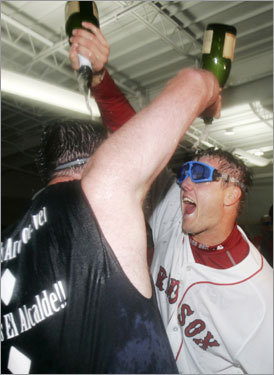

Jonathan Papelbon (right) and Sean Casey (left) dumped champagne on each other during celebrations.

Notes: Lackey was rescued from a second loss in the series when the Angels tied it in the eighth. He allowed two runs on seven hits, giving up four runs in 13 2-3 innings in the pair of starts but was outpitched by Lester both times. ... Hunter was 5-for-11 with runners in scoring position. The rest of the Angels had three hits combined. ... Pedroia was hitless in 19 postseason at-bats dating to the 2007 World Series.

Sarah Palin in 30 seconds


All you need to know about Sarah Palin in 30 seconds, from the editing room of Sim Sadler.

The top five reasons why Windows Vista failed

Posted by Jason Hiner

On Friday, Microsoft gave computer makers a six-month extension for offering Windows XP on newly-shipped PCs. While this doesn’t impact enterprise IT — because volume licensing agreements will allow IT to keep installing Windows XP for many years to come — the move is another symbolic nail in Vista’s coffin.

The public reputation of Windows Vista is in shambles, as Microsoft itself tacitly acknowledged in its Mojave ad campaign.

IT departments are largely ignoring Vista. In June (18 months after Vista’s launch), Forrester Research reported that just 8.8% of enterprise PCs worldwide were running Vista. Meanwhile, Microsoft appears to have put Windows 7 on an accelerated schedule that could see it released in 2010. That will provide IT departments with all the justification they need to simply skip Vista and wait to eventually standardize on Windows 7 as the next OS for business.

So how did Vista get left holding the bag? Let’s look at the five most important reasons why Vista failed.

5. Apple successfully demonized Vista

Apple’s clever I’m a Mac ads have successfully driven home the perception that Windows Vista is buggy, boring, and difficult to use. After taking two years of merciless pummeling from Apple, Microsoft recently responded with it’s I’m a PC campaign in order to defend the honor of Windows. This will likely restore some mojo to the PC and Windows brands overall, but it’s too late to save Vista’s perception as a dud.

4. Windows XP is too entrenched

In 2001, when Windows XP was released, there were about 600 million computers in use worldwide. Over 80% of them were running Windows but it was split between two code bases: Windows 95/98 (65%) and Windows NT/2000 (26%), according to IDC. One of the big goals of Windows XP was to unite the Windows 9x and Windows NT code bases, and it eventually accomplished that.

In 2008, there are now over 1.1 billion PCs in use worldwide and over 70% of them are running Windows XP. That means almost 800 million computers are running XP, which makes it the most widely installed operating system of all time. That’s a lot of inertia to overcome, especially for IT departments that have consolidated their deployments and applications around Windows XP.

And, believe it or not, Windows XP could actually increase its market share over the next couple years. How? Low-cost netbooks and nettops are going to be flooding the market. While these inexpensive machines are powerful enough to provide a solid Internet experience for most users, they don’t have enough resources to run Windows Vista, so they all run either Windows XP or Linux. Intel expects this market to explode in the years ahead. (For more on netbooks and nettops, see this fact sheet and this presentation — both are PDFs from Intel.)

3. Vista is too slow

For years Microsoft has been criticized by developers and IT professionals for “software bloat” — adding so many changes and features to its programs that the code gets huge and unwieldy. However, this never seemed to have enough of an effect to impact software sales. With Windows Vista, software bloat appears to have finally caught up with Microsoft.

Vista has over 50 million lines of code. XP had 35 million when it was released, and since then it has grown to about 40 million. This software bloat has had the effect of slowing down Windows Vista, especially when it’s running on anything but the latest and fastest hardware. Even then, the latest version of Windows XP soundly outperforms the latest version of Microsoft Vista. No one wants to use a new computer that is slower than their old one.

2. There wasn’t supposed to be a Vista

It’s easy to forget that when Microsoft launched Windows XP it was actually trying to change its OS business model to move away from shrink-wrapped software and convert customers to software subscribers. That’s why it abandoned the naming convention of Windows 95, Windows 98, and Windows 2000, and instead chose Windows XP.

The XP stood for “experience” and was part of Microsoft’s .NET Web services strategy at the time. The master plan was to get users and businesses to pay a yearly subscription fee for the Windows experience — XP would essentially be the on-going product name but would include all software upgrades and updates, as long as you paid for your subscription. Of course, it would disable Windows on your PC if you didn’t pay. That’s why product activation was coupled with Windows XP.

Microsoft released Windows XP and Office XP simultaneously in 2001 and both included product activation and the plan to eventually migrate to subscription products. However, by the end of 2001 Microsoft had already abandoned the subscription concept with Office, and quickly returned to the shrink-wrapped business model and the old product development model with both products.

The idea of doing incremental releases and upgrades of its software — rather than a major shrink-wrapped release every 3-5 years — was a good concept. Microsoft just couldn’t figure out how to make the business model work, but instead of figuring out how to get it right, it took the easy route and went back to an old model that was simply not very well suited to the economic and technical realities of today’s IT world.

1. It broke too much stuff

One of the big reasons that Windows XP caught on was because it had the hardware, software, and driver compatibility of the Windows 9x line plus the stability and industrial strength of the Windows NT line. The compatibility issue was huge. Having a single, highly-compatible Windows platform simplified the computing experience for users, IT departments, and software and hardware vendors.

Microsoft either forgot or disregarded that fact when it released Windows Vista, because, despite a long beta period, a lot of existing software and hardware were not compatible with Vista when it was released in January 2007. Since many important programs and peripherals were unusable in Vista, that made it impossible for a lot of IT departments to adopt it. Many of the incompatibilities were the result of tighter security.

After Windows was targeted by a nasty string of viruses, worms, and malware in the early 2000s, Microsoft embarked on the Trustworthy Computing initiative to make its products more secure. One of the results was Windows XP Service Pack 2 (SP2), which won over IT and paved the way for XP to become the world’s mostly widely deployed OS.

The other big piece of Trustworthy Computing was the even-further-locked-down version of Windows that Microsoft released in Vista. This was definitely the most secure OS that Microsoft had ever released but the price was user-hostile features such as UAC, a far more complicated set of security prompts that accompanied many basic tasks, and a host of software incompatibility issues. In order words, Vista broke a lot of the things that users were used to doing in XP.

Bottom line

There are some who argue that Vista is actually more widely adopted than XP was at this stage after its release, and that it’s highly likely that Vista will eventually replace XP in the enterprise. I don’t agree. With XP, there were clear motivations to migrate: bring Windows 9x machines to a more stable and secure OS and bring Windows NT/2000 machines to an OS with much better hardware and software compatibility. And, you also had the advantage of consolidating all of those machines on a single OS in order to simplify support.

With Vista, there are simply no major incentives for IT to use it over XP. Security isn’t even that big of an issue because XP SP2 (and above) are solid and most IT departments have it locked down quite well. As I wrote in the article Prediction: Microsoft will leapfrog Vista, release Windows 7 early, and change its OS business, Microsoft needs to abandon the strategy of releasing a new OS every 3-5 years and simply stick with a single version of Windows and release updates, patches, and new features on a regular basis. Most IT departments are essentially already on a subscription model with Microsoft so the business strategy is already in place there.

As far as the subscription model goes for small businesses and consumers, instead of disabling Windows on a user’s PC if they don’t renew their subscription, just don’t allow that machine to get any more updates if they don’t renew. Microsoft could also work with OEMs to sell something like a three-year subscription to Windows with every a new PC. Then users would have the choice of renewing on their own after that.

24 Words the CED Want to Exuviate (Shed)

Apparently the dictionary needs to make room for 2,000 new words. They must be trying to embrangle us with that many new words I think. Or, maybe it will just make us all more nitid?

Here are a list of words the Collins English Dictionary want to discard to make room for up to 2,000 new entries.

Abstergent: Cleansing

Agrestic: Rural

Apodeictic: Unquestionably true by virtue of demonstration

Caducity: Perishableness

Caliginosity: Dimness

Compossible: Possible in coexistence with something else

Embrangle: To confuse

Exuviate: To shed

Fatidical: Prophetic

Fubsy: Squat

Griseous: Somewhat grey

Malison: A curse

Mansuetude: Gentleness

Muliebrity: The condition of being a woman

Niddering: Cowardly

Nitid: Bright

Olid: Foul-smelling

Oppugnant: Combative

Periapt: An amulet

Recrement: Refuse

Roborant: Tending to fortify

Skirr: A whirring sound, as of the wings of birds in flight

Vaticinate: Prophesy

Vilipend: To treat with contempt

CNN Gets Waaay Too Excited About Dakota Fanning 'Sex'


A prequel to Sex and the City? Starring Miley Cyrus? And WHO?


Eight Real-Life Doctor Frankensteins Who Pushed the Boundaries of Life and Death

Mary Shelley helped advance the science fiction genre with her tale of a scientist who brings a man built of corpses to life. But in real life, plenty of mad and not-so-mad scientists have played with human and animal bodies (and body parts) to gain a greater understanding of the limits on life. After the jump, right real-life scientists who have performed shocking experiments on the nature life and death.

Johann Dippel: An actual inhabitant of Castle Frankenstein, Dippel is believed by many to be an inspiration for Shelley’s story. His life’s work was to discover the Elixir of Life, which would make anyone immortal, and created "Dippel’s Oil," an elixir made from bones, blood, and other bodily fluids and widely used as a neurostimulant. He was also rumored to have been an ardent vivisectionalist, frequently stealing corpses from the local graveyard.

Andrew Ure: Ure was also looking for the secrets of life in human corpses. He obtained and experimented on the body of John Clydesdale, a criminal who had been executed by hanging. Ure caused a stir among the scientific community when he revealed the nature of his experiements. He claimed that men who had died of suffocation, drowning, or hanging could be restored to life through the stimulation of the phrenic nerve.

Giovanni Aldini: Luigi Aldini discovered that a frog’s legs would kick as electricity traveled through the muscles. His nephew Giovanni took the discovery a step further. He studied the effects of galvanizing human and animal bodies. He publicly electrified a recently severed dog’s head, giving it the appearance of life. He also performed experiments on recently deceased criminals, churning electricity through them to achieve momentary reanimation. His corpses convulsed, grimaced, and even raised their limbs, much to the shock of onlookers. Aldini was also the first to use electric shocks to the brain in the treatment of neurological disorders, a practice still in use today.

Gabriel Beaurieux: France’s use of the guillotine led to Beaurieux’s fascination with severed heads. He examined heads immediately after decapitation and noted that the heads would open their eyes, fix their pupils on the objects before them, and even respond to their own names for several seconds before appearing to completely lose consciousness.

Robert Cornish: Building on the work of George Washington Crile, who pioneered the blood transfusion, Cornish worked in resuscitating dead animals. After asphyxiating dogs in a lab, Cornish would place the bodies on a teeterboard while infusing them with saline, oxygen, and adrenalin. The fourth and fifth dogs in the experiment (named Lazarus, as were their less fortunate predecessors) were successfully revived, although they never fully recovered. Cornish went on to play himself in Life Returns a film about a doctor who works to revive the dead.

Sergei Bryukhonenko: We have mentioned Soviet scientist Sergei Bryukhonenko before. Another fan of canine experimentation, Bryukhonenko invented the autojektor, a heart and lung machine, and proved its efficacy by attaching it to a severed dog’s head, which stayed alive, eating and drinking.

Vladimir Demikhov: We can credit Demikhov with many modern advances in organ transplants, but he is perhaps best remembered for his work in two-headed dogs. Demikhov transplanted the head and front legs of one dog onto a second dog’s body. Both dogs were awake, aware, and hungry. He made 20 of these two-headed creatures, but, tragically, due to tissue rejection, none of them lived longer than a month.

Robert White: Following the revelation of the Soviet Union’s two-headed dog program, the United States began working on some mad transplant programs of its own. During the 1970s, surgeon Robert White successfully transplanted the head of one monkey onto the body of another. Because he was unable to repair the resulting nerve damage, the monkeys were paralyzed from the neck down, but the heads themselves could see, taste, think, and feel. It was believed the monkeys could survived this way indefinitely, although they were ultimately euthanized.

Johnny Depp to Earn £32 million for Fourth ‘Pirates of the Caribbean' film


Johnny Depp to Earn £32 million for Fourth ‘Pirates of the Caribbean' film

The staggering sum (US$56 million/AU$75 million) is the largest upfront payment in film history and will see Johnny, 45, move to the top of Hollywood's rich list - overtaking Will Smith - when he reprises his role as Captain Jack Sparrow.

A source said: "It's a hell of a lot of money for one movie but there’s only one man who can play Captain Jack Sparrow - and that's Johnny Depp."

"Pirates just wouldn't be the same without him, so they were more than willing to smash the record books to land Depp again. He's been the star of the show every time."

Earlier this year, Will was named the highest earning actor in Hollywood by Forbes magazine after he grossed £40 million (US$70 million/AU$94 million) in one year.

However, Johnny's new deal will see his earnings soar to £72 million (US$123 million/AU$165 million).

The source added: "He's laughing all the way to the bank. Not only is he probably the biggest heartthrob in Hollywood, he's now going to be the richest."

Johnny's co-stars in the first three films in the franchise, Orlando Bloom and Keira Knightley, are unlikely to appear in the latest instalment.

Celebration Of Smoke Photography and Smoke Art (PICS)


In this edition of our Monday Inspiration series, we present 60 examples of beautiful smoke photography and smoke art: a round-up of some of the best examples of photos and artworks where smoke dominates.

read more | digg story

Getting 133 MPG in a 1998 Pontiac

Benjamin F.T. Jones

Updated: 10/1/2008 2:25:38 PM

When you first start hypermiling, I find, you really wish you had someone to ride along with you to show you the ropes. Sadly, that's not yet an option for most people. Until then, we can learn from some of the best.

Darin Cosgrove has been "hypermiling" since before the term was made up, and has taught me more about it than any other person. He runs a variety of websites detailing his projects, experiments, and thoughts, including MetroMPG.com and ForkenSwift.com. Darin is also the (other) founder of EcoModder.com.

In my mind, he's the best, so I invited him to answer a few short questions about himself and hypermiling.

Hypermiling has received a lot of attention recently, yet you have been doing it long before it became cool. So when did you first start hypermiling?

I was an efficiency nerd 15 years before there was a sexy name for it. My interest in the topic grew out of a part-time job I had teaching defensive driving when I was at university in the early 90s -- the company I worked for had "economy driving" in its curriculum. As an instructor trainee, I researched and gave a seminar on the subject to my fellow trainees, and I haven't looked back since.

What kind of car do you drive? It is at all optimized for hypermiling or gas mileage? Could you give us a few details on that?

I have two cars: a 3-cylinder 1998 Pontiac Firefly, which is a Canadian market Geo Metro clone. It's optimized with aerodynamic mods like smooth wheel covers, a partial grille block and wheel skirts, plus drivetrain mods like a transmission with taller than normal gearing and a special efficiency camshaft. Oh, and the interior is fairly stripped out -- the seats are pretty light and easy to reinstall when I need to take passengers.

My other car is electric: a 1992 Geo Metro I converted into a battery-powered runabout with a friend.

I know you also do something called ecomodding. What's that about and how does it complement hypermiling?

You know those guys (they're mostly guys) who modify their cars for speed and power? Ecomodders are sort of like them, except our goal is better mpg, not mph. Most of the "green gearheads" who mod their cars for better mileage also use hypermiling driving techniques, but not always. The advantage of an ecomodded vehicle is it's more efficient regardless of how it's driven or who drives it.

Are high gas prices, ultimately, a good or bad thing?

High gas prices are causing a lot of people to pay attention to fuel efficiency in the cars they choose and the way they drive, and that's a good thing. Consumers are forcing innovation from the automakers, and they've already started to respond.

What's your personal best? What kind of techniques do you have to employ to get that kind of mileage?

Best round trip was 133 mpg (U.S.). Best tank was 104 mpg. My average these days (warm weather) is around the mid 70s. To get those silly high numbers, the secret was exclusively using the pulse and glide technique. I happen to live in an area where a good portion of my driving can be done on lightly traveled rural highways. You need light traffic to get away with widely varying speeds (and a low average speed).

Thanks, Darin!

So, what can one learn from Darin? I think the most important thing is that hypermiling isn't about being some nutball or learning some mystical trick. If you really want good mileage, find yourself a car that's pretty good to begin with and start to optimize your driving. Soon enough, people will be coming to you asking for interviews!

A Look at Steve Fossett's Super Secret Flying, Diving, Space Bound Submersible

Unbeknownst to most of the world, the late super rich adventurer Steve Fossett had started work on an amazing flying submersible that would one day theoretically touch the stars. More importantly, however, was that the design would have allowed adventurers and scientists alike (and most importantly Fossett himself, of course) to venture into the deadly depths of the Mariana Trench, some 36,000 feet below the ocean's surface. Sadly, the design was put on hold immediately after Fossett went missing about one year ago, but that hasn't stopped San Anselmo inventor Graham Hawkes from detailing the project that Fossett tapped him to create two years before his death.

Called the Deep Flight Challenger, the submersible would have been "part spacecraft, part airplane and part submarine," Hawkes said. And somehow, thanks to the stuff street racers use to trick out their dashboards, the Challenger would have been capable of withstanding pressures of 20,000 pounds per square inch, (approximately 15,000 times the atmospheric pressure), he said.

The "stuff" we're referring to is carbon fiber, and Hawkes said he opted for that material over conventional technologies, which use titanium.

"The best and strongest materials such as titanium will only get you about halfway down to the ocean floor. We used carbon fiber that's laid down filament by filament under computer control, the same as what's used on rocket motor nozzles," he said.

Fossett's remains were found amidst his plane's wreckage last week, confirming what many people had already suspected about the doomed billionaire adventurer. The fate of the submersible is unknown. Currently, the design belongs to Fossett's estate. [Marinij]

Vudu offers new format to stream 1080p HD movies to its BX100 player

Posted by Sean Portnoy @ 5:39 pm

Vudu BX100As I mentioned in my post yesterday about Netflix, one of the obstacles video-streaming services are going to have to overcome is the quality of the files they’re sending to big HDTVs. Apple has recently introduced 720p HD files on iTunes to download to its Apple TV device, but lesser-known Vudu may have gone one better with its new high-def format for its own streaming devices. The company has introduced the new HDX format, which manages to send 1080p HD content to its BX100 living-room box.

And apparently, this announcement deserves any hype it’s receiving. Resident New York Times tech columnist David Pogue gushed over the video quality of the HDX format in a column yesterday, pointing out that the data rate of its video is somewhere between DVD and Blu-ray quality. Notably, the video is displayed in cinema’s native 24 frames per second (fps) instead of 30fps of video, and the company also boasts that its audio output is superior to the surround sound of conventional DVDs. Pogue concludes that “The HDX versions of Vudu movies are insanely sharp; they make standard films look blurry and washed out by comparison.”

Vudu’s player works by storing the first 30 seconds of movies on its hard drive (250GB, or more than either of the two Apple TV configs), and then downloading the rest of a selected movie while it’s playing. That’s not the case, however, when it came to grabbing HDX movies, which could take up to a few hours to download. You rent a movie for 24 hours, which you can extend for an additional day for an extra $1. Standard-def titles (which the player upconverts) cost anywhere from 99 cents to $3.99 to rent, while HDX titles cost a couple bucks extra. Right now, 65 HDX titles are available, ranging from new releases like Speed Racer to older titles like The Jerk and The Breakfast Club.

One roadblock for Vudu is that you need to buy the player for a hefty $300 before you get the chance to pay extra to rent movies. The company is making that a little more palatable as it’s partnered with Best Buy to offer you $200 worth of movies if you buy the BX100 at the electronics chain. Is that enough to entice you?

Floating fortress: Chelsea owner Abramovich builds £200m super-yacht half the size of the Bismarck

By Liz Hull


When you have a personal fortune of £11.7billion, you can perhaps be forgiven for feeling the need for protection.

In Roman Abramovich's case, the solution is to order an armour-plated mega-yacht with missile detection system to offer early warning of attack by pirates or terrorists.

At 550ft long, the vessel, costing more than £200million, will be the largest private yacht ever constructed.

Enlarge graphic

A £200m floating fortress: An artist's impression of the new yacht displays its impressive size and defence capabilities

It is being built secretly at the shipyard in Germany which produced the World War II battleship the Bismarck.

The yacht will include radar equipment designed to warn the crew of incoming rockets, together with bullet-proof windows and armour plating on the bridge and around the 41-year-old Russian tycoon's cabin.

There will be twin helicopter pads and anti-bugging equipment, while the crew of 70 will include former SAS and Special Boat Service personnel.

If intruders make it on board the Eclipse, named because it is intended to overshadow all other private boats, Abramovich and his girlfriend Daria Zhukova, 26, could escape in a yellow submarine which can dive to 160ft.

Enlarge Roman Abramovich and Daria Zhukova: The tycoon is not taking any chances against pirates and other potential attackers at sea

Roman Abramovich and Daria Zhukova: The tycoon is not taking any chances against pirates and other potential attackers at sea

The tycoon's other yachts - the 377ft Pelorus, 282ft Ecstasea and 160ft Sussurro - are not believed to have missile defence systems or submarines.

And with a growing number of pirates operating in the world's oceans, the Chelsea Football Club owner does not want to take any chances.

Should he decide to sail to the 2010 World Cup in South Africa, he will be prepared for an attack by gangs such as the Somali pirates who seized a Ukrainian cargo ship loaded with Russian tanks before demanding a large ransom less than a fortnight ago.

According to the International Maritime Bureau, pirates attacked 269 vessels last year, took nearly 300 hostages and killed five people.

Even the Mediterranean, where Abramovich usually keeps his yachts, is becoming less safe.

Ship

The 377ft Pelorus will soon be playing second fiddle to Abramovich's newest ship - the 550ft Eclipse

In August, a gang boarded a £20million yacht off Corsica and robbed guests and crew of £100,000.

Under maritime law, non-naval ships are banned from carrying firearms. Some yacht owners are adopting high-powered water cannon, earsplitting klaxons and lubricant foam intended to make boarders slip.

Diane Byrne, editor of Power and Motoryacht News, said pirates and terrorists were an increasing worry for private yacht owners.

'Piracy isn't a problem limited to Somalia,' she said. 'It can and unfortunately does happen around the world.'

Abramovich's yacht will also have cabins for 24 guests as well as a cinema, aquarium, disco and hospital.

Trains of Russia [Pics]


Russia is a big country and trains are widely used all across it. See some of them from Russia and nearest ex-Soviet states.

read more | digg story

Brett Favre's house for sale for $475K

By Patti Zarling • pzarling@greenbaypressgazette.com • October 2, 2008

photo

A screen shot from the Webs ite of Micoley and Company, the real estate agent listing the home of former Packers quarterback Brett Favre on Shady Lane in Ashwaubenon.


ASHWAUBENON — If you have some spare cash and are looking for that final piece of Brett Favre memorabilia to complete your collection, the former Green Bay Packers quarterback’s home is on the market.

There’s no “for sale” sign in front of the ranch-style home at 2085 Shady Lane, at the corner of Shady Lane and Morris Avenue, but it’s listed by local real estate agency Micoley and Company for $475,000. The nearly 3,000-square-foot home includes four bedrooms and three baths, according to Micoley’s Web site.

Brown County land records indicate the home’s value at $424,900. D.L. Tynes is named the property’s owner, and tax bills are sent to a Hattiesburg, Miss., address. Tynes is Deanna Favre’s maiden name. The Favre family’s permanent home is in Hattiesburg.

Real estate agent Wade Micoley wouldn’t confirm who owns the house, but said it’s been on the market for about 48 to 72 hours.

“I really can’t get into any more than that,” he said.

The sale is one of the final pieces of the Favre retirement drama that gripped Green Bay for much of late summer.

Favre visited the Green Bay area in August, when he came out of retirement. After it briefly looked like he might return to Green Bay, he was traded to the New York Jets.

But his footprint remains in the neighborhood. A driver called out “He’s in New York now,” to a reporter in the neighborhood on Thursday.

Tina Ebert, a nanny for one of Favre’s neighbors for about a year and a half, said she liked the connection. She has seen people come in and out of the home, but didn’t know it was for sale.

“I always thought it was pretty exciting to work across the street from Brett Favre,” she said.

See the listing

Click here to see the real estate agent's listing for Brett Favre's home in Ashwaubenon.

Monday, October 6, 2008

Five Best Media Converters


We've all been there: you've downloaded an episode of your favorite TV show to watch on your commute or stream to your living room, but the file you downloaded isn't supported on the device you want to use it with. Once a significant obstacle to enjoying your media anywhere, this problem is easily solved by any number of free media converters. On Wednesday we asked you to share your favorite media converters, and today we're back with the five most popular answers. Keep reading for a closer look at the most powerful and easiest to use media converters, then cast a vote for the one you like best.

Super (Windows)

Super is a free media converter that acts as a graphical front end to several of the most powerful command line tools like FFmpeg, MEncoder, and MPlayer. The application boasts extensive options for customizing your preferences with virtually any aspect of your conversion. The downside to that control is that Super's interface is cluttered and intimidating for first-time users. Luckily for most purposes, converting a file to the right format with Super is as simple as selecting your output format (e.g., Apple iPod) and just sticking with the defaults.

FormatFactory (Windows)

Format Factory is a free media converter for Windows that converts video, audio, and even images between formats. With a nice icon-driven interface for helping you choose the kind of conversion you're looking for, FormatFactory is one of the friendliest batch media converters you'll find.

MediaCoder (All Platforms)

MediaCoder is a batch media transcoder that converts video and audio from and to most popular formats through a powerful graphical interface. Like Super, MediaCoder is a front-end for a number of command line media tools, allowing you to get as simple or complex as you want with your conversions. MediaCoder is available on all platforms, but it's best supported on Windows. MediaCoder is also available in device-specific flavors for the iPhone and iPod touch, PSP and more.

HandBrake (All Platforms)

HandBrake is a popular open-source media converter that encodes video from DVDs to many popular output formats. Available in both graphical and command line flavors, HandBrake can't convert the range of formats the rest can—it's limited to MPEG video (that includes DVD video). HandBrake easily earns its place as one of the five best DVD ripping tools, but it doesn't have the versatility of many of the other applications featured in this Hive.

FFmpeg (All Platforms)

FFmpeg is free, cross platform command-line encoding tool that powers many of the more popular graphical applications in this Hive Five. While FFmpeg has more of a learning curve than the rest, it's also undeniably powerful and flexible. If converting your media from the command line with FFmpeg appeals to you, check out how to FFmpeg your way to media conversion bliss.


This week's big honorable mention goes to VisualHub, a Mac OS X conversion tool that lost its place in the top five because it mysteriously closed its doors between the time we put out the Hive Five Call and now.

Ancient Peru pyramid spotted by satellite

Image: Satellite image of Peru pyramid
National Research Council, Italy
In this satellite image, the white arrows show the buried pyramid and the black arrows other structures which have yet to be investigated.
INTERACTIVE
Image: Egypt
Discovering ancient treasures from space
Satellite images help scientists detect clues that lead to archaeological finds on Earth.
MSN Tracking Image

New remote-sensing technology reveals huge structure beneath surface
By Rossella Lorenzi
Discovery Channel

A new remote sensing technology has peeled away layers of mud and rock near Peru's Cahuachi desert to reveal an ancient adobe pyramid, Italian researchers announced on Friday at a satellite imagery conference in Rome.

Nicola Masini and Rosa Lasaponara of Italy's National Research Council (CNR) discovered the pyramid by analyzing images from the satellite Quickbird, which they used to penetrate the Peruvian soil.

The researchers investigated a test area along the river Nazca. Covered by plants and grass, it was about a mile away from Cahuachi's archaeological site, which contains the remains of what is believed to be the world's biggest mud city.

Via Quickbird, Masini and colleagues collected high-resolution infrared and multispectral images. After the researchers optimized the data with special algorithms, the result was a detailed visualization of a pyramid extending over a 97,000-square-foot (9,000-square-meter) area.

The discovery doesn't come as a surprise to archaeologists, since some 40 mounds at Cahuachi are believed to contain the remains of important structures.

"We know that many buildings are still buried under Cahuachi's sands, but until now, it was almost impossible to exactly locate them and detect their shape from an aerial view," Masini told Discovery News. "The biggest problem was the very low contrast between adobe, which is sun-dried earth, and the background subsoil."

Cahuachi is the best-known site of the Nazca civilization, which flourished in Peru between the first century B.C. and the fifth century A.D. and slid into oblivion by the time the Inca Empire rose to dominate the Andes.

Famous for carving in the Peruvian desert hundreds of geometric lines and images of animals and birds that are best viewed from the air, the Nazca people built Cahuachi as a ceremonial center, molding pyramids, temples and plazas from the desert itself.

There, priests led ceremonies including human sacrifices, drawing people from across the region.

Between the year 300 and 350, two natural disasters — a powerful flood and a devastating earthquake — hit Cahuachi. The site lost its sacred power to the Nazca, who then abandoned the area.

But before leaving, they sealed all monuments and buried them under the desert sand.

"Up to now, we have completely unearthed and restored a huge asymmetrical pyramid, known as the Grand Pyramid. A terraced temple and a smaller pyramid are in an advanced state of excavation," Giuseppe Orefici, an archaeologist who has spent decades excavating Cahuachi and has also worked with the CNR researchers, wrote in the conference paper.

Featuring a 300-by-328-foot base, the newly discovered pyramid consists of at least "four degrading terraces which suggest a truncated pyramid similar to the Grand Pyramid." With seven levels, this imposing monument was sculpted from the landscape and enhanced by large adobe walls.

"This is an interesting finding. As with the Grand Pyramid, it is likely that also this pyramid contains the remains of human sacrifices," Andrea Drusini, an anthropologist at Padova University, told Discovery News.

In previous excavations at Cahuachi, Drusini found some 20 severed "offering heads" at various locations inside the Grand Pyramid.

"They have circular holes cut into the forehead and were perfectly prepared from an anatomical point of view," Drusini said.

The researchers are now investigating other buried structures next to the newly discovered pyramid.

"This innovative technology opens up new perspectives for the detection of buried adobe monuments in Cahuachi and elsewhere," said Masini. "Once we have more information about the size and shape of the structures, we might turn to virtual archaeology to bring the pyramid and its nearby structures back to life."

An earlier version of this report included incorrect measurements of the newly discovered pyramid.

New iJET Solar Cell is as Easy to Make as Pizza

An Australian scientist has developed a new method of manufacturing solar cells using nothing more than some nail polish remover, a pizza oven and a standard inkjet printer.

The iJET technique is so easy and cheap to carry out that it could revolutionize access to solar technology in the developing world.

In a recent radio interview (audio), Nicole Kuepper, a 23 year-old PhD student at the University of New South Wales, explained the process.

Firstly, she takes a standard silicon solar cell and sprays it with a substance similar to nail polish. Then, she inkjet prints something like nail polish remover onto the wafer in a set pattern in the same way that you’d print a normal photo. This enables the creation of high-resolution patterns on the cell at a very low cost. The cell is then metallized with an aluminum spray and baked at a very low temperature of around 550 fahrenheit in “something like a pizza oven.”

Kuepper went on to explain how solar cells are currently manufactured using expensive “high-tech, high-cleanliness equipment,” too costly for many countries in the developing world, adding, “we’re trying to do away with all of that so that so we can ensure that these solar cells can actually be manufactured in a developing country’s environment that you might find in say Ghana or Laos for example.”

Image Credit - Mulad via flickr.com on a Creative Commons license

Tim Burton and Johnny Depp take on Alice in Wonderland

I have a pretty soft spot for Lewis Carroll’s Alice’s Adventures in Wonderland and Through the Looking Glass. I read it, of course, for enjoyment when I was young; I read it academically in a Victorian literature class; and I based my novel for my novel-writing course at uni on the original plot, creating a modern re-imagining of Alice set in the internet age (don’t expect to see it on bookshelves any time soon - it’s only half finished and I’m not sure when I’m going to get back to it).

I also really like Tim Burton. I think this started when my sister, and some ridiculously young age, decided that The Nightmare before Christmas was her favourite movie and deserved to be watched every single day for three months. His newer films are pretty awesome too.

So imagine how excited I am to hear that Tim Burton is filming a live version of Alice in Wonderland with Johnny Depp as The Mad Hatter. They’ve just started filming here in the UK (I missed the extras casting call by a few weeks which would have been fun!) and there have already been some leaked pictures of Mia Wasikowska, the actress playing Alice:

Although certain die-hard fans of the original are already nervously speculating about why Alice seems to be on a boat (a scene not taken from the text), I’m pretty excited to see how this turns out. As someone who has already subjected Carroll’s classic text to a modern reworking (and with no where near the skill or creativity that Burton is sure to manage) I’m just excited to see another take on one of my favourite stories.

Alice is set to be released in March of 2010, and the cast is also set to include Michael Sheen and Matt Lucas. Helena Bonham Carter has also been seen around the set and is rumoured to be playing a role as well.

Final curtain for the Kimbo show

By Dan Wetzel, Yahoo! Sports

SUNRISE, Fla. – The legend of Kimbo Slice was built by beating bums in boat yards and back alleys not far from here. It came crashing down Saturday courtesy of a quick punch from a pink-haired journeyman giving up two inches in height, four in reach and 30 pounds in muscle and might.

One simple shot sent Slice to the canvas and from there some guy named Seth Petruzelli needed just 12 punches and 14 seconds to put an end (we hope) to one of the great sporting charades of all time.

It was just a matter of time before Kimbo got exposed. He was little more than a character out of central casting, a bunch of addictive YouTube videos and a lot of insane hype by CBS, which made him a headliner before he made himself a fighter.

He was the Kimbo the Cash Machine, everyone lining up to exploit the lie that this was the baddest man on earth as long as he could walk through hand-picked tomato cans.

Only this time his match with 44-year-old Ken Shamrock, who hadn’t won a fight in over four years, fell apart when Shamrock cut his eye in a light training session Saturday and was deemed unfit to fight by state officials.

In the scramble to find a suitable replacement that Slice couldn’t possibly lose to, EliteXC considered Shamrock’s brother, Frank, who was there to be CBS’s color commentator, hadn’t fought lately due to a broken arm and would have given up around 45 pounds. Despite all this, Frank likely would have submitted Kimbo in the first round.

When that matchup couldn’t happen (EliteXC said state officials wouldn’t clear him, Frank said they did but CBS blocked it), EliteXC promoters turned to Petruzelli. The Fort Myers, Fla., native had been dumped by the big-league UFC, was just 2-2 since 2004, had recently taken a year off to start a business, weighed just 205 (to Kimbo’s 235) and was so lightly regarded he was competing in the non-televised undercard.

Despite the oft-repeated propaganda that Slice was a man of “courage” for taking a fight with this smaller guy who was likely to stand and trade punches anyway, EliteXC paid Kimbo a cash bonus just to get him to step into the cage.

“We made it up to him,” said Jeremy Lappen, EliteXC’s head of fight operations. He wouldn’t disclose the amount.

For the myth of Slice, the matchup may not be a 44-year-old on a losing streak or someone from the broadcast booth, but really, what was the worst thing that could happen?

“It didn’t feel too flush,” Petruzelli said of the first punch that apparently didn’t even need to land squarely to fell Kimbo.

Make no mistake – or listen to the EliteXC spin – this was a disaster for Slice and the company. “This is MMA, all the best have lost,” said Lappen. True, but Kimbo wasn’t defeated by a crafty Brazilian jiu-jitsu master. He wasn’t caught in a submission by an experienced wrestler. He didn’t lose a decision after a three-round brawl.

Those would be understandable considering his novice status.

Kimbo was KTFO by a guy he absolutely towered over yet was willing to bang with him anyway. Not that Kimbo did any banging. Slice charged him (“He was like a truck,” Petruzelli said) but he never actually landed a punch.

In the end, Kimbo’s hand speed, defense and chin proved incapable against even an average mixed martial artist. Which was pretty much what every hardcore fan had predicted.

Not that CBS didn’t keep up with the Slice willing to fight, “anyone, anywhere, at anytime.” This was a 100 percent true statement if “anyone, anywhere, at anytime” means “no one any good, anywhere, ever.”

Slice seemed stunned and a bit saddened at the turn of events. After it was over, he initially began wrestling the referee. Whether that was a protest for the decision or because he was dazed isn’t certain. Then he walked around the cage complaining to fans about the stoppage.

Later he walked out on his CBS interview (“Kimbo?” asked a stunned Gus Johnson), although not before inviting America to an after party at a local nightclub. Then he showed up 45 minutes late for the main press conference, where he gave a quick statement and bailed.

“I got my first black eye,” he laughed. He later turned to Petruzelli and joked, “You knocked me out in front of my family; that’s (expletive) up.”

Through it all Slice remained the only likable character of this foolish farce. He wasn’t the one claiming he was the best in the world. He was just a working-class dude who figured out how to beat the system and cash in on his 15 minutes of fleeting fame.

He’s got kids to feed and bills to pay and right to the end, he was milking bonuses out of the promotion, a one-time homeless man holding the Tiffany Network’s prime-time programming hostage. Only in America.

He was the grand actor in the middle of a three-ring circus, a tall tale that would eventually come tumbling down under the bright glare of reality.

Where Slice goes from here is anyone’s guess. He can’t rebuild his reputation without stepping up in competition from the guy who just beat him in seconds. He can’t headline a card and have anyone believe he’s legit. He can’t claim he, “just got caught” when it wasn’t some wild, roundhouse right or sneaky arm-bar that did him in.

The truth was always coming for Kimbo. Saturday it arrived sooner rather than later, the money train grinding to a halt courtesy of a smaller, less heralded fighter that no one can claim is some elite champion.

No, this was it. It’ll never be the same, not for the fighter and not, perhaps, for his entire promotion that just lost its signature star on top of the $58 million it’s burned the past two years.

Afterward, EliteXC execs tried to paint a bright future but admitted they needed a drink. Lower-level employees used gallows humor about finding new jobs.

Kimbo just said he was going home to see his kids.

In 14 seconds flat, the whole mirage was gone.

20 ways to speed up your Mac

Computing power has increased massively over recent years, and for Mac users the switch to Intel processors brought new heights of speed and performance to even the most entry-level Macs. Thanks to the longevity of the average Mac, there are many thousands of older PowerPC machines still in use, dutifully chugging away day after day. And even for

read more | digg story

Prehistoric cave paintings took up to 20,000 years to complete

It may have taken Michelangelo four long years to paint his fresco on the ceiling of the Sistine Chapel, but his earliest predecessors spent considerably longer perfecting their own masterpieces.

xxxx
By comparing the ratio of uranium to thorium in the thin layers on top of the cave art, researchers were able to calculate the age of the paintings

Scientists have discovered that prehistoric cave paintings took up to 20,000 years to complete.

Rather than being created in one session, as archaeologists previously thought, many of the works discovered across Europe were produced over hundreds of generations who added to, refreshed and painted over the original pieces of art.

Until now it has been extremely difficult to pinpoint when prehistoric cave paintings and carvings were created, but a pioneering technique is allowing researchers to date cave art accurately for the first time and show how the works were crafted over thousands of years.

Experts now hope the technique will help provide a valuable insight into how early human culture developed and changed as the first modern humans moved across Europe around 40,000 years ago.

Dr Alistair Pike, an archaeologist at Bristol University who is leading the research, said: "The art gives us a really intimate window into the minds of the individuals who produced them, but what we don't know is exactly which individuals they were as we don't know exactly when the art was created. If we can date the art then we can relate that to the artefacts we find in the ground and start to link the symbolic thoughts of these individuals to where, when and how they were living."

Dr Pike and his team were able to date the paintings using a technique known as uranium series dating

Hundreds of caves have been discovered across Europe with elaborate prehistoric paintings and carvings on their walls. It is thought the designs, which often depict scenes of animals, like bison, grazing or hunting expeditions, were created up to 40,000 years ago – sometime after humans began moving from southern Europe into northern Europe during the last ice age.

Traditional dating techniques have relied on carbon dating the charcoal and other pigment used in the paintings, but this can be inaccurate as it only gives the date the charcoal was created not when the work was crafted.

"When you go into these caves today there is still charcoal lying on the ground, so the artists at the time could have been using old charcoal rather than making it fresh themselves," explained Dr Pike.

"If this was the case, then the date for the painting would be very wrong. Taking samples for carbon dating also means destroying a bit of these precious paintings because you need to take away a bit of the pigment.

"For carvings, it is virtually impossible to date as there is no organic pigment containing carbon at all."

The scientists have used their technique to date a series of famous Palaeolithic paintings in Altamira cave near Santillana del Mar, northern Spain. Known as the "Sistine Chapel of the Palaeolithic", the elaborate works were thought to date from around 14,000 years ago.

But in research published today by the Natural Environment Research Council's new website Planet Earth, Dr Pike discovered some of the paintings were between 25,000 and 35,000 years old. The youngest paintings in the cave were 11,000 years old.

Dr Pike said: "We have found that most of these caves were not painting in one go, but the painting spanned up to 20,000 years. This goes against what the archaeologists who excavated in the caves and found archaeology for just one period.

"It is probably the case that people did not live in the caves they painted. It seems the caves they lived in were elsewhere and there was something special about the painted caves."

Bison on the ceiling of the polychrome chamber in the Altamira cave in northern Spain
Bison on the ceiling of the polychrome chamber
in the Altamira cave in northern Spain

Dr Pike and his team were able to date the paintings using a technique known as uranium series dating, which was originally developed by geologists to date rock formations such as stalactites and stalagmites in caves.

As water seeps through a cave, it carries extremely low levels of dissolved radioactive uranium along with the mineral calcium carbonate. Over time small amounts of calcium carbonate are deposited to form hard layer over the paintings and this layer also traps the uranium. Due to its radioactive properties, the uranium slowly decays to become another element known as thorium.

By comparing the ratio of uranium to thorium in the thin layers on top of the cave art, the researchers were able to calculate the age of the paintings.

The researchers have also applied their technique to engravings found in rocks around Cresswell Crags in Derbyshire, which are Britain's only examples of ice age cave art. They proved the engravings were made at least 12,000 years ago.

Professor Pablo Arias, an expert on Palaeolithic cave art at University of Cantabria, Spain, said: "Until about ten years ago it was only possible to date cave art by using the style of the figures, but this new technique developed by Bristol allows that date to be accurately bracketed.

"We want to study how the people of the time behaved and how they felt and Palaeolithic art gives us a way of looking at the type of symbols that were important to them, so we need to know when the people who were making the art actually lived."

British skydiver makes first jump over Mount Everest

A British skydiver has entered the record books as one of the first to parachute jump over Mount Everest towards the world's highest landing zone.

Everest Skydive team member plummets to earth over Shyangboche airport some 120 kilometers (69 miles) north east of Kathmandu
A skydiver plummets to earth near Kathmandu Photo: GETTY IMAGES

Adventurer Holly Budge, 29, described the experience as "amazing, just spectacular" after making a safe landing at 3,900 metres (12,870 feet).

The Hampshire camerawoman was one of three skydivers in Nepal to make the first plunge from above the world's highest peak.

"We had one minute of freefall and while we were above the clouds you could see Everest and the other high mountains popping out of the top," she said.

The trio, described by onlookers are looking "like tiny birds flying in the blue sky", faced sub-zero temperatures and fast-changing weather when they touched down in the foothills of the mountain.

The event, organised by British adventure travel company High and Wild, will see up to 30 more skydivers from around the world perform the same feat in the coming days. Each of its clients have paid about £13,500 for the experience.

"It was worth the money - it is something that has never been done before," Ms Budge, who has completed 2,500 skydives and who jumped to raise money for charities in Britain and Nepal.

Skydiving at altitudes just higher than the summit of Mount Everest created numerous challenges for the project.

Due to the thin air, their parachutes were three times the size of regular ones, and the jumpers used oxygen tanks strapped to their waists.

They also wore neoprene undersuits and thermal gear to keep out the freezing temperatures as they leapt out at about 8,940 metres (29,500 feet).

"The organisers have brought a plane over from Switzerland, and the permits have been very expensive, as has getting everyone to the jump site," said Budge.

The oldest client slated to make the jump in the coming days is Alan Walton, a 72-year-old British partner in a bioscience company, organiser Nigel Gifford said.

"Although many are very experienced, others are making their first ever skydive and will be going in tandem with experts," said Gifford, whose company has permission to operate in the area for another 13 days.

The "Everest Skydive" is an event that has been 15 years in the making for Mr Gifford.

"It came about because I have been a Himalayan mountaineer and took up skydiving. I love doing both and I thought it would be good to marry the two," he said.

Krishna Aryal, an official with the logistical support agency Explore Himalaya, said: "They looked like tiny birds flying in the blue sky as they jumped from the plane. This is the first of its kind and has never been tried before."

Along with Ms Budge, the New Zealander Wendy Smith and Canadian Neil Jones were in freefall for nearly half a minute and then opened their canopies before landing at a flat drop zone after cruising over Everest.

New Zealand's Sir Edmund Hillary and Tenzing Norgay Sherpa first climbed Mount Everest's 8,850-metre (29,035 feet) peak 55 years ago.

More than 3,000 climbers, among them a 16-year-old boy, a 76-year-old man, a man with an artificial limb and a blind person, have since reached the top of the mountain.

"It was stunning. I had never seen so many mountains before," said Ms Smith. "To be on top of the world was simply stunning. Thank you."

Citigroup seeks $60 Billion in suit over Busted Wachovia Deal

Citigroup Inc.'s lawsuit against Wachovia Corp., Wells Fargo & Co. and their directors is seeking at least $60 billion.

Citi had reached an agreement in principle last Monday to buy Wachovia's banking operations for $2.16 billion, but Wells Fargo swooped in and announced early Friday a $15.1 billion deal to buy all of Wachovia. Citi immediately cried foul, prompting Saturday's suit.

[NEW YORK - JULY 22:  (FILE PHOTO) Pedestrians walk past a Wachovia bank July 22, 2008 in New York City. It has been announced on October 3, 2008 that Wells Fargo will take over the Wachovia Corporation in a deal worth over USD 15billion.  (Photo by Chris Hondros/Getty Images)] Getty Images

Pedestrians walk past a Wachovia bank in New York.

The company is seeking more than $20 billion in compensatory and over $40 billion in punitive damages from Wells Fargo for tortious interference with Citigroup's deal with Wachovia. Citigroup is also seeking undisclosed "relief" from Wachovia for breaking their deal.

Legal wrangling over the weekend prompted officials from the Federal Reserve to push for Citigroup and Wells Fargo to reach a compromise, one in which could result in the two carving up Wachovia, people familiar with the situation told The Wall Street Journal.

The New York legal fight resolves around the validity of an "exclusivity agreement" Wachovia signed when it reached its deal with Citigroup. A lower-court judge Saturday extended the expiration to Friday from Monday, but an appeals court on Sunday overruled that decision.

Without some sort of compromise, the fate of Wachovia could drag out for weeks or months in a legal battle that leaves the battered bank in limbo, distracted by controversy and further weakened by the mountain of bad loans that led to its government-engineered deal with Citigroup last week.

Citi shares were recently down 11% at $16.30 while Wachovia fell 9.7% to $5.61 and Wells Fargo dropped 3.7% to $33.25.

The lawsuit was filed Saturday at the Supreme Court of the State of New York in New York County. Citigroup released a copy of the suit Monday along with a statement in which the New York company said it "remains willing to enter into an agreement with Wachovia which Citi believes would deliver powerful capabilities of the two entities to their respective stakeholders."

According to the lawsuit, had Citigroup not reached its $2.1 billion deal with Wachovia on Sept. 29, the Charlotte, N.C., bank "would have failed the following day and the debt issued by its holding company would have collapsed, with potentially devastating implications for the stability and security off the financial markets."

Citigroup also alleges in the suit that the Wells Fargo deal "triggered the golden parachutes of Wachovia CEO Robert Steel and its other senior executives," enabling the executives to "bestow upon themselves a $225 million windfall."

A Wachovia spokeswoman said Monday that the company hadn't received the lawsuit.

In an email to Wachovia employees, Mr. Steel said the bank's agreement with Wells Fargo, of San Francisco, "is proper and valid. The agreement is in the best interests of shareholders, employees, creditors and retirees, as well as the American taxpayers, which is why our board of directors approved it."

The ongoing legal wrangling is "a fact of business life when interested parties disagree," Mr. Steel added.

Dollar Skyrockets against the Euro

NEW YORK (CNNMoney.com) -- The dollar continued to rally against European currencies Monday but sank again against the Japanese yen as the credit crisis spreads around the globe.

The euro traded at $1.3510, down 1.2% from $1.3772 Friday. Earlier Monday, the euro hit $1.3471, the lowest level the currency has seen since Aug. 20, 2007.

The British pound bought $1.7369, down 1.9% from $1.7690. At one point Monday, the U.K. currency sank as low as $1.7335, the lowest point the pound has seen since March 13, 2006.

European governments are stepping up their efforts to restore confidence in large financial institutions in order to deal with the credit crunch.

Germany's government orchestrated a $69 billion bailout of property lender Hypo Real Estate AG on Sunday and Belgium worked out a $6.5 billion bailout of troubled bank Fortis.

"Concerns over the financial system in continental Europe are increasing and becoming more prevalent in the market," said Dustin Reid, ABN AMRO senior currency strategist.

Rumors of rate cuts or even a system-wide rescue plan that mirrors the United States' effort have been floating around. But so far the European bailouts and rate cuts have been more selective.

The U.S. House passed a $700 billion financial rescue plan Friday that gives the Treasury Department the power to buy up distressed mortgage-backed securities. President Bush signed the bill into law Friday afternoon.

There have been some concerns that the bailout will lead to a weaker dollar because the government will be printing more Treasurys to pay for the plan.

But the dollar has held up against the euro as the crisis deepens in Europe. However, the yen fared well in comparison to the dollar.

The dollar fell a substantial 3.5% against the Japanese currency to ¥101.22 from ¥105.32 Friday. Earlier Monday, the dollar fell as low as ¥100.23, the first time the greenback traded that low since Mar. 31.

"The yen typically outperforms other currencies during periods of extreme risk aversion," said Reid.

U.S. recession: After the bailout legislation was enacted, economists worried that the bill would have little immediate effect on the struggling economy. The credit markets remain frozen, home prices continue to sink and the economy is still losing jobs.

The Labor Department reported a net loss of 159,000 jobs in September on Friday, the ninth straight month of job cuts. Year-to-date, the U.S. has shed 760,000 jobs.

As a result, banks and investors began to speculate that the Federal Reserve will cut its key fed funds rate by as much as a half of a percentage point to stimulate the economy at its Oct. 28-29 meeting. Some even think the Fed will cut rates in an emergency meeting before the end of the month.

Lower rates tend to encourage lending and boost the economy. But rate cuts are also inflationary. So investors in the dollar may worry that their investments will devalue over time as the Treasury prints more money.

But some think that the dollar will continue to rise, even if the Fed takes action to bolster the economy.

"The dollar won't fall again in this environment," Reid said. "Thanks to the Fed's actions and the passed bill, the U.S. probably has the best chance to recover quickly and could lead a global economy recovery in 2009."

Dow Crushed- Down 700

NEW YORK (CNNMoney.com) -- Stocks tanked Monday, with the Dow, S&P 500 and Nasdaq falling to nearly five-year lows as credit markets seized up and European governments' rush to prop up failing financial firms underscored the global reach of the credit crunch.

Credit markets remained tight, with two key measures of bank jitters hitting an all-time high. Treasurys rallied, lowering the corresponding yields as investors sought safety in government debt. Gold rallied for the same reason. Oil dipped. The dollar jumped versus the euro and fell against the yen.

The Dow Jones industrial average (INDU) lost as much as 604 points before pulling back a little bit, hitting the lowest level during a session since Nov. 24, 2003, when it touched 9629.83.

The Standard & Poor's 500 (SPX) index fell 7.7%, hitting its lowest point since Sept. 12, 2003. The Nasdaq composite (COMP) lost 7.9%.

The spate of bank rescue in Europe were reminding people that the crisis is a global one, said Todd Salamone, senior VP of research at Schaeffer's Investment Research. At the same time, investors were also digesting the passage of the $700 billion bank rescue bill.

He said that initially there was uncertainty about whether the bill would be passed after the House shot down the first version. Now there's uncertainty about how much it will help.

Investors are also showing disappointment that the Federal Reserve hasn't stepped in to announce an emergency interest-rate cut, said Ben Halliburton, chief investment officer at Tradition Capital Management.

"It looks like panic capitulation, but there's no telling how long it will last," Halliburton said.

"The concern is that we will roll into a very severe recession or even a depression," he said. "Purchases that require financing are extremely difficult to pull off currently and that's going to have a severe impact on the economy."

A CNN/Opinion Research poll showed that nearly 60% of Americans think another economic depression is likely. (Full story)

A measure of investor fear surged, with the CBOE Volatility index (VIX), or the VIX, at a 19-year high.

Salamone said this shows nervousness on a short-term basis is rising, but not enough to signal a stock market bottom is forming. "Fear is getting higher, but it's not at panic levels that have implied major market bottoms in the past," he said.

Bailout questions remain: Stocks slumped Friday, as Wall Street's worst week in seven years ended with President Bush signing the historic $700 billion bailout bill after weeks of contentious debate. The bill involves the Treasury buying bad debt directly from banks in order to get them to start lending to each other again. (Full story)

President Bush said Monday that the purposed of the package was to loosen up the nation's credit markets to "get money moving again," AP reported. However, Bush said "it's going to take a while," for the program to start working. "We don't want to rush into the situation and have the program not be effective."

Also on Monday, the Treasury Department issued interim rules for hiring money managers for the program as well as conflicts of interest.

But the bill won't help loosen up credit markets in the near term, and with cash still scarce, investors remained on edge.

The Federal Reserve attempted to address this Monday by making an additional $300 billion available to banks in return for a broad range of damaged assets. That raises the amount available to banks to $600 billion as of Monday and the Fed could expand that to $900 billion by the end of the year. (Full story)