Zazzle Shop

Screen printing
Showing posts with label deep sea drilling. Show all posts

Wednesday, June 9, 2010

The Deepest Sea Diving Suit Is A 40-Year Old Sci-Fi Human Submarine

Posted by Alex_Pasternack

From: http://www.motherboard.tv/
Sylvia_earle_1__large
Above: a KQED video on oceanographer Sylvia Earle and her JIM Suit dive. See 3:11

-
In case you’re wondering why BP has turned to robots to stop the Deepwater Horizon oil leak 5,000 feet (1,500 m) underwater: the deepest humans have ever gone walking underwater is only 381 meters.

And that was in 1979.

It may not be terribly surprising in an era when we’re better at flying to space than fixing an oil leak. But the technology that made that dive possible is a forty years old sci-fi-esque suit. The JIM atmospheric diving suit, a system that maintains one atmosphere despite external pressures, was built by DHB Construction, and originally envisioned for use by the British oil industry (which notably did not contribute to the suit’s development). It was named after Jim Jarrett, the chief diver of suit designer J. Peress. Motherboard contributor Chris Hatterhill reports at Vice:

Developed in the late 1960s, the JIM Suit took deep-sea diving to a whole new level – both depth-wise and stylistically. Based on earlier old-school diving suits that wouldn’t look out of place in a Captain Nemo lithograph, the JIM updated the all-in-one with a dose of clean 60s sci-fi design. Paving the way for what became known as Atmospheric Diving Suits, the JIM was effectively a one-person submarine. Instead of dealing with complicated gas mixtures, freezing cold water and decompression sickness, you could breath regular air, surface quickly and dress casually inside, with a thick wool jumper being the garment of choice among users.

The original suit, measuring 6’6” and featuring eight movable joints, first saw action in 1974, when it was used to recover lost oil tanker chains in the Canary Islands. Two years later, it was used on an extreme dive in the Arctic, working on an oil well at a depth of 275 meters for six hours.

The Deepest Dive
It was in 1979 that American oceanographer Sylvia Earle (video above — see 3:11) set a world record in the JIM Suit, descending to a depth of 381m before detaching from the ship to walk across the sea floor. For two and a half hours, she strolled along the bottom untethered, browsing a gorgeous array of mysterious undersea life. It was the deepest such walk before or since. The experience inspired Earle to work on mini-submarines with one of JIM’s engineers, Graham Hawkes.

The JIMs were still in use during the 1980s, including in the recovery of a Wellington Bomber from Loch Ness in 1986. But they were soon overtaken by its more advanced successor, the WASP suit.

By 1990, the JIM suit had gone out of commercial operation (DHB had been acquired by undersea engineering firm Oceaneering), and today resides mainly in museums. It was also committed to celluloid twice, once in the James Bond film “For Your Eyes Only”, and again in the 1989 sci-fi/horror film DeepStar Six.
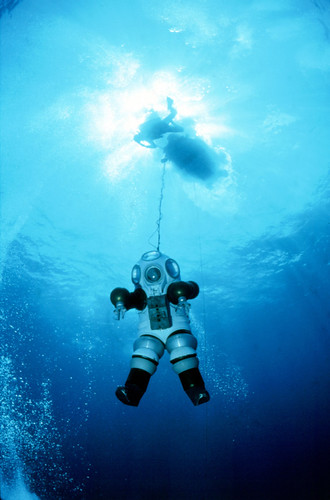

Sylvia Earle exploring the ocean in the JIM Suit

Friday, July 31, 2009

Scientists Drill a Mile Into Active Deep Sea Fault Zone

By Hadley Leggett Email Author

riser-pipe

In the first deep sea drilling expedition designed to gather seismic data, scientists have successfully drilled nearly a mile beneath the ocean floor into one of the world’s most active earthquake zones.

Researchers aboard the drilling vessel Chikyu — meaning “planet Earth” in Japanese — used a special technology called riser drilling to penetrate the upper portion of the Nankai Trough, an earthquake zone located about 36 miles southeast of Japan. By collecting rock samples and installing long-term monitoring devices, the geologists hope to understand how stress builds up in subduction zones like Nankai, where the Philippine Sea plate plate is sliding beneath the island of Japan.

riser

Riser drilling involves encasing a deep sea drill in a giant metal tube, called a riser, that extends from the ship down to the drilling site, effectively bolting the ship to the sea floor. The researchers circulate lightly pressurized mud down through the drilling tube and back up through the riser.

“One of the key benefits is the pressurized mud keeps the wall rock from collapsing on the drilling pipe, which allows you to drill deeper and with better control,” geologist Timothy Byrne of the University of Connecticut wrote in an e-mail. “For example, nearly perfectly vertical holes or steeply inclined holes can be drilled,” wrote Byrne, who co-led the project.

Using a riser also makes it easier to send core samples and cuttings, or small chips of rock collected during drilling, back up to the surface.

The Nankai Trough last ruptured twice in 1944 and 1946, generating earthquakes greater than magnitude 8 that shook the region and caused deadly tsunamis. Since then, the two plates have continued to move, but the boundary between them has been locked, causing pressure to build.

“We know that a locked fault is not a quiet thing, but we don’t quite understand why,” said geologist Kelin Wang of the Geological Survey of Canada, who was not involved in the research. “When we understand what is meant by locking, we can understand how energy is building up for the next event.”

The Nankai project is part of an international effort called the Integrated Ocean Drilling Program, designed to investigate a variety of scientific questions through drilling. The IODP chose to drill for seismic data in Nankai because of the region’s history of recent earthquakes and the accessible location of the rupture zone. The drilling is not powerful enough to trigger an earthquake.

What is learned in Japan will help scientists understand other earthquake-prone plate boundaries, such as the Cascadia subduction zone, which extends along the Pacific coast from British Columbia to Northern California

“For us in North America, the good news is that the Nankai subduction zone is strikingly similar to ours,” Wang said. Both zones are hotter and accumulate more sediment than average. “By studying Nankai, we North Americans can actually benefit pretty directly from the project. It’s almost as if we are drilling our own subduction zone, because we’ll see a lot of the same things.”

The first drilling and sampling operations in Nankai began on May 12 and are expected to conclude on August 1. After the initial drilling stage, scientists lowered various gauges and logging instruments into the hole to measure temperature, stress, water pressure and rock permeability. Once they gather enough data, the scientists will prepare the hole for future installation of long-term monitoring equipment.