Zazzle Shop

Screen printing
Showing posts with label Wind Farm. Show all posts

Friday, April 30, 2010

Why Are Windmills Always White?And why do they always have three blades?
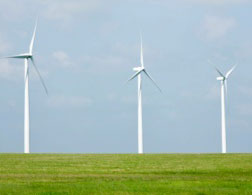


Windmills.
The federal government has green-lighted the nation's first offshore wind farm, to be built off the coast of Cape Cod, Mass. Opponents claim that 130 white, three-bladed turbines will detract from the natural beauty of Nantucket Sound. Why do all modern windmills look the same?

So they're unobtrusive. A windmill's noise is directly proportional to the speed of its rotor tips. Two-bladed turbines have to spin faster than their three-bladed competitors to generate the same amount of energy. As a result, the whooshing sound they emit is somewhat louder. Two-bladed windmills would be a sensible choice for a remote, offshore wind farm like the one in Cape Cod, since they're just as efficient as the three-bladed models and cheaper to produce. But manufacturers—who cater to the densely populated and wind-power-oriented countries of Europe—have switched almost exclusively to producing the latter.

The placement of rotors relative to the tower is also a design controversy with acoustics implications. The downwind design, with the tower between the blades and the wind, is more structurally sound. (Think of a pinwheel: If you don't grip it tightly, it will tend to rotate into the downwind position.) The problem is that the tower creates a dead spot for airflow, which stresses the spinning rotors and generates a repetitive whop that can carry for miles. Right now, most manufacturers favor the upwind layout.

The white paint, which many localities require by ordinance, is also a matter of aesthetics. City planners seem to think white windmills are less of an eyesore. The white also reflects sunlight, which minimizes expansion and cracking of the gel coat that protects the fiberglass composite rotors. Not all windmills are white, though. Some Midwestern turbines are yellow to match the grain. (This doesn't work so well in the spring, when the crops are green.) German windmills are sometimes painted dark green at the bottom to blend into the forest. European rotors usually have a red stripe to make them visible to aircraft. Engineers once tried painting the rotors black to absorb sunlight and prevent icing, but it didn't seem to help much.
Hollow, tubular towers have vanquished the old girder design, because they discourage birds from landing on them. (Birds and windmills don't mix.) The tubes are also favored by construction crews, who can climb up a tower to repair it from the inside, protected from the elements.

The biggest design question for most engineers is rotor length. The energy a windmill generates is proportional to the area of the rotors' circular sweep, so energy increases proportionally to the square of the blade length. However, the volume of the rotor, which determines the cost, is proportional to the cube of the length, and increases faster than energy production. As we get better at materials engineering, the rotors will get longer. But at any given time the arms of a windmill will be built out to the length that maximizes energy return relative to the cost of production. The rotors on modern windmills are sometimes as much as 200 feet long. As such, transportation can also be a problem.

Explainer thanks Douglas E. Adams of the Purdue Energy Center, Scott Larwood of the University of the Pacific, James Manwell of the University of Massachusetts Renewable Energy Research Laboratory, and Jonathan Naughton of the University of Wyoming Wind Energy Research Center.

Friday, February 13, 2009

Germany Aims Big with a 960-Megawatt Offshore Wind Farm

by Kristie Wilson

rwe innogy, enova wind farm, german offshore wind farm, renewable energy, offshore wind turbines, wind farm, sustainable design, 960 megawatt wind farm

When it comes to offshore wind farms in the North Sea, bigger is certainly better! RWE Innogy, a German-based company, recently acquired the rights to a 960 Megawatt offshore wind project from ENOVA Energieanlagen GmbH, a subsidiary of the ENOVA Group. The offshore wind farm, named Innogy Nordsee 1, is anticipated to run just under 4,000 full-load hours and with the ability to supply over 3 TWh (Terawatt-hours) of electricity per year! Consisting of up to 250 wind turbines planned, each with a capacity of 5 to 6 Megawatts, this will be Germany’s largest offshore wind farm.

rwe innogy, enova wind farm, german offshore wind farm, renewable energy, offshore wind turbines, wind farm, sustainable design, 960 megawatt wind farm

This gigantic offshore wind farm will span an area of around 56 square-miles at a location just 25 miles north of the North Sea island of Juist. RWE Innogy and Enova are investing approximately €2.8 billion into the project. Pending approval, its initial preparations will start in 2010 and its first wind turbines could start running as early as 2011. The project expected to be completed by 2015.

RWE’s construction of Innogy Nordsee 1 marks an important step towards achieving the climate and protection targets set by Germany and EU. According to the Fraunhofer Institute for Systems and Innovation Research, the wind farm alone will avoid approximately 2.6 million tones of CO2 annually—a pretty nice number for a country who has pledged a key role in reducing emissions for the EU. RWE has other ambitious wind farm projects planned for countries such as Poland and Wales, and with competitors from neighboring countries, it doesn’t seem like RWE has any plans to slow down anytime soon.

RWE states: Some 1000 MW of wind power on the high seas – that is the largest single project RWE has undertaken so far in the area of renewables. Even in these times of economic crisis, RWE Innogy is consciously stepping up its investment pace.”

+ RWE Innogy

Via Treehugger

rwe innogy, enova wind farm, german offshore wind farm, renewable energy, offshore wind turbines, wind farm, sustainable design, 960 megawatt wind farmLeft: Wind Farm at North Hoyle. Right: Construction of the Rhyl Flats offshore wind farm

rwe innogy, enova wind farm, german offshore wind farm, renewable energy, offshore wind turbines, wind farm, sustainable design, 960 megawatt wind farm


Friday, January 23, 2009

Mexico fires up $550 million wind farm

A $550 million wind farm project was inaugurated on Thursday in La Ventosa, Mexico, on the narrow isthmus between the Gulf of Mexico and the Pacific Ocean.
By Luis Cruz Hernandez, AP
A $550 million wind farm project was inaugurated on Thursday in La Ventosa, Mexico, on the narrow isthmus between the Gulf of Mexico and the Pacific Ocean.

LA VENTOSA, Mexico — Mexico inaugurated one of the world's largest wind farm projects Thursday as the nation looks for alternative energy, in part to compensate for falling oil production.

Mexico is trying to exploit its rich wind and solar potential after relying almost exclusively on petroleum for decades. With oil production down by 9.2% in 2008, Mexico now is turning to foreign companies, mainly Spanish, to tap its renewable riches.

"If we don't do something about this problem of climate change it probably could become — I'm sure it already is — one of the biggest threats to humanity," said President Felipe Calderon at the inaugural ceremony attended by about 1,000 residents, many of whom held on to their cowboy hats on this wind-swept day.

The new, $550 million project is in a region so breezy that the main town is named La Ventosa, or "Windy." It's on the narrow isthmus between the Gulf of Mexico and the Pacific Ocean, where winds blow at 15 mph to 22 mph, a near-ideal rate for turbines. Gusts have been known to topple tractor trailers.

Spanish energy company Acciona Energia says the 6,180-acre farm should generate 250 megawatts of electricity with 167 turbines, 25 of which are already operating. The rest should be on line by the end of the year, making the project the largest of its kind in Latin America.

It will produce enough energy to power a city of 500,000 people, while reducing carbon monoxide emissions by 600,000 metric tons each year, according to the company.

Esteban Morras, Acciona board member, said the project could be just the start for Mexico.

"This country has great potential for wind development and should take advantage," he said.

The project is also a joint venture with Cemex Inc. and will provide 25% of the Mexican cement giant's energy needs, fulfilling the company's goal of using alternative fuels.

Mexico hopes to boost the nation's wind energy capacity, mainly at La Ventosa, to 5,000 megawatts — about 10 times its current output. Wind energy now accounts for less than 2% of electricity production.

Energy Secretary Georgina Kessel said the government is planning a series of wind projects that by 2012 should generate 2,500 megawatts of electricity.

"The intensity of wind in various parts of the country can make our plants among the most efficient in the world," she said.

But the project hasn't been welcomed by local residents, who say they see few benefits and aren't being paid enough for use of their lands.

Several hundred protesters blocked a road leading to the site, holding a banner reading "no to the project."

The mayor of Juchitan, the municipality where La Ventosa is located, attended the ceremony but called for more benefits for the local community.

"We want to be part of a project that does not consider us just cheap labor but property owners and partners," Mariano Santana Lopez said.

Critics argue that foreign companies build the turbines, rent the land, run the project and produce the power for companies like U.S.-owned retailer Wal-Mart.

"They promise progress and jobs, and talk about millions in investment in clean energy from the winds that blow through our region," a leftist farm group known as the Assembly in Defense of the Land said in a statement. "But the investments will only benefit businessmen, all the technology will be imported ... and the power won't be for local inhabitants."

The group is calling on supporters to "defend the land we inherited from our ancestors." But so far it hasn't been able to stop the project.

Acciona, for its part, says the construction of the project created 850 jobs.

Local residents, largely Zapotec Indians, are accustomed to foreigners' coveting their land. The United States demanded rights to transport goods over the isthmus in the 1850s, and foreigners tried to build a railway alternative to the Panama Canal there.

Copyright 2009 The Associated Press. All rights reserved. This material may not be published, broadcast, rewritten or redistributed.