

Attacker slashed her throat, but he could not silence her
(CNN) -- Jennifer Schuett's search for the man who snatched her from her bed when she was 8, sexually assaulted her and left her for dead on top of an ant hill ended Tuesday with the arrest of a suspect.

Jennifer Schuett, 27, was abducted and left for dead at age 8. A suspect was arrested Tuesday.

Now begins another chapter in Schuett's 19-year quest for justice.
Standing in front of the television cameras, Jennifer Schuett blinked back tears.
"This is a huge day for me," she later told CNN over the phone. "And I want to see this through the end. The rest will come out during the trial."
Schuett, 27, joined a multi-agency team of investigators in her hometown of Dickinson, Texas, as they announced the arrest earlier in the day of Dennis Earl Bradford, a 40-year-old welder, in Little Rock, Arkansas.
The arrest came after new DNA testing and other evidence made it possible to identify Bradford as the suspect.
Schuett's boyfriend and two police investigators who kept the case alive stood beside her. Fighting tears, she thanked them for their support.
"Throughout this journey, I've had two main goals," she said. "And they were to find the man who kidnapped, sexually assaulted and attempted to murder me 19 years ago so that he could not hurt anyone else. And to use my voice in telling my story to as many people as I possibly could over the years in hopes that I may encourage other victims of violent crimes to stand up and speak out against criminals."  Watch Schuett explain why she's speaking out »
She continued, "Today, I can say very proudly that I have accomplished both of these goals."
Schuett spoke with CNN two weeks ago about her 1990 ordeal. CNN normally does not identify victims of sexual assaults. But Schuett decided to go public with her story and her name to increase the chances of finding and prosecuting her attacker.
Schuett was in her bed when a man crept in through a window on August 10, 1990. She remembers waking up in a stranger's arms as he carried her across a dark parking lot. She said he told her he was an undercover cop and knew her family.
He drove her through the streets of Dickinson, pulling into an overgrown field where, she said, he sexually assaulted her.
She passed out. When she regained consciousness, she was lying on top of an ant hill with her throat slashed and her voice box torn. She spent about 14 hours in the field before she was found and rushed to the hospital in critical condition.
"Three days after the attack, I started giving a description. The doctors told me I would never be able to talk again, but I proved them all wrong," Schuett said. She believes she got her voice back so she could tell her story.
At the news conference, a driver's license photo of the suspect was shown next to the 1990 sketch based on her description. There was a clear resemblance. Watch the sketch artist's memories of Schuett »
On the left is a driver's license photo of suspect Dennis Earl Bradford. At right, a 1990 police sketch.

Shauna Dunlap, a spokeswoman for the FBI's Houston office, said Bradford lived in North Little Rock, with his wife and two children -- a boy, 12, and a girl, 15. He also has three adult stepchildren.
Bradford worked as a welder for United Fence in North Little Rock. A company representative said Bradford had been working there for 10 years and was a "good guy" who had mended "his old ways" and "changed his life." He wouldn't go into specifics about what those "old ways" were. Court documents give some indication.
In 1996, Bradford was accused of kidnapping, sexually assaulting and cutting the throat of a female victim. He was initially charged with attempt to commit first-degree murder, but prosecutors amended the charges to rape and kidnapping.
Dennis Earl Bradford, a 40-year-old welder, was arrested after DNA allegedly tied him to the crime.
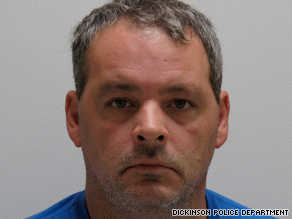
A Garland County Circuit Court jury found him guilty of kidnapping but was not able reach a verdict on the rape charges. Arkansas corrections officials said he entered prison in March 1997, facing a 12-year-sentence, and was paroled in February 2000. Investigators also found Bradford lived slightly more than two miles from Schuett's residence and just a mile and a half from where she was found, according to an affidavit released Tuesday.
"It's truly a rare occasion when we have the opportunity to prosecute a case like this," said Galveston County District Attorney Kurt Sistrunk. His office is charging Bradford with attempted capital murder.
"Jennifer has been a tremendous asset to this investigation from the beginning, an inspiration to all of us, and we are going to be very proud to have Jennifer by our side as we continue with our efforts to seek justice for you in the courtroom," said Sistrunk.
The break in the case came after FBI agent Richard Rennison and Dickinson police Detective Tim Cromie persuaded the FBI's Child Abduction Rapid Deployment (CARD) team to get involved.
"The main reason the CARD team picked this case was because she was alive," Rennison said. "In cases of child abduction, it is rare that the child is recovered alive. Frequently, you recover a body. And most times, you never find them."
In March 2008, the investigators found evidence collected 19 years ago -- the underwear and pajamas Schuett was wearing, as well as a man's underwear and T-shirt, which were found in the field where Schuett was left for dead.
The clothes had been tested in 1990, but the sample wasn't large enough for conclusive results. But newer techniques allow DNA to be isolated from a single human cell.
The FBI lab recently informed Rennison that the DNA in the man's underwear matched Bradford's DNA profile. He was entered into the database after the 1997 kidnapping conviction in Arkansas.
 .
.

 Posts
Posts

