A Syrian-born airline pilot allegedly tricked a schoolteacher from Haverfordwest into having sex with him by pretending he had to administer ointment on the end of his penis, a jury heard yesterday (Tuesday).
Fadi Sbano, 38, even pretended to know a gynaecologist who advised him on how often to have intercourse with her and whether to thrust "slowly or quickly". And, on the "doctor's advice", he kept a clock on the bedside table to time the sessions.
The teacher put up with the treatment for nine months before telling her doctor.
Huw Rees, prosecuting, told Swansea crown court: "The allegations here are of rape by deception."
Mr Rees said the pair met while Sbano was based at Gatwick and the teacher was working nearby.
In November, 2000, she discovered a rash of white spots and feared that typhoid, which she contracted on holiday some years before, had returned.
Sbano claimed he was in talks with a gynaecologist who was anxious for a certain cream to be applied, the prosecutor said.
"He (Sbano) suggested he would apply the cream to his penis and apply it inside her.
Mr Rees said the woman found the sessions "Clinical, not at all erotic". She consented only because she believed it was a proper treatment.
"When the insertions took place, and depending on the instructions of his friend, he would thrust slowly or quickly for anything from one to ten minutes,"
Her doctor told her to find out the identity of Sbano's gynaecologist friend but he "became evasive and never gave his name" beyond the word "Ibby".
"It began to dawn on her that he had devised this treatment in order to have sex with her on his terms."
Mr Rees said "Ibby" was traced but said he knew nothing about the treatment.
Sbano was arrested at Heathrow while attending a pilots' training facility.
He claimed the woman had invented the entire story about the "treatment".
Sbano, from Harrow, London, denies nine charges of rape and 11 or obtaining money by deception.
AUBURN HILLS, Mich. — In a surprise move here this morning amid struggling sales numbers from its dealers and fuel-efficient buzz from competitors, Chrysler announced that it's charging into the electric vehicle market a lot sooner than expected. The automaker just unveiled a trio of battery-powered vehicles—including an all-electric, 200-mile-range Dodge sports car that we revved up near its 120-mph top speed on the test track and think could give the Tesla Roadster a run for its money—and plans to bring one of them to market by 2010, aligning Chrysler with the timetable for General Motors' Chevy Volt.
Chrysler officials, who reinforced their case for an entirely hybrid fleet at least partially powered by batteries, said at a news conference on Tuesday that they're aiming to sell all three cars—extended-range plug-in versions of a Jeep Wrangler and Chrysler Town & Country were unveiled in addition to the Dodge EV—within a decade. But how fast they reach dealerships, CEO Bob Nardelli cautioned, may well depend on whether the federal government comes through with a package of loan guarantees for Detroit's Big Three.
"You're going to see the electrification of all vehicles" in the years ahead, said Frank Klegon, Chrysler's executive vice president for product development. That will range from full battery power to simpler systems, like Stop/Start, which temporarily shuts off an engine at a stoplight. Indeed, Klegon forecasts that "at least 50 percent of the market" will consists of pure EVs or extended-range electric vehicles (EREVs) by around 2020.
The former category very well could include the Dodge EV. If the look is familiar, that's because the body and platform are borrowed from the Lotus Europa sportscar (not the Lotus Elise, as you might first imagine). There have been minor modifications made to squeeze in a 200-kilowatt motor and a lithium-ion battery pack that, in production, would yield somewhere between 150 and 200 miles on a charge. Doug Quigley, engineering lead for Chrysler's ENVI advanced powertrain division that is also working on three concepts we saw at the Detroit auto show this year, said the rear-drive two-seater should be able to launch from 0-to-60 in under 5 seconds. He wouldn't say how much under, but the goal is to be faster than the Lotus with a target of the mid-13-second range for the 1/4-mile run. And if our 20-minute test drive on the 2-mile track here is any indication, that should be very doable. The new EV handles like a charm, with sharp steering and some serious giddyup—we could feel the 100-plus-mph beneath us while hearing nary a thing.
The Jeep and Chrysler plug-ins, like the Volt, both fall into the extended-range category to combine battery and gasoline power. And like GM, Chrysler is aiming for a 40-mile range on electric charges alone, claiming that both vehicles should be able to hit 400 miles with an 8- or 9-gal. tank of gas. Chrysler modified its newest Jeep Wrangler for the white plug-in truck unveiled here today—and that should mean the same off-road capabilities. The minivan is a slightly upmodded version of the popular Town & Country, with the underbody tubs—used to hide the Stow-and-Go seats in a conventional Chrysler minivan—housing the large battery packs.
So which of the three new electric cars will come to market first? Chrysler isn't saying—in part, President Tom LaSorda acknowledged, because the company has yet to decide. There are serious questions to answer, including what batteries the company will use—and who will supply them. The good news, Klegon said, is that the number of potential battery vendors has "tripled" in recent years. Coming up with reliable, high-power batteries is a clear challenge, but there's also the issue of cost. Lithium-ion technology is phenomenally expensive, but Chrysler, like its competitors, believes that in high volume, costs should plunge.
Meanwhile, the automaker is launching a new joint venture with General Electric (where Chrysler CEO Nardelli first rose to prominence) aimed at developing even more advanced battery systems. One approach that the partners plan to study would pair two different types of batteries, such as lithium-ion and sodium-sulfur, to see if they can yield improved levels of power and performance.
Admittedly short on cash and struggling with sales, Chrysler officials recently have spent a lot of time in Washington, D.C., meeting with the lawmakers who would have to approve a loan guarantee package that might exceed $25 billion for Detroit. Nardelli said he was "very impressed" with the feedback he has gotten, but stressed that without that assistance, there will have to be some "very tough decisions" made about what Chrysler can afford to fund.
Chrysler actually put a fourth product on display here, too: the buggy-size "Peapod" Neighborhood Electric Vehicle (NEV) from the automaker's GEM division. NEVs are, effectively, gussied-up electric golf carts; they have found a small but comfortable niche in places like retirement villages and college campuses. Newly renamed Green Eco-Mobility, GEM will launch the 25-mph Peapod and its 30-mile-range sometime next year, with more eco-friendly rides to come from the division—and its parent company, suddenly back in the game in a big way—in the new decade. —Paul Eisenstein
(LifeWire) -- During an evening out at a San Francisco bar some years ago, Matt Colling and a friend ended up buying drinks all around. But when it came time to pay the $100 tab, Colling was on his own.
"I pulled out money and I was the only one that had any," the 28-year-old bartender remembers. His friend had conveniently "forgotten his wallet."
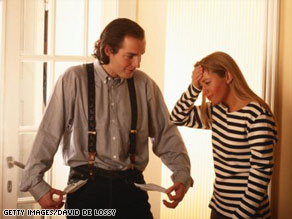
Whether it's stiffing drinking buddies with the check, bumming rides, "borrowing" cigarettes or sponging off meals, moochers can push the limits of friendship by making a habit of manipulating others to avoid paying their fair share.
Brandon Ward, a sports marketing executive in San Diego, got an early lesson in dealing with deadbeats. Now 37 and married, Ward readily remembers a former roommate who rarely picked up his fair share, including his portion of a weekend trip that involved four tanks of gas and three cases of beer.
For Ward, it wasn't so much the money as the principle. "He never pulled out his wallet. If he had even offered, there was a chance I would have said no. That was the big sin."
No matter how charming they may be, a friend who mooches isn't really a friend, says Jeanne Fleming, a financial ethics columnist for Money magazine who also holds a Ph.D in sociology. "Moochers are fundamentally motivated by being selfish and self-centered," she says. "They habitually forgive their behavior. But the truth is that it's complete self-indulgence. It's not benign."
From friend to freeloader
At what point does a friend become a mooch? It's a matter of frequency.
"Everybody has at some point asked a friend for 20 bucks and forgotten to pay it back," says Fleming, who researched relationship offenders for a book she co-authored with Leonard Schwarz, her "Money" magazine writing partner. But mooching begins when reciprocating ends. Or maybe when you start asking the tightwad to pick up his fare share of expenses.
When the authors asked 800 people nationwide to choose between a relative hitting them up for a large loan or getting a bad case of the flu, over two-thirds said they'd take the flu. That may be because 36 percent of Americans in the survey had at least one family member who is a moocher, and 32 percent were saddled with a deadbeat friend.
Fleming and Schwarz also questioned 1,000 adults across the country for another survey and found that a whopping 95 percent had lent money to friends or family members. Over a third of those had lent more than $1,000. And the chances of seeing their money again? Forty-three percent weren't repaid in full for the largest loan they ever made to friends or relatives, and 27 percent were never repaid at all.
But mooching isn't limited to money, which can make it harder to know when to draw the line. Take 35-year-old journalist Colin Sullivan of San Francisco. As a writer for Greenwire.com, he says he takes pains to minimize his carbon footprint, and carpooling is a one effective tactic.
But when a close friend adopted a habit of bumming rides -- "He's the kind of guy who would just assume that if we were going somewhere that I would be picking him up" -- Sullivan felt torn between being environmentally responsible and being a chauffeur. Even then, Sullivan chalked it up to his friend being "a tight-ass about money," which he believes isn't the worst fault in the world.
Fleming sees it another way: Cars are expensive to own and operate. "They think they're being green and maybe they are," she says, "but they're also mooches."
Ending the free ride
Moochers are successful because people are sheepish about confronting them, says Fleming. "You're not supposed to care about money," she says."You're not supposed to notice when your friends are flawed on this front." And by the time you do notice, it's often difficult to break the pattern.
Dealing with moochers is tricky even for etiquette experts like Lizzie Post, who keeps an eye on America's "civility barometer" at the Emily Post Institute in Vermont. Even the great-great-granddaughter of America's manners matriarch has had to request repayment for small loans and dinners out. But she, too, understands how it's tempting to let uncomfortable matters slide.
"It's hard because these issues aren't etiquette," she says, "they're more social and relationship issues."
But it's not impossible. Suggestions from the experts include nipping the habit in the bud by learning to say no -- politely -- to loans, tabs and rides. Post advises planning ahead by deciding whose turn it is to pay before you even leave the house. And if that's not possible, you can always ask for separate checks.
If your moocher is a close friend, you may want to give him a chance to change. But a perfectly reasonable response to repeat offenders is to drop the friendship. That may actually turn out to be a favor because mooching is a self-correcting habit, says Fleming. "If a moocher loses enough friends, they modify their behavior."
And that's ultimately how Ward handled his old friend, the deadbeat roommate.
After their one-sided weekend vacation, Ward joined his roommate and others at a local pub for a few rounds of beer. Everyone took turns buying, but when it was the roommate's turn to pay, he was -- where else? -- in the bathroom. The second time he tried the disappearing act, Ward called him on it.
"I don't remember inviting him out again," says Ward
This guide not only gives you all you need to know about every component that goes in your gaming PC, but also thoroughly walks you through the entire building process with detailed instructions and helpful photographs.
The designation LP560-4 harkens back through Lamborghini's 46-year history to a naming scheme that has come and gone through the years. The most notorious of models, the Countach, was an LP400 or 500, depending on which piece of history you remember. The Italian initials LP translate to longitudinal mid-engine. In the past, the number following LP was displacement; the current number is roughly the engine's power output — while the "4" represents all-wheel drive. From now on, the LP560-4 will simply be known as the 2009 Gallardo.
The vibrant color screams, as does its updated V-10. At a peak speed of 168 mph while lapping the Auto Club Speedway oval in Southern California, the Gallardo's song reverberated like the calling of a king's entrance. Our test car was built to German specification; however, the 552-bhp output is said to remain nearly identical.
Power is delivered from a revised 90-degree naturally aspirated V-10. It does, however, share technology that is in the parent company's newest Audi RS 6. The changes include enlarging the bore by 2 mm, resulting in an extra 0.2 liter of capacity over the previous 5.0-liter. But rather than adding forced induction as on the RS 6, the engineers stuck with a high-revving naturally aspirated design that relies on direct injection, a 12.5:1 compression ratio and an attention-getting 8500-rpm redline. Half the fun of driving the new Gallardo is unleashing the violence of full-redline throttle blips. The dual exhaust tips emit a bark that demands attention, and one looks for every opportunity to squeeze the downshift paddle of the e.gear system.
Revised e.gear internals include a mechanical shift drum that replaces linear actuators — à la motorcycle transmissions. It speeds the shift process, but also removes weight and complexity. While lapping the Willow Springs road course, the paddles worked their magic with only brief pauses in the power delivery. The spindly levers extend from the steering column, so they don't rotate with the wheel, a nice feature when flicking the car around tight corners which require the suede-covered steering wheel to be twisted past 180 degrees. Their quick reaction feels almost telepathic. Of course, the superb rev-matching skill of the e.gear's microchip brain is impeccable.
There are five drive modes in an e.gear-equipped Gallardo: Automatic, Normal, Sport, Corsa and stability-control off. Only on rare occasion did I bother with the Automatic mode, for it's as unpleasant as all the other single-clutch manu-matics I've ever driven. In Normal mode, the shifting can be smooth if the driver pays attention and does not dabble with the throttle mid-shift. In Sport, the gear changes are more aggressive, but not to the whiplash level of the Corsa mode. Corsa not only slams gears 40 percent quicker than the last-generation e.gear, but also decreases the stability-control restrictions. This allows a 1–2 shift to kick the tail out — oh, what fun!
Of course, e.gear has launch control, and with all-wheel drive it's very effective. The system is enabled by invoking the Corsa mode, disabling ESP, mashing the brake, flooring the throttle until it peaks at about 5000 rpm, selecting 1st gear and releasing the brake. When the foot comes off the left pedal, the clutch engages at a rate that minimizes wheelspin. There's a thunk as slack in the driveline is taken up and the car lurches out of the hole like Michael Phelps off the blocks. If you're sitting at a stoplight and decide you want to smoke the lesser automobile next to you, be warned the driver will hear you coming as there is an audible exhaust note change when switching into the Corsa setting — pleasant hum to ferocious growl. I found myself enjoying Corsa, and when not confined by traffic would automatically select that mode, even when commuting on the freeway. There's something about being swaddled in exotic-car beauty and leaning back against 552 horsepower that makes any rush hour pleasant.
Swing open the conventionally hinged doors and a quilted leather interior with deep bucket seats seduces the driver into a classically low-slung position with the steering wheel extending far from the dash for a positively race-carlike feel. Audi-sourced navigation, climate control and audio are well integrated into the broad center console that's topped with a classic hooded-gauge cluster. From the driver's perspective, all the elements of the interior slant forward. It's as if the car had been stretched like taffy, taut over its aluminum skeleton.
Physically, the new car is much like the old car; however, the devil is in the details. Suspension pick-up points are new, as are rubber-metal bushings, forged aluminum control arms and a newly added rear track-rod. The result is better ride quality and a more predictable chassis that is stiffer and lighter by 44 lb. Can't ask for more than that. Shod with some serious Pirelli rubber, the optional $5200 Cordelia basket-weave wheels really put the power down at all four corners. The fixed 70-percent rear bias of the viscous center differential keeps the handling similar to that of a rear-drive machine, but allows earlier power application mid-corner. The addition of a mechanical limited-slip rear differential induces some stability, as does a brake-modulated front differential. Where the last Gallardo tended to push in most cornering conditions, the LP560-4 can be rotated easily with throttle modulation, although invoking any sideways action is difficult. The stable and balanced driving dynamics never feel out of sorts. There is great joy in pushing the new Gallardo around a track because it doesn't feel abused, but rather hungry for more.
All doubt of the Lamborghini's performance is erased with a glance at the data panel. The numbers best those of the Ferrari F430 and 599! But what about a Scuderia, you say? We'll have to wait and see. For now we are content to celebrate Lamborghini's decision to build a truly hard-core exotic and give Ferrari something to worry about, aside from the pretty lime-green paint.
Lindsay Lohan has hailed seminal sitcom Sex And The City for inspiring her dating philosophy. Even though Lohan was only 12 years old when the Sarah Jessica Parker-starring comedy started, the star admits she loves having open and casual relationships with men, like "Sex And The City" characters Carrie Bradshaw, Miranda Hobbs, Samantha Jones and Charlotte York.
She says, "Sex And The City changed everything for me, because those girls would just sleep with so many people."
Did she really say this? That's fucking crazy. Those are women on a cable show, not real people. Granted this was probably taken out of context, but WTF?
Lohan admits to having a double standard with the men she dates, and said some crap about how she can sleep around but they can't.
Pictures found at Hollywood's Best and taken by X17. I know you've already seen them, but these versions are sort of high res.
When Charlie Kratzer started on the basement art project in his south Lexington home, he was surrounded by walls painted a classic cream. Ten dollars of Magic Marker and Sharpie later, the place was black and cream and drawn all over.
There are fictional detectives Hercule Poirot and Sherlock Holmes, Winston Churchill lounging with George Bernard Shaw — and the TV squirrel Rocky and his less adroit moose pal Bullwinkle.
Says Kratzer of his cartoon of a cartoon: "You appreciate the cleverness more as an adult."
There's Georges Seurat's Sunday Afternoon on the Island of La Grande Jatte.There is Blenheim Palace, the birthplace of Winston Churchill, and the Cornell Law School, of which Kratzer is an alumnus. There is Kratzer's dad. There is the harlequin pattern — alluded to in culinary culture today by the Panera bread bag — and a fake fireplace facing a real one.
There are both The Walrus and the Carpenter (from Lewis Carroll's Through the Looking Glass and What Alice Found There), and William Shakespeare. The Marx Brothers peer around a corner. A flip-top garbage can is transformed via marker art into Star Wars' plucky little beeper R2D2.
Says Kratzer, 53, the associate general counsel for Lexmark: "People are amazed that with something as simple and inexpensive as a Sharpie, you can decorate a whole basement."
How did this Sharpie world start? With a single swipe of the marker.
Kratzer started mid-wall, with the Salon by Picasso. Then he thought, well, taking a design out to the edge of the wall wouldn't be overwhelming.
Then the rest of the basement flared off that first wall.
Kratzer's basement suggests that the great cultural influences wandered out of college humanities class — here a Churchill for eloquence during harsh times, a Joan Crawford for cinematic vampiness, Holmes and Poirot for great literary characterization — and set up shop together in the carefully hand-drawn markings of an educated imagination come to life.
Kratzer might be a lawyer by day, but in his off hours he is a man who has taken the artistic influences and heroes of his life and imagined them onto his walls, that he might keep company with them while he uses the pool table.
Look carefully in this basement o' dreams and you'll see a drawing of the Kratzers' upstairs library — with Claude Monet, the greatest of the Impressionists, at the doorway. It's a tribute to Monet, but it's also a way of living with cultural influences: Kratzer and his wife, Deb, don't just keep them within book covers or admire them in museums. Their Picasso spends each day close to their pinball machine. Agatha Christie's shrewd little Belgian detective and his carefully pruned mustache hover over the deck door.
From the main floor leading down to the basement, there is a color mural inspired by Picasso's The Dream.
But through most of the spacious basement there is black line-drawing — around the pinball machine and the pool table and over the bathtub and toilet.
Why the black marker theme? Says Kratzer: "You can do a lot with it."
Indeed, Sharpie art has its own little corner of the Internet: Artist Justine Ashbee, at www.justineashbee.com, features a gallery of intricate Sharpie art.
Kratzer likes the Impressionists, but he's also inspired by Picasso — in particular the artist's ability to convey a lot of information with just a few lines. A gathering at Picasso's Paris salon in 1919 dominates a far wall, featuring a pantheon of artistic greats including Jean Cocteau, Erik Satie, Clive Bell and Olga Picasso, striking a kind of Sharpie synthesis of marker art between film, music, dance, literature and the muse.
While Kratzer's basement mural art might have started with one mark, he had decided in his 30s that he wanted Impressionist art in his house, quite a lot of it, and that to afford such a stunning variety he'd best produce it himself.
He began to paint, and now there are paintings all over the house — created by Charlie and critiqued and guided by Deb. The two met at Muhlenberg College in Pennsylvania. Deb, now an at-home mom, formerly taught deaf students.
The couple has two sons, one at a Massachusetts engineering college, the other in the pre-engineering programat Lafayette High School.
Says Deb: "I have the coolest husband. He's so bright, and artistic on top of it."
In this day and age when the greenhouse effect takes precedence over just about every other environmental subject, the popular notion is that we must all do our part in minimizing our carbon footprint on the world, starting by staying away from high-performance automobiles. Not so fast. Trucks and SUVs usually burn more fuel and emit more carbon dioxide on a consistent basis, and if we all do our part by restricting daily home energy use, recycle everything imaginable and perhaps plant a tree or two, there's no reason to give up our weekend jaunts to the local track or to a favorite winding road, especially with cars like these.
Let us introduce to you the latest crop of special high-performance machines that has recently come R&T's way. While these cars are labeled "aftermarket," their amazing attention to detail and high level of quality have them on the same playing field as today's production cars, but with a lot more guilty pleasures mixed in, including the all-important "bling" factor.
Noted GT-R tuner, Mine's, shipped the world's first seriously tweaked Nissan GT-R (R35) to us from Japan. Also making the trek across the Pacific was Honda's preeminent tuner and race specialist, Spoon, and its Honda NSX-R GT. From Europe came TechArt's amazing GTstreet, based on the 997 Porsche 911 Turbo, and representing the stars and stripes is D3 and its impressive Cadillac CTS.
We took this special foursome to our favorite local handling course, the Streets of Willow Springs in Rosamond, California, where we put a new twist into the proceedings by running the track in the opposite direction. Why? Because the layout provided for faster speeds on the straights, and it seemed like a fun thing to do.
After all, the main reason for the existence of these cars is to have fun. Lots of fun.
Saturn's rings may be much older and more massive than previously thought, according to a new study.
The study's computer simulation showed how the planet's rings could date back billions of years ago to the early ages of the solar system, rather than only 100 million years ago (during Earth's Age of Dinosaurs), as previous observations suggested. The calculations are consistent with recent observations of the rings by the Cassini–Huygensspacecraft currently studying Saturn and its moons.
Larry Esposito and Joshua Elliott, both at the University of Colorado, modeled how meteorites smash into the rings, shattering the ring particles and coating each one in a layer of ice and dust. Before, scientists had assumed that this shattering led to the eventual dissipation of the rings, but a new simulation, created by Glen Stewart and Stuart Robbins of the University of Colorado, shows that after breaking up, the particles could again clump together in a perpetual recycling process.
Previously, researchers had thought the rings were relatively young because they appeared bright and pristine, not covered with the detritus of billions of years of meteorites smashing into them. But the new calculations show that if the effect of this clumping and re-clumping is taken into account, the dust would also be recycled through the rings and wouldn't appear as dark as might be expected.
Many scientists had assumed that we just happened to be catching Saturn at a relatively rare time when it had rings. Now it would seem Saturn, and maybe lots of other large planets in the universe also, could have rings for much of their lives.
"Both Cassini observations and theoretical calculations can allow the rings of Saturn to be billions of years old," said Esposito, principal investigator of Cassini's Ultraviolet Imaging Spectrograph (UVIS) instrument. "This means we humans are not just lucky to see rings around Saturn. This would lead us to expect massive rings also to surround giant planets circling other stars."
Our own Jupiter, Uranus and Neptune each have rings, and even Earth might have had them once.
Earlier estimates of Saturn's rings' mass had come from observations of how much starlight is blocked by the rings. But the new calculations indicate that these measurements underestimate the mass by about a factor of three, since they do not account for the clumping effect.
If the rings are really more massive than thought, that could also help explain why the rings appear so bright and clean. The more individual pieces of mass in the rings, the more material there is to spread the pollution around, so the less noticeable it would be to outside observations.
Esposito will present these findings at the European Planetary Science Congress in Muenster, Germany, on Sept. 23. Cassini–Huygens is a joint project by NASA, the European Space Agency, and Italian Space Agency.
There's no getting around it:
We live in a tough new world of $4 per gallon gasoline, and a U.S. economy that has its share of difficulties — with no signs of relief coming anytime soon. But enthusiasts still need to have fun, right? Right! Luckily, small turbocharged engines make sense, as they offer decent fuel economy when driven like Grandma — the Chevrolet Cobalt SS, for example, gets an EPA-rated 30 mpg on the highway — along with kick-in-the-pants acceleration that'll make Prius owners "green" with envy when you get playful with that right-most pedal. Add in that all four cars here start at under $27,000, and you can see we just might be on to something.
For those of you keeping score at Road & Track, it has been Mazdaspeed3: two; and the Mazdaspeed3's competition: zero. In the two previous comparison tests in which it took part, the Mazdaspeed3 unleashed its special brand of punishment, first on the Honda Civic Si, Mini Cooper S, Nissan Sentra SE-R Spec V and Volkswagen GTI in our June 2007 issue, and more recently on the Dodge Caliber SRT4 in the February 2008 issue.
So here's the question: Can the Chevrolet Cobalt SS, Mitsubishi Lancer Ralliart or Subaru Impreza WRX dethrone the mighty Mazdaspeed3 as the King of the Sport Compacts?
We know what you're thinking: How could the "Evo junior," armed with a detuned 4B11 turbo-4, Mitsubishi's 6-speed Twin Clutch-Sportronic Shift Transmission (TC-SST) and all-wheel drive finish in last place?
First you must realize the Ralliart is less of an Evo junior, and more of a maxi Lancer. It uses Lancer suspension pieces (not the Evo's), sits on a narrower track and forgoes the Evo's wide body design.
It does share the Evo's 2.0-liter turbocharged 4-cylinder, but with a smaller, single-scroll turbo, smaller intercooler and different intake system. The Ralliart's peak power of 237 bhp is the weakest of the group, and its 253 lb.-ft. of torque is second from the bottom. Yet despite this, and despite a portly curb weight of 3540 lb. — 280 lb. heavier than the WRX, and 545 lb. heavier than the lightest car, the Cobalt SS, the Ralliart posted a respectable 0–60-mph time of 5.4 seconds, finishing 0.3 sec. quicker than the torque-king Mazdaspeed3. But by 100 mph, the Ralliart's lack of top-end power leaves it 1.3 sec. behind the Mazdaspeed3, and way behind the WRX and the Cobalt SS.
In real-world driving, the limited power is more obvious. "It just doesn't feel that fast," said Executive Editor Douglas Kott, "especially in high-speed passing maneuvers." It's like you're Captain Kirk calling down to Scotty, looking for more power to reach Warp 9, and Scotty yells back, "I'm givin' her all she's got, Captain!"
Shifting the TC-SST gearbox is merely a flick of the fingers away via the large, steering-column-mounted paddle shifters, and this system is both one of the car's strong and weak points. "The SST works really well when you're attacking a back road, but it's a bit clunky around town," said Senior Technical Editor Patrick Hong. Even in full automatic mode, the twin clutches aren't very smooth in stop-and-go traffic, and the occasional expensive-sounding thunk! when manually shifting from 1st to 2nd gear is disconcerting.
But the main area we were let down by the Ralliart was its handling: "Its steering feel is not the greatest," said our Assistant Road Test Editor, Calvin Kim. It also has too much body roll and a lack of front grip. Around our 0.50-mile ProSolo autocross course (the same used in our "4-Track Free-For-All" cover story, September 2008), the Ralliart posted the slowest time — 47.16 sec., or 1.7 sec. off the best time set by the WRX. Kott called its nature "floppy and imprecise. It's an understatement to say it's not my favorite." But we actually learned to enjoy the Ralliart, especially since the chassis reacts well to left-foot braking to rotate the rear — surprisingly so, at times. "Once you're used to it, it's fun to drive in a throw-and-catch kind of way," continued Kott.
We love the optional Recaro front seats, which are straight out of the Evolution GSR, although Kott complained he wouldn't want to squeeze in and out of the thick bolsters every day. Others of us feel these Recaros are the best in the business, and that if they came standard in all cars, the world would be a far better place to live.
So think of the Ralliart as a mild Evo for those who don't want to deal with the frenzied nature and harsh ride of the real thing. While it's a neat car in some aspects, we'll admit we were a bit let down from a pure performance standpoint.
Any discussion of the front-wheel-drive Mazdaspeed3 always starts with its engine. This direct-injected 2.3-liter 4-cylinder makes 263 bhp and a steering-wheel-wrenching 280 lb.-ft. of torque that hits low and hard. "It's a torque monster!" enthused Kim. Although it has plenty of sauce when the turbo hits, it runs dry much sooner than its 6750-rpm redline. "Best roll-on car in the group," said Kott. "I just wish the turbo lasted past 5500 rpm."
But in its sweet spot, it hits far harder than any other engine in this test. We found the following strategy works so as not to get caught out by the narrow powerband: If you're coming to a turn and you're thinking of downshifting...don't. This torque beast will pull you through. It's the opposite with upshifting...if you're even considering it, absolutely do it. Because the last thing you want is to be caught out up high in the revs where there's no power.
All this torque is shepherded to the front wheels by a limited-slip front differential and a torque-management system that doesn't allow full power in 1st and 2nd gears. It uses the only true 6-speed manual in the test, but we actually prefer the 5-speeds in the Cobalt and the WRX; it's not that the extra gear confuses us, but the gearbox's sloppy action annoys. "The Mazdaspeed3's shifter is my least favorite," said Kott. "A fast 2–3 shift can get bungled up, and the uneven gate spacing makes 4–5 and 5–4 shifts more concentration-intensive than they should be."
But we love the Mazdaspeed3's lively handling. It has the most roll stiffness of the group and turns into corners with great quickness. It's also not afraid to rotate the tail slightly, which increases its cornering precision and ups the fun factor. Kott mostly agreed, saying the Mazdaspeed3 has "a nice flat cornering stance and lots o' grip," but admitted "the nonlinear rising-rate suspension can get pretty harsh over big bumps."
The Mazdaspeed3 didn't fare as well as we expected around the autocross, finishing about a second behind the WRX and Cobalt SS, despite being able to run most of the course near the thick of its powerband in 2nd gear. "It felt sloppy and needs more front grip for better initial turn-in," Hong said. And we were all surprised by the amount of shudder generated by the front tires through the course's fast slalom section.
A couple of us rated the Mazdaspeed3's interior as the best design, although we felt the WRX has the best ergonomics. "The Mazdaspeed3's interior has pleasing textures and shapes, and the piano-black trim pieces are nice...despite photographer Guy Spangenberg's grumblings that they're hard to photograph," said Kott.
Engineering Editor Dennis Simanaitis often refers to Mazdas as "rorty," which he defines as "sporty, with just a tad of raucousness." The Mazdaspeed3 brings the rortiness level to a whole new dimension, with its stiff ride, quick-reacting chassis, narrow all-or-nothing powerband and a boomy interior. This is a raw car in an era of refinement, and we enjoy the Mazdaspeed3 for exactly those reasons — a couple of us even rated it as the most exciting of the bunch to drive. But in the end it finished behind two more polished contenders.
Every once in a while a manufacturer listens to us. Okay, it's more likely Subaru was listening to the scores of enthusiasts who cried out in horror that the completely redesigned 2008 car had lost its fun-to-drive nature. We said the new car had "lost its WRX-ness" in a Road Test report.
So one year after unveiling the new WRX, Subaru reworked it again for 2009. And addressed pretty much every issue we, and all the enthusiast buyers, had: an engine that ran out of steam up high, overly soft suspension and conservative styling (turns out WRX owners want people to know they're driving a WRX, not just an Impreza).
The engine remains the same smooth 2.5-liter horizontally opposed 4-cylinder from last year's car, but now with a larger turbocharger, increased boost (from 11.4 psi to 13.3), an optimized catalytic converter and a larger-diameter exhaust with a 30-percent increase in flow. Power jumps from 224 to 265 bhp, with torque increasing from 226 lb.-ft. to 244. Mated to a fine-shifting 5-speed manual (the only way the WRX comes for 2009 — last year's WRX becomes this year's Impreza 2.5 GT, with a 4-speed automatic), the WRX's all-wheel drive clawed and pulled its way to 60 mph in a test-stomping 5.1 sec. That's 0.6 sec. quicker than last year's car and 0.3 sec. quicker than the Cobalt SS and the Ralliart. It's also within 0.1 sec. of the mighty STI!
Subaru engineers moved the power a bit higher up the rev range (peak bhp at 6000 rpm, compared to 5200 last year). Kott said the car's newfound power makes it a "sleeper" version of the STI.
Last year's soft suspension was addressed by adding 43-percent-stiffer front springs and 42-percent-stiffer rears, along with front and rear anti-roll bars each increased by 1 millimeter. The Dunlop SP Sport 01 tires are stickier and wider — 225/45R17s, up from 205/50R-17s. The result is a sure-footed, fine-handling back-road machine, with a ride quality almost as good as last year's marshmallow.
Despite the stiffer suspension, Kim still felt the WRX was "squishier than the Cobalt SS, although it's a competent all-rounder."
Kott agreed, "The WRX has a nice, supple ride that doesn't sacrifice too much handling precision." And although the WRX didn't win any outright handling categories, such as the slalom or skidpad, it posted the best time around the autocross, beating the Cobalt SS by 0.16 sec.
"It feels more settled and relaxed when driven hard compared to the others," said Hong, while Kott, our resident autocross Meister, said, "It felt great through fast slalom sections — it just flows from one transition to the next, while the other cars weren't as fluid." But if you left-foot-braked too much around the autocross, the pedal went hard and braking ability decreased substantially.
Although the interior is mostly carryover from last year, we're not complaining, as it has the most straightforward controls of the bunch, without the cheap-feeling pieces found on the Cobalt SS. The seats are comfortable for long hauls, but for sporty driving they're substandard: "It seems they were built for a wider person," said Kott, "as I was bouncing off the bolsters during cornering."
So if we like this new WRX so much, why didn't it win? Because in terms of pure dynamics, there's another car in this test that's just a slight bit better.
The Cobalt SS may be the most underrated car in the world. We're about to set it free of that title.
It's no secret GM engineers spent a lot of time tearing around racetracks in the Cobalt SS, fine-tuning the car's FE5 suspension. They did one heckuva job, as how else can you explain a car with a torsion-beam rear axle handling as well as this one does?
And handle it did — everything we could throw at it, from the racetrack-worthy back roads of California's Central Valley, to a challenging autocross course, to our traditional performance testing. In the last, the Cobalt SS posted test-best numbers in the skidpad and slalom — a superb 0.92g and 70.0 mph, respectively. And it didn't just win, it dominated the others.
But what surprised us even more than the raw data was how composed and quick the Cobalt SS was on back roads. Its slightly heavy steering has near-perfect weighting, and the car goes exactly where you tell it. "I'm impressed!" said Kott. "It's the rental car that went to hot-rod school. It feels light, turns in like crazy, has lots of grip and only moderate body roll." He admitted the Cobalt SS occasionally displayed an "odd, disjointed feel while cornering — probably attributable to the torsion-beam rear axle — but it's sure hard to upset this car."
Another strong point for the Cobalt SS is its 2.0-liter turbocharged and direct-injected 4-cylinder, which makes 260 bhp and 260 lb.-ft. of torque. Not only is this sweet engine virtually lag-free, it's also vice-free, as it's smooth and quiet, and has "right now" power at all times. Torque peaks at just 2000 rpm — yet it makes usable power all the way to its 6300-rpm redline. It's mated to the most precise gearbox of the group, a 5-speed, "marred only by its cheap-feeling plastic knob," said Kott.
One of the few sore points dynamically for the Cobalt SS is its ability at times to put this wondrous power to its front wheels, because for reasons we can't comprehend, GM gave us a Cobalt without the optional limited-slip front differential. So in tight turns, spinning the inside front wheel was as easy as, well, pressing hard on the throttle pedal. This was especially apparent around the autocross, where exiting slow corners was an exercise in right-foot willpower. But because of its nimble handling, its best time was just 0.16 sec. slower than the all-wheel-drive WRX. Just think what it could have done with the $495 limited-slip diff!
What else is cool about the Cobalt SS? For its $23,510 as-tested price, it comes with forged-alloy wheels, 4-piston Brembo front brakes, a boost gauge and the ability to perform no-lift shifts via an algorithm in the engine controller.
What's not cool about the Cobalt SS? The interior. "It doesn't have the quality feel of the others," said Hong. The plastics, the fabric covering the seats (although the lateral support is quite good) and the lack of proper cubbies are annoying. Obviously, engineering time was spent elsewhere.
Then there's the exterior. Despite those racy wheels and new front air dam, let's face it: it still looks like a Cobalt, which means bland with a capital "B." But maybe that's part of its allure: "It's a sleeper car," said Hong, "and no one will expect it to be so fast."
The Cobalt SS won this test by virtue of being good (more often great) at just about everything. It won three of the seven Performance categories outright, while never finishing worse than second in the rest. In our Subjective section, it won six of the 12 categories, all of them performance-related. The WRX put up a phenomenal fight, and is a class act itself, but it just couldn't overcome the Chevy's performance advantages. Kim summed it up thus: "Dynamically, the Cobalt SS is the best — it completely shocked us."
So for all those who have said, "I'd buy an American car if they made one that could compete with the Europeans and Japanese," Chevy is calling your bluff. Because the Cobalt SS doesn't just compete with the foreign cars, it beats them. It is the hottest-performing sports compact you can buy in the U.S. for under $30,000. That it's also the least expensive in this test is even more reason to rush to your Chevy dealer immediately. Not only will it help stimulate the economy, but every aspect of your enthusiast driving senses as well.
.
All you art collectors out there. Here is a chance to get a Giclee copy of some of Ian M Sherwin work. Ian is planning on doing a whole series of Marblehead, Massachusetts paintings. His work is amazing.






 See below the 360-degree photo of Kratzer's artwork


 .

 Posts

