Zazzle Shop

Screen printing

Wednesday, April 16, 2008

China will execute 374 people during Olympics, Amnesty estimates


This article was first published on guardian.co.uk on Tuesday April 15 2008. It was last updated at 09:31 on April 15 2008.
Chinese police display a group of prisoners at a sentencing rally in the east Chinese city of Wenzhou

Chinese police display a group of prisoners at a sentencing rally in the east Chinese city of Wenzhou. Eleven prisoners were later executed. Photograph: AFP/Getty Images

An estimated 374 people will be executed in China during this summer's Olympic games in Beijing, Amnesty International has claimed.

A new league table of the world's most frequent executioners showed China officially used capital punishment 470 times last year. But some campaigners believe the true figure may be 8,000.

The human rights group called on Olympic athletes and the International Olympic Committee (IOC) to press for greater openness about executions by the host country.

Amnesty's UK director Kate Allen said: "As the world's biggest executioner, China gets the 'gold medal' for global executions.

"According to reliable estimates, on average China secretly executes around 22 prisoners every day - that's 374 people during the Olympic games.

"Everyone involved in this year's Olympics, especially the IOC, should be pressing China to reveal the extent of its use of the death penalty, to reduce the 60-plus crimes for which it can be imposed and to move toward abolition."

Chinese criminal law professor Liu Renwen estimated that 8,000 executions took place during 2006 in China, which hosts the 29th Olympiad from August 8 to 24. The US-based Dui Hua foundation estimated that 7,500 to 8,000 executions took place in the same year.

Nearly 70 crimes can carry the death penalty in China, including tax fraud, stealing VAT receipts, damaging electric power facilities, selling counterfeit medicine, embezzlement, accepting bribes and drugs offences.

In total, today's league table showed there were 1,250 people executed worldwide last year, down from 1,591 over the previous 12 months.

There was a large rise in the number of executions in Iran - at least 317 people, up from 177 - and Saudi Arabia, where the total rose from 39 to at least 143.

Cases in Iran included the stoning to death of a man for adultery, and the execution of three teenagers who were aged between 13 and 16 at the time of their arrests.

In Saudi Arabia, a child offender aged 15 or 16 at the time of his detention was among those executed, and a man was beheaded for "sorcery" and adultery.

Last year Albania, Rwanda and the Cook Islands abolished the death penalty, bringing the total number of countries to have done so to 135.

Executions in the United States, usually among the world's most frequent users of the death penalty, dropped to 42 in 2007, the lowest

Dan Neil's Take on the GT R


By Dan Neil, Los Angeles Times Staff Writer
April 16, 2008
I know what you want from me. You think I'm just your little word slut, that I'm here just to arouse you with steamy descriptions of the new and instantly legendary Nissan GT-R. You want me to parade around in frilly verbiage, like: "The acceleration of the twin-turbo, all-wheel-drive, 480-hp GT-R is much like a 50-yard field goal in the NFL, wherein your butt is the football." Sigh. I feel so used.

But I'm not going to do that, see? I'm not going to say that Nissan's appallingly fast, superbly balanced GT-R sports car is a Ferrari killer, though it easily manhandles Maranello's F430 in 0-60 mph performance, quarter-mile time and lateral grip, and for a fraction of the price (an MSRP of around $70,000, though dealers can charge what they want, and will). I refuse to be drawn into comparisons between the Porsche GT2 -- a $200,000 street racer with suspension settings by Torquemada -- and this serene, effortlessly livable, all-weather coupe that, inconveniently for the top-line Porsche, matches it step for step. It matters a little, but not a lot, that the GT-R is within a second or two (7.38 seconds) of the production-car lap record at Germany's fabled Nürburgring. After all, most Americans think the Nürburgring is a lobster dish.

Why? Because, for all its pants-ripping performance, the GT-R is surprisingly -- amazingly -- not all that exciting to drive. Oh yeah, there's epic velocity here, and yet, because there is so much assurance, so many layers of electronic self-preservation, there isn't much frisson or fear. Without fear, there is no fun, which anyone who's had sex in a public place can tell you.

Nissan doesn't even blush. Here's a direct quote from the product briefing: "GT-R offers supercar performance to a broad range of customers for the first time without intimidation."

Despite the GT-R's official nickname, "Godzilla," it's more like 2 tons of fluffy kitten.

Right about now legions of fanboys are throwing down their Sony PlayStation controllers to fire off strongly worded, if badly spelled, e-mails of outrage and dissent. The GT-R's cult status comes courtesy of the video game Gran Turismo, which introduced American audiences to Japan's only true super car. (Previously known as the Skyline GT-R, several generations of the car have appeared over the past 20 years.) In that it started life as an ordinary coupe and was then invested with such insane amounts of raciness (some Skylines had as much as 600 factory horsepower under the hood), the Skyline GT-R had that certain something, that deep perversion of purpose, that Asian import tuners dearly love. It was so wrong it was right.

The new model -- which in the past few years has been repeatedly sighted in prototype testing around the Nürburgring like some 193-mph Brigadoon -- now has its own distinct sheet metal, so the Skyline part of the name has been dropped. It is the first GT-R model to come to the United States. What's fascinating about the GT-R project is just how much Japanese national pride it has come to represent. Nissan's chief creative officer and GT-R guru Shiro Nakamura insisted that the design reflect Japanese culture and avoid aping the razor-cut European exoticism of Ferrari and Lamborghini. And so the GT-R's bluff, blocky masses and angular lines, inspired by the robots -- oh, excuse me -- mecha mobile suits in the "Gundam" anime series. Words cannot describe how awesome this is, if you are 11.

About as pretty as a meat mallet, the GT-R sure does look menacing in person. Its most distinctive features are the dramatic "aero-blade" air extractors aft of the front wheel wells and the fierce glowering headlamps drawn back in a scowl like a Kabuki mask (or Cindy McCain). The underbody is fared in to reduce lift -- the car has significant aero downforce at speed. And coefficient of drag is only .27.

Another surprise: This is a big car, 183.3 inches long (almost 10 inches longer than a Corvette). And it's heavy: 3,836 pounds.

And why not? This is a lot of automobile. Beginning with the engine: a hand-built and blueprinted 3.8-liter, twin-turbocharged V6 putting out 480 hp at 6,400 rpm and 430 pound-feet of torque between 3,200 and 5,200 rpm. At a minimum. Motor Trend's resident skeptic Frank Markus, puzzled that the GT-R was outperforming lighter and more powerful cars like the Porsche 911 Turbo, recently put a GT-R on a borrowed dynamometer. He concluded the engine is producing at least 507 hp and likely a lot more. I don't have access to a dyno, but given the gear ratios and quarter-mile trap speed (the poor man's dyno) of 120.0 mph, I estimate the engine is putting out more like 530 hp.

The big crank is connected to a six-speed, dual-clutch gearbox in a rear transaxle/all-wheel-drive transfer case. Typically, 100% of engine torque is directed at the rear wheels. If the AWD system's cybernetics detect wheel slip, big yaw moments or other kinds of slipping and sliding, it will step in, rerouting up to 50% of engine torque to the front wheels while coordinating with the angels of the stability control system. You can turn off stability control, but it's plain the car's dynamics have been developed with the system ciphering away in the background. Which is to say, the car's faster around a racetrack with stability control on.

The powertrain ends with four gorgeous 20-inch Reys Engineering wheels, with bead knurling on the wheel lip (to prevent the tires from twisting on the rim), wrapped in spec-built, nitrogen-filled Bridgestones.

It all gets pretty nerdy from here, so let me button it up a bit. Computer-controlled adaptive suspension. Race-threshold settings for transmission, traction and stability control. And a launch-control system that allows the mother of all torque-brake takeoffs: There's a brief moan as the highly excited gear packs sluice torque fore and aft, but there's no drama, no wheel spin, no choking incense of clutch. The GT-R simply begins moving like some pneumatically powered experiment in a physics lab. Your guts and wits catch up a beat or two later. On the day I drove the car at Fernley Raceway, near Reno, testers were getting 0-60 mph launches in the 3.1-second range. That's as quick as any car I've ever driven.

By the way, the car is built like the freakin' Yamato. I mean, it's solid.

So, what's the problem? It's not really a problem, just a matter of character. This car has been engineered to produce astonishing performance numbers, specifically around the Nürburgring, when driven by the finest drivers in the world. Driven by something less than the finest drivers in the world -- and that would include me -- the margins of safety and control are so broad that it actually makes the car uninvolving. Say what you want about the Porsche GT2: when you drive that car hard, you're in the fight for your existential soul. You are hanging on for a life made ever more dear by the peril.

Around the track in the GT-R, at first I thought, "Oh, wow, I'm driving my butt off. I'm a genius behind the wheel." Soon, though, I realized the car was doing most of the work, saving me from mistakes. The GT-R is the ultimate self-correcting mechanism. No matter how wrong you get your line or how bad you fumble your braking, simply turn the wheel where you want to go and mat the throttle. In an instant, the computers and AWD riddle out a solution and off you go. That doesn't happen in a Ferrari.

And so, the paradox of the Japanese super car that does everything better but is still somehow less fun. As for the engineering, you cannot question that some of the smartest car guys in the world nailed the GT-R together. But when it comes to the thrill of driving, they still have something to learn.

dan.neil@latimes.com

2009 Nissan GT-R

Base price: $69,850

Price, as tested: $71,900

Powertrain: Twin turbocharged 3.8-liter, DOHC 24-valve V6 with variable intake valve timing and direct ignition; six-speed dual-clutch automated manual transmission; all-wheel drive.

Horsepower: 480 at 6,400 rpm

Torque: 430 pound-feet at 3,200 to 5,200 rpm

Curb weight: 3,836 pounds

Wheelbase: 109.5 inches

Overall length: 183.3 inches

EPA fuel economy: N/A

Final thoughts: Godzilla on Prozac

Corvette to pace Indy 500 for tenth time


Check out this Gold Rush Green paint- its not different on either side, the color shifts depending on the angle of the light. Very cool.

Chevrolet points out that there are layers of meaning to having Indy champ Emerson Fittipaldi pilot the Corvette Z06 E85. "Although not a production FlexFuel vehicle, the Corvette Z06 E85 concept pace car is a high-powered example of Chevrolet's gas-friendly-to-gas-free initiative, demonstrating viable fuel solutions," said Ed Peper, Chevrolet general manager. "As an ethanol refiner in his native Brazil, Emerson Fittipaldi is the fitting Chevrolet champion to help support GM's efforts with E85."

The Z06 E85 gets a Gold Rush Green paint job and a checkered-flag-pattern graphic. Chevy says safety equipment and strobe lights are the only other equipment added to the car.

Tuesday, April 15, 2008

Star Wars 1942


Another site I stumbled across today - custom made Star Wars figures set back in World War 2. If these were for sale, I'd buy them in a heartbeat. I would love to see an animated feature along these lines a la the Clone Wars series that was done on Cartoon Network.

See them all here.

Ten still attainable 70's Muscle Cars

A classic car expert identifies a category on the rise: 1970's muscle cars.
Phil Skinner, Special to the Los Angeles Times
April 14, 2008
As you cruise car shows in the greater Los Angeles area, you might notice that muscle cars from the 1970s are increasing in popularity. Phil Skinner, editor of Kelley Blue Book's "Early Model Values Guide," agrees. He's the sort who would rather spend time snooping around at auction yards and surfing Ebay Motors than sipping pina coladas in Malibu.

Knowing his penchant for a good classic-car deal, we asked him to share his knowledge and his photos of this latest upstart classic category. The result is this list of 1970s muscle cars that a) are still financially viable, and b) have the potential of increasing in value.

See the related photo gallery for:
1973-76 Chevrolet Nova SS
1973 Ford Mustang Mach 1 fastback
1977-78 Pontiac Trans Am coupe
1970-71 Plymouth Duster 340 coupe
1971-73 De Tomaso Pantera coupe
1979 Oldsmobile Cutlass 442/W30 coupe
1975-76 Chevrolet Vega Cosworth ed
1973 Mercury Cougar XR7 convertible
1971-73 Datsun 240Z coupe
1977-79 Chevrolet Corvette T-top coupe

Cheap(er) Drinks: Tips For Enjoyable Drinking Without Going Broke

While the Pig Roaster isn't in dire straits, saving money always goes a long way with Mrs. Roaster. I also like the arguments provided in the article below for trying out the premium rum market. The Roaster has become a bit of a fan recently and would HIGHLY recommend just about any of the Havana Club line of premiums - the only caveat being that you need to be outside of the US to procure any. Keep it in mind the next time you're visiting our neighbors to the north.

The Roaster also digs the daquiris when they're made at home (and not frozen) - just remember, FRESH lime juice IS A MUST! None of that off-the-shelf bottled crap. Its got an artificial sugary bite to it that just won't do. Do yourself a favor and pick yourself up a nice juicer over at Target for 10 bucks and squeeze 'em yourself - it'll make a world of difference. While you're there, grab a muddler for another 10 spot, pick up some mint leaves, and you can use those freshly juiced limes to serve up some killer Mojitos as well - the perfect summertime beverage! Impress the ladies (and get 'em drunk). Tasty with a kick!

-----------------------------------------------------------------------------------

Posted by Paul Clarke, April 9, 2008 at 3:15 PM

It’s tax time, and once you’re done sweating over the paperwork and writing out your check, you could probably use a drink. Ah, but there’s the rub—the IRS just walked away with your wallet, there’s a recession staring us in the face, and, to top it all, the real estate market is peeking into the abyss. At times like these, it’s hard to saunter out of the liquor store with a $50 bottle of scotch in your hand when within a few months it could turn out to be worth more than your house.

But that’s okay (well, it’s really not, but let’s pretend it is for now)—you can still have friends over for a perfectly satisfying and relaxing drink without cracking into the kids’ college fund. Here are a few ways to accomplish this (beyond the patently obvious "drink less"); be sure to join us in the comments section with any ideas you have.

  • Change your brands: Obvious, yes, but it’s one of the first places where you can save. If you’re accustomed to unwinding with a glass of Laphroaig—around $66 a bottle in my area—it may be time to reassess lower-priced single malts such as Glenfiddich, which weighs in around $40.
  • Change spirits: This may call for a greater shift in tastes and habits, but ultimately it could be the most rewarding. Let’s take that glass of scotch: basic single malts tend to start in the $35 range, depending on where you live, and the price rapidly escalates into the $50, $75 and beyond stratosphere for anything beyond the most basic. The situation is similar with cognac, and with decent tequila. But take a walk around the liquor store, and you’ll find excellent spirits that are still true bargains: satisfying and sippable bourbons start a good $10 to $15 cheaper than scotch, and except for the absolute top-of-the-line, the super-premium bottles top out at a price-point where scotch and cognac are just starting to get respectable.
  • Discover rum: Premium rums are astonishingly cheap when compared to similarly aged spirits such as whiskey and cognac, with sippable rums starting in the low $20s. Even better, the quality and range of excellent sipping rums has taken off in recent years, and some truly exceptional rums can be found for about the same price as a basic single-malt scotch or reposado tequila—think Ron Zacapa Centenario 23 Anos, which retails for around $35; or Barbancourt 15-year-old, which goes for around $40. Explore the rum category, and walk out with two bottles of top-of-the-line spirits for less than what you’d pay for a single bottle of mid-range cognac.
  • Embrace the cocktail: You don’t always have to break out the good stuff when guests come over, as long as you employ a little creativity. Cheaper, premium brands make wonderful cocktails (in many cases, they work a lot better than the higher-priced super-premiums), and you can prepare a wonderful drink for a fraction of the price of a glass of straight spirit. For instance, instead of opening that $40 bottle of Macallan, try mixing some Manhattans: you can pick up a bottle of Rittenhouse bonded rye—a double-gold winner at the San Francisco World Spirits Competition, and one of the best bargains out there—for around $15, plus a bottle of decent sweet vermouth for another $6; toss in some Angostura bitters—$6 for a bottle that’ll last for years—and you’ve got perfectly respectable drinks for a crowd for much cheaper than what you’d spend on a single bottle of good scotch.
  • Mix cheaper cocktails without compromising quality: Good tequila and triple sec can be heart-stoppingly expensive, so instead of serving margaritas, switch to daiquiris: Cruzan, Brugal and Flor de Cana all offer excellent white rums in the $15 or less region; add some fresh lime juice and a little laughably cheap sugar, and you have a classic, equally respectable daiquiri.

Volunteers needed for trip to Mars


The European Space Agency (Esa) is seeking volunteers for a simulated human trip to Mars, in which six crew spend 17 months in an isolation tank. Are you up for it?

read more | digg story

Mario Theme Played with RC Car and Bottles

Super Mario theme recreated by driving an RC car at perfectly placed line of glass bottles. Pretty damn cool.
Mario Theme Played with RC Car and Bottles - Watch more free videos

Trapped In An Elevator For Two Days: The Video

nightmares

elevatorvid.jpegIn 1999, BusinessWeek production manager Nicholas White went outside to smoke a cigarette and, upon returning, got stuck in an elevator. For 41 hours. The story of his ordeal is woven through Nick Paumgarten's new New Yorker feature about elevators, and is, predictably, the most interesting part. It's amazing how much 41 hours in a small metal box altered White's life forever, for the worse. And—oh yes—there is (sped-up) security camera footage of him the entire time. It's mesmerizing, because you can imagine him slowly going insane, which is exactly what's happening. Below, the video, and the article's summary of White's life since he was rescued. Let this be a cautionary tale to all of you who may find yourself similarly ensared in this most primal of New York office drone nightmares!


White never went back to work at the magazine. Caught up in media attention (which he shunned but thrilled to), prodded by friends, and perhaps provoked by overly solicitous overtures from McGraw-Hill, White fell under the sway of renown and grievance, and then that of the legal establishment. He got a lawyer, and came to believe that returning to work might signal a degree of mental fitness detrimental to litigation. Instead, he spent eight weeks in Anguilla. Eventually, Business Week had to let him go. The lawsuit he filed, for twenty-five million dollars, against the building's management and the elevator-maintenance company, took four years. They settled for an amount that White is not allowed to disclose, but he will not contest that it was a low number, hardly six figures. He never learned why the elevator stopped; there was talk of a power dip, but nothing definite. Meanwhile, White no longer had his job, which he'd held for fifteen years, and lost all contact with his former colleagues. He lost his apartment, spent all his money, and searched, mostly in vain, for paying work. He is currently unemployed.

Secret underground warehouse in Tokyo (video)

Secret underground disaster supply warehouse in Tokyo --

In this video, a camera crew follows a city official to a trapdoor hidden in a Tokyo sidewalk, which opens to a narrow stairway leading to a giant underground warehouse stocked with emergency supplies. (Watch it.)

Located 20 meters (65 ft) underground, the 1,480 square meter (16,000 sq ft) space contains emergency supplies to be distributed to the public in the event of a major earthquake. Items include 5,000 blankets, 8,000 rugs, 4,000 candles, 300 cooking pots, 200 t-shirts, and emergency medical supplies. A conveyor belt system is installed to help transport the supplies up to street level.

The underground warehouse is connected to an unnamed station on the Oedo line, Tokyo’s deepest subway. Apparently, the Tokyo Metropolitan Government maintains more than one of these warehouses, but the locations are kept secret.

10 beautiful iMac setups worth a look (pics)


The original Intel iMac (24″) received CNET’s “Must-have desktop” in their 2006 Top 10 Holiday Gift Picks list. Technology columnist Walt Mossberg described it as the “gold standard of desktop computing”, and Forbes hailed it as “industry-altering success”. No wonder iMacs turn eyeballs wherever it is spotted.Here are 10 beautiful iMac setup

read more | digg story

Batman Gotham Knight - DVD / Blue-Ray


Anime-inspired direct-to-DVD anthology film. Comprised of six short stories, from diverse creators, including Academy Award-nominated Josh Olsen (A History of Violence), Batman Begins writer David S. Goyer, and comics scribe Brian Azzarello. It's planned for a release window of two to four weeks prior to the release of The Dark Knight, and would bridge the gap between Batman Begins and The Dark Knight. Written by batfan

Official Site Warner Video


IMDB Batman: Gotham Knight (2008) (V)

wiki

250,000 Plastic Bottles => 1 Floating Island Paradise

Spiral Island Closeup

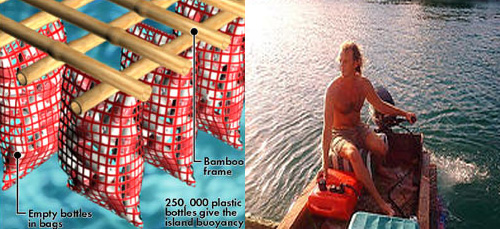
If you can’t afford to buy your own tropical island paradise, why not build your own? That is exactly what Richie Sowa did back in 1998, from over a quarter-million plastic bottles. His Spiral Island, destroyed years later by a hurricane, sported a two-story house, solar oven, self-composting toilet and multiple beaches. Better yet, he has started building another one! His ultimate goal? To build the island bigger and bigger and finally float out to sea, traveling the world from the comfort of his own private paradise.

Spiral Island Construction and Steering

The original Spiral Island was (as its successor will be) built upon a floating collection used plastic bottles, all netted together to support a bamboo and plywood structure above. Located in Mexico, the original was 66 by 54 feet and was able to support full-sized mangroves to provide shade and privacy, yet also able to be moved from place to place by its creator as need with a simple motorized system.

Spiral Island Early Stages

An environmentalist to the core, Sowa is also an artist and a musician. More than just the universal dream of an island retreat, Spiral Island is also his vision for low-impact sustainable living. The next version of the island will be built to withstand more treacherous weather than the first and will also be located in a more sheltered part of Mexico’s waters.

The Above Ripley’s Believe-it-or-Not video is a great introduction to the island, which conjures images of Gilligan-done-right. Spiral island is able to exist and move about in Mexico in part because it is classified as a ship, not an island, like an atoll out of WaterWorld (only much much cooler). On September 7, 2007 the new Spiral Islander social network utility was opened to the public to allow visitors, Spiral Islanders and friends of Richie Sowa to connect and communicate about the history of Spiral Island and to learn more and discuss Richie Sowa’s new Spiral Island. Want more islands? See these 7 Island Wonders of the World from WebUrbanist.

Fly Away! The Ultimate Guide to Budget Airlines Travel

Next time you are planning a trip but are a little short on cash, this ultimate guide will supply you with some excellent tips and links to help you find the cheapest airfares available. Choose your destination, take your pick of several low-cost budget airlines companies, and then just find the best prices around for your journey. Bon voyage!

read more | digg story

Recession Cigar Tips from my friends at Stogie Review

Cigars are almost always marketed toward an affluent crowd, or at least with affluence in mind. The major manufacturers in the industry assume that you are both willing to pay premium prices for premium sticks, and that you can. But those of us not in the investment banking trade can hardly afford to stock up on boxes of pCigars in a Recessionricey Fuentes whenever the fancy strikes us. And, given’s today’s rocky consumer market and quite probable economic recession, it’s tougher than usual to maintain our expensive cigar hobbies.

But there’s a silver lining here. I see today’s adversity as the best education a stogie enthusiast can get. Let’s face it; most of us could stand to get better at managing a cigar budget. This recession might be precisely the kick in the pants we need to start spending and collecting responsibly. In that spirit, below I present five tricks that I’ve developed to help me get the best bang for my bear-market buck:

1. Take a course in personal finance and/or financial accounting at your local college. I can’t stress enough how important it is to know the basics of personal finance. Sadly, American schools – including most of the country’s best universities – are doing a piss-poor job teaching us how to keep our books and budgets in order. The next time you’re thinking about dropping $250 on a new appliance at Best Buy, think again. That quarter-thou is much better spent on an online or night course in financial accounting. You’d be amazed how much practical, lifelong value you can get out of such an investment. And when you buy your textbooks, buy them used.

2. Get smart about CBid. CigarBid.com, affectionately known as “CBid,” is a bargain hunter’s paradise. But it can be tricky. Always, always, always know the retail price of what you’re bidding on. That box of vintage Patels might look like a steal at $75, but once you factor in shipping costs, you’re roughly at the MSRP. It helps to keep two windows open on your browser: one for CBid, and one to run spot-checks on prices via Google, Cigar.com, CigarsInternational, Tinderbox, etc. Remember: You can only beat the market price if you know the market price.

3. Reverse-engineer a yearly “luxuries” budget. Developing a budget from scratch can be a daunting and often counterproductive task. Instead, take stock of all of last year’s expenses, then work backward. How much do you really spend each year? How much do you earn? What expenses can be cut? What allowances can be made? By building a template from last year’s budget, then whittling down unnecessary expenditures, you can develop a smarter and leaner budget for the year ahead.

4. Don’t get carried away. Nabbing great deals on CBid or in B&M bargain bins can be exhilarating. But know when to quit while you’re ahead. That $20 bargain might look attractive today, but five “$20 bargains” over the course of a week will be every bit as expensive as a one-time $100 splurge.

5. Find your inexpensive, everyday cigar. Discover your favorite cheap cigar. Now stock up on a box or two. Try to make these your go-to sticks for everyday (or every other day) occasions. Oftentimes, online retailers will sell wheels of 50 $1 sticks that are comparable to much pricier premiums. There’s no shame in smoking these house blends, especially when no one’s around to impress.

-Jon N

Green Yachting Chismillionaire style

Sabdes50_view05_black_s

From Australian superyacht designer Scott Blee comes the Sabdes 50M, an impressive follow-up to his 230-foot Sabdes 70M. The artful vessel is a "mere" 164 feet of floating luxury, but it carries within its modest dimensions a surprising degree of earth-friendliness.

Rest assured there's no shortage of big-money opulence on board, including acres of wood veneer and glass, but this one hits the waves with a hybrid propulsion system that employs electric motors and a diesel-powered generator to charge a bank of batteries.

The system promises to be vastly cleaner and more fuel-efficient than traditional marine powerplants, and Sabdes says the 50M will have a higher cruising speed than comparably sized vessels. With retractable battery-powered electric thrusters fore and aft, the big boat has the ability to maneuver silently in port or through more sensitive marine environments.

Other elements ease the superyacht's eco-impact in subtler ways.

The eco-friendliness includes a bow design that reduces wave slap and wake, making life a little easier on aquatic animals and the shoreline. Inside, LED lighting preserves battery power, as does a greater reliance on natural cooling to supplement the climate control system.The steel hull's slender, aquadynamic shape gives the vessel a cruising range of 3,000 nautical miles (almost 3,500 statute miles, or roughly the distance from New York to London) and contributes to its relatively fast cruising speed of 25 knots (about 29 mph).

So - how much? If you have to ask...

More photos, courtesy of Sabdes.

Sabdes50_view09_black_s

Sabdes50_view18_black_s

Sabdes50_view33black_s

Sabdes50_closeup3

Sabdes50_closeup4

If your personal life is your business, is everything a writeoff??

Sometime last year, podcaster Anneke Rudegeair bought three different brands of condoms. This month, she sat down with TurboTax and listed the cost of rubbers as a deduction. It was, she believes, a business expense.

Rudegair, 28, is better known to legions of fans as Soccergirl Incorporated, the self-described "podcasting librarian with big tits." Her job, for which she grossed $22,000 in 2007, is to show off her charms on her site and purr about all things sexual in her podcasts.

So there's an argument to be made that the Future-Condom Challenge she and her boyfriend undertook was part of the gig.

"What otherwise would be your regular life becomes your business life; that's been true for podcasting since the beginning," said Rudegair, of Germantown, N.Y. "It's all legitimate."

Nice work if you can get it. Which, technically, is the central conundrum of new media pioneers and their accountants at tax time: In an age when bloggers and podcasters are making a living -- or trying to -- by blogging and podcasting about their personal lives, what exactly is legitimate? And if writing off your personal life is as easy as writing about it online and getting some Google ads, why doesn't everybody do it?

The Internal Revenue Service certainly doesn't make it clear. A request for information was met with directions to a page at IRS.gov entitled Business or Hobby? Answer Has Implications for Deductions. There, the public is informed that "an activity is carried on for profit if it makes a profit during at least three of the last five tax years, including the current year."

Broadly, the notion is you have to make some money. But there's no further details concerning the IRS' views on how living one's life in public apply to expenses that are "common and accepted in the taxpayer's trade or business."

It's a topic so new, it confounded a number of legal and tax experts contacted for this story. A spokeswoman for the Office of Tax Policy Research at the University of Michigan's Ross School of Business said her experts couldn't comment because, "As we move into new technology, it's really hard to know about some of this stuff."

"I hadn't really thought about bloggers, but they're basically making their personal lives their businesses," said John Robinson, an accounting professor at the University of Texas' McCombs School of Business. "When you make expenditures that are primarily for business purposes, then it's deductible. If it's primarily personal, then it's not. As for the experimental use of a condom, you have to ask, would she have engaged in these extra expenditures were it not for her work? I honestly don't know how I'd apply that rule. This is plowing new ground."

Indeed, those in the field are feeling their way as the mediums mature. Rudegair said she was nervous the first time she put "podcaster" on the form as her occupation, worried that "they'll think it's a made-up thing." And Mike Yusi, who produces the twice-weekly music show UCRadio out of his Los Angeles home, illustrated the difficulty defining whether his show is a hobby or a job by indicating that he "would do it whether I could write it off or not, but once the possibility to offset the costs came up, I jumped at it."

Rob Walch, coauthor of Tricks of the Podcasting Masters and host of Podcast411, agreed there's some gray area.

"If you were to go to get a manicure or massage and you blog podcast about it and you are making money on the blog or podcast, you could write it off," Walch said. "But that does not mean you will not get audited."

That's the rub, said New York blogger Julia Allison, who writes extensively about her personal life at her And Another Thing… blog and in her work for TimeOut New York. The IRS, she quipped, will audit a podcaster who expenses condoms "just for fun."

"The IRS doesn't understand, isn't interested in understanding that your personal life can sometimes merge with your professional life," she said. "It has to be 100 percent business. If there's even a small percentage that is for your personal life, you can't expense it."

Many play it safe. Dennis Gray of San Luis Opisbo, California, host of the parenting podcast 101 Uses For Baby Wipes, often receives free products for review. To avoid the tax consequences of receiving those items, he gives them away on the show when he's done.

"That makes it a wash, an income and expense at the same time," he said. "I don't want to have to declare all that nonsense, book it as income, use it as income, calculate appreciation and turn around and sell it. So I get rid of it to avoid the tax man."

For Rudegair's part, she said she hesitated to deduct much early on but now she puts down such items as those condoms and outfits she buys for her web videos as well as such traditional business expenses as computer equipment, home-office space and travel related to promoting her show.

"I don't know if I'm going to get in trouble for this, but it's defendable," she said. "I mean, I'd love to show the IRS which episode I did what I did in."

Promise of a Quantum Internet

larger text tool icon

Entangled Web: The optical components on this lab bench, such as mirrors and filters, allow researchers in Prem Kumar’s lab at Northwestern University to direct and manipulate light. In Kumar’s most recent work, he has created a quantum logic gate within an optical fiber; such gates could eventually enable networks of quantum computers.
Credit: Prem Kumar

The promise of quantum computers is tantalizingly great: near-instantaneous problem solving, and perfectly secure data transmission. For the most part, however, small-scale demonstrations of quantum computation remain isolated in labs throughout the world. Now, Prem Kumar, a professor of electrical engineering and computer science at Northwestern University, has taken a step toward making quantum computing more practical. Kumar and his team have shown that they can build a quantum logic gate--a fundamental component of a quantum computer--within an optical fiber. The gate could be part of a circuit that relays information securely, over hundreds of kilometers of fiber, from one quantum computer to another. It could also be used on its own to find solutions to complicated mathematical problems.

A logic gate is a device that receives an input, performs a logic operation on it, and produces an output. The type of gate that Kumar created, called a controlled NOT gate, has a classical-computing analogue that flips a bit registering a "1" to "0," and vice versa. Quantum logic gates like Kumar's have been built before, but they worked with laser beams that passed through the air, not through fiber. The new gate lays the foundation for experiments that demonstrate the abilities of quantum computers in fiber, says Kumar. "The exciting thing here is that an application is within reach," he says. Within the next year, Kumar and his team plan to test the gate in a specific application: conducting a complex auction over a secure quantum network.

Researchers at IBM, MIT, and many other corporations and universities have been working on quantum computers since they were first proposed in the 1980s. A quantum computer is a device that processes bits of information by exploiting the weird quantum-mechanical properties of particles such as electrons and photons. A quantum computer is theoretically able to process exponentially more information than classical computers can. The unit of information in a classical computer is the bit, which represents either a "1" or a "0"; but in a quantum computer, it's the qubit, which can represent both a "1" and a "0" at the same time. Since qubits compute with multiple values at once, the processing power of a quantum computer doubles with each additional qubit. This characteristic would enable a quantum computer with only a couple hundred qubits to significantly outperform today's best supercomputers.

Kumar's group makes qubits out of photons that are "entangled." That means that their physical characteristics, such as polarization, are linked in such a way that if one photon assumes a particular physical state, the matching photon instantly assumes a corresponding state. A few years ago, Kumar demonstrated that optical fiber itself could cause photons to become entangled, and that they would remain entangled over a distance of 100 kilometers. His recent work, described in Physical Review Letters, goes one step further, creating a logic gate that entangles photon pairs.


To use this gate, Kumar needs photons that are identical in every way except polarization, or the orientation of their electromagnetic fields.These "identical" photons are sent through optical fiber to the gate itself, a small maze of devices that route photons in different directions depending on their polarization. Passing through the maze causes certain photon pairs to become entangled. But not all photons make it through the gate; only when photons reach detectors on the other end, and the researchers can measure whether or not they are entangled, do they know the gate succeeded.

The only way to know whether or not the gate worked is to wait until a collection of photons has been fired at it, says Carl Williams, coordinator of the quantum information program at the National Institute of Standards and Technology. "Most of the time the gate fails," he says. "It's a probabilistic thing." But when the gate fails, the researchers simply disregard the unentangled photons.

"The great thing about this work," says Williams, "is that it's in fiber. This is a big deal because it could lead to distributed networks. ... The obvious application is for long-distance quantum communication between two smaller quantum computers." One of the crucial elements in a conventional optical network is a device called a repeater, which amplifies signals that have degraded over distance. Williams says that a quantum logic gate, such as the one that Kumar built, could be used in a circuit that amplifies a signal without losing the entanglement of the photons.

"This is an important step toward constructing a quantum Internet," says Seth Lloyd, a professor of mechanical engineering at MIT and a leading researcher in quantum computation. "Such a network would have powers that the ordinary Internet does not," he says. "In particular, communication over the quantum Internet would be automatically secure."

Lloyd notes that Kumar's paper illustrates how a simple quantum logic operation can be performed using individual photons. "The current paper represents a significant advance in the technology of quantum computation and quantum networks," he says.


Jaguar XF getting solid reviews

Now the key is to see if that translates into sales growth.

Posted Today 04:00 AM by Angus MacKenzie
Filed under: Auto Review, The Big Picture, Jaguar, Sedans

2009 Jaguar XF

"Wow!" That's the first entry in the notebook from Saturday morning's run up the Angeles Crest Highway in the supercharged Jaguar XF. The Angeles Crest, with its switchbacks and sweepers that jink and dive and swoop through the mountains behind LA, is one of the world's great driving roads. And on it the new XF proved it's one of the world's great driver's cars.

There's a delicacy, a deftness of touch about this car that's preternaturally animalistic: Alert and agile, light on its feet, oily-smooth in its transitions, this Jaguar felt truly cat-like as it sashayed up the Angeles Crest at sport bike speeds. The steering is near perfect in its weighting and linearity; the turn-in response almost telepathic; the ride buttoned down yet beautifully composed. I've had some exhilarating drives on this road, most recently in a Porsche 911 GT2. But I don't think I've driven a better sedan here. Yet.


2009 Jaguar XF rear

Curiously, there's nothing unique, or even particularly special, about the XF's chassis hardware. The front suspension is double wishbone, and there's a multi-link set up at the rear, fairly standard fare for a car in this class. Okay, the shocks feature Jaguar's CATS adaptive damping technology, but, again, this is hardly a new or unique technology. So what's the alchemy at work here?

I know from experience Jaguar's ride and handling wizard, Mike Cross, is one of the best in the business. The quietly spoken Cross is our kinda car guy: A demon driver, race quick on the track, with the innate ability to make almost any rear drive car corner in a lurid tire-smoking drift when he feels like having fun. Yet his cars are anything but the rock-hard, kidney-rattling rides you can sometimes get from enthusiast engineers.

Part of the secret -- and only part, for although I've known Mike for years, and been on several very fast and very sideways rides with him in prototype Jags, he won't reveal all the tricks of his trade -- is that Jaguar pays very close attention to controlling the roll rate of the suspension, even when car is travelling in a straight line. The idea, says Cross, is to reduce what ride and handling engineers call "head toss", the side-to-side pitching of your head that occurs when your car rides over bumps on alternate sides.

You can feel it in the XF in the way the vertical body movements are so deftly modulated. But that's only part of the story. The XF, like our much-missed XKR long termer, rides beautifully for a car rolling on low profile 20-inch Pirelli P Zeros. It's firm and taut, but never harsh. A constant dialogue from the chassis means you know exactly what's going on where the rubber meets the road, but the conversation is always calm and muted, even when you're driving hard. How? I suspect a lot of time and effort on geometry and bush design, but only Mike Cross and his team really know.

Here's what I like most about the new Jaguar XF: I find it somehow reassuring that even in this age of computer aided engineering and zillion gigabyte simulation programs, the auto industry still has black arts that are only truly mastered by their most experienced and talented practitioners. The XF's sublime chassis proves beyond question that when it comes to fine tuning ride and handling, there is simply no substitute for the human touch.

Color From The Adelaide Festival: Northern Lights


Light projection installations have been filling dark nights with radiant colors a lot in the past year. With the previously mentioned exhibit Evoke, by Usman Haque, who wrapped the facade of York Minister with projected colors that were sensitive to the sound waves created by people in the immediate area, to the recently ended Adelaide Festival...

read more | digg story