Nice Wave!!



By Frederik Pleitgen
DEUTSCHNEUDORF, Germany (CNN) -- Digging has resumed at a site in the southeastern German town of Deutschneudorf, where treasure hunters believe there are almost 2 tons of Nazi gold and possibly clues to the whereabouts of the legendary Amber Room, a prize taken from a Russian castle during World War II.
Heinz Peter Haustein, one of the two treasure hunters and a member of Germany's parliament, said: "We have already hit a hollow area under the surface, it's filled with water and we are not sure if it is the cave we are looking for."
Digging was stopped more than a week ago amid safety concerns, as authorities and the treasure hunters feared that the shaft might collapse and that the cave -- if it is there -- may be rigged with explosives or poisonous booby traps.
At a news conference Friday, Christian Hanisch, the other treasure hunter, said that geological surveying equipment had located a possible cave about 30 feet under the surface containing "precious metals that can only be either gold or silver. The instruments would not have reacted to any other metal like copper."  See photos from hunt for lost Nazi gold »
Hanisch pointed out that his father, who was a navigator in the Luftwaffe, the Nazi air force, was one of the troops said to have been involved in hiding art, gold and silver as the Nazis realized that they would lose the war.
He said that when his father died, he left coordinates leading to the spot in Deutschneudorf.
"It's not about getting the reward," Hanisch said at the site. "I just want to know if my father was right and if my instincts were right."
Haustein, who is paying for the expedition, said he hopes that finding the gold could lead to the Amber Room, whose interior is made completely of amber and gold. It was looted by the Nazis from a castle in St. Petersburg, Russia, after Adolf Hitler's forces invaded the Soviet Union in 1941.
The room looked so majestic, many called it "the eighth wonder of the world." It disappeared after the war, and today a replica stands in its place in St. Petersburg.
Although parts of the Amber Room have resurfaced, the vast majority remains missing.
Haustein has been looking for the room for more than 12 years.  Watch hunt for Nazi gold at German mountain »
"I am certain that large parts of the Amber Room are buried somewhere here," he said.
He said he has collected much circumstantial evidence suggesting that the Nazis hid the Amber Room in old copper mines around Deutschneudorf, but he has no proof.
Haustein said the Nazis began bringing valuables including art, gold and silver to the region around Deutschneudorf as early as summer 1944.
Deutschneudorf is in Germany's Ore Mountains, and the mountain where the treasure hunters claim to have found the Nazi gold was a copper mine until the 19th century. Although the mine was shut down in 1882, geologists found evidence that soldiers from Hitler's Wehrmacht -- the German armed forces -- had been there. The machine guns, parts of uniforms and explosives are on display at the town's museum.
Though both treasure hunters say they are certain they will find cultural goods, both admit that they fear disappointment.
"Of course, if you embark on something like this, you ask yourself: 'What if we find nothing again? What if I was fooled?' " Haustein said. "But every man has to go his own way, for better or for worse."
If they do find the treasure, Haustein says, it would legally belong to Germany, although he would recommend that Germany give any Amber Room parts back to Russia.
Treasure hunters have typically received rewards of 10 percent of the value of the goods found, but Hanisch says there are no laws dictating the reward amount.

Four USAF F-117A Nighthawk stealth fighters fly in formation during a sortie over the Antelope Valley, California, USA. Photographer: Bobbi Zapka, Chief, Aerial Photo Department at Edwards Air Force Base


LOS ANGELES -- Researchers at UCLA made headlines this month by developing a nanoscale crystal that traps roughly 80 times its volume of carbon dioxide. This particular crystal has excited proponents of carbon-capture technology for its ability to absorb CO2 and nothing else, but the process that head researcher Omar Yahgi and his lab used to develop the compound is potentially much more significant.
Yahgi’s lab employs automation techniques frequently found in the biotech and pharmaceutical industry to rapidly test crystal samples on a scale not previously possible, which has led to an avalanche of new discoveries. At one point, the technique was yielding so many potentially useful compounds that Yahgi had to ask his students to stop so they could publish their findings. Possible uses for crystals that can selectively absorb specific molecules are numerous, including military applications and hydrogen-fuel storage for green vehicles.
Click through this gallery to see how these nanoscale crystals are formed, tested and scanned.

Left: An array of ZIF, or zeolitic imidazolate framework, crystals that were photographed by a robotic microscope using polarized light to show detail. ZIF crystals are the primary substances that Yahgi and his crew develop. The nicely formed and innately beautiful crystals at left await further testing in the lab. The finer specimens may be individually mounted and imaged using X-ray crystal diffraction.
Dave Bullock/Wired.com
 PaperKraft.net is a site with more papercraft geekiness than you can shake an Xacto blade at. Characters from video games, movies, anime, and sci-fi are all represented. You can start your recreation of the Battle of Hoth with K-3PO, forever immortalized in 2.3 seconds of movie and soon, glue and card stock. (Be warned, papercraft projects like this are a time sink for you and the geeklings.)
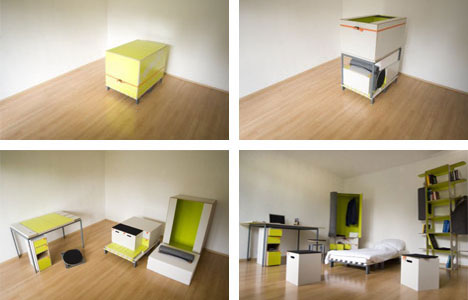
Why is transforming furniture so alluring? Does it appeal to our sense that innovation is progress, the fact that fewer materials for more uses is sustainable or simply a return to the childhood love of things that we can actively change and shape as we wish? Whatever the reason, these designs range from humorous and impractical to jaw-dropping...
read more | digg story
Last updated at 12:20pm on 22nd February 2008

One child is a full-time job - but SEVEN, including two sets of triplets, all before you are 17 years old, is mind-boggling (file photo)
Named only as Pamela, the girl had her first set of female triplets aged just 15, giving birth to the second set a year later.
As she gave birth to a son when she was just 14, that means young Pamela is now a mother seven times over, all before her seventeenth birthday. All seven children were born prematurely but without any kind of fertility treatment.
While doctors say the three newborns and their mother are well, the case has sparked debate across Argentina, the BBC has reported.
In bars, cafes, and newspapers, there has been widespread criticism of Pamela's alleged promiscuity.
Her family already receives help from the provincial authorities, which donated land and built them a house when the first set of triplets was born.
But some Argentines are arguing that perhaps what Pamela needs is not financial help but more advice on contraception.
Pamela's mother, who cleans houses to supRetail Theft or Driving on Suspended License or Contempt of Court?
Odd, how something can be funny and creepy at the same time.
read more | digg story

SAN FRANCISCO -- Nostalgia can be a disappointing thing, says the producer of Street Fighter IV.
"Sometimes, you remember things as looking cooler than they did," says Capcom's Yoshinori Ono. "Since it's been 15 years since Street Fighter II came out, you might envision something that looks better. What we're trying to do with Street Fighter IV is to build a game that looks like your ultimate memories."
Capcom will release the long-awaited 3-D followup to their epoch-making fighting game series into Japanese arcades this June. But the game's makers haven't forgotten the sting of Street Fighter III, an immensely demanding and complex game that only appealed to a tiny sliver of hardcore players.
Somewhere along the line, Capcom lost the millions of casual quarter-droppers that made SFII the biggest game that video arcades ever saw. With Street Fighter IV, Ono wants to get them back.
 Ono, general manager of Capcom's online game development group, was faced with the Herculean task of creating the first Street Fighter game to be built from the ground up for online play. But he is also adamant that SFIV is a throwback, a step away from SFIII.
"Street Fighter III was kind of an exclusive club where if you didn't know what you were doing, there was no reason to even try and play it," says Ono (pictured right). "This time, we're trying to re-open the fighting genre to people who haven't played it in a while."
That's why SFIV will feature, first and foremost, the eight well-known fighters from SFII: Ryu, Ken, Chun-Li, Blanka, Dhalsim, E. Honda, Zangief, and Guile.
Ono didn't select these characters one by one, he says. "They all made the cut individually as one group. It's important, because this game is starting its life in the arcades, where you have a limited time to sit and play. You don't want people flushing their 100-yen coins down the toilet; you've got to give them some level of familiarity."
It certainly worked for me. Sitting down at the arcade cabinets that Capcom had hauled up to its hotel suite offsite of Game Developers Conference, I immediately settled into a groove with my old standby Chun-Li, despite not having put more than a few hours into a Street Fighter game for the last five years or so.
SFIV has the slow, deliberate pacing of 15 years ago, before fighting games became a frantic coke-fueled nightmare. This might turn off Capcom's deeply hardcore base, but Ono insists he's creating a game that is accessible but deep.
"It's going to be a lot like chess," he says. "There are grand master chess players who play on ESPN2, but you could also have a grandfather and his granddaughter playing chess. You're in charge of playing at whatever level you're capable of. We give you the board and some pieces and rules."
Ono wants beginners to at least derive some satisfaction from fighting high-level players. "Even if you can't get a checkmate, you're going to get his knight, you're going to get a couple of his pawns. That's the driving theme of the game."
Saying you want to reach out to casual players is one thing, but making it happen is quite another. Ono has chosen as his first battleground the arcades of Japan, which today mostly feature music games like Taiko Drum Master and UFO Catcher machines in their front lobbies to draw in schoolgirls and window-shoppers. Fighting games are shoved in the cigarette-stained basement.
Ono would like to get as close as possible to the street, for one particular reason. "Envision the front doors. First is the Taiko Drum Master. Right behind those are the gun shooting games like House of the Dead. We want to be right behind those, because we want people who walk by the doors to hear the nostalgic sound, hadouken!, and say, 'Did I just hear a Hadouken? I want to check that out.'"

When they get there, they'll be greeted by some amazing visuals. I enjoyed playing SFIV, but I enjoyed watching it perhaps even more. Seeing the cartoonish cel-shaded visuals in still screens is one thing, but watching them move is quite another. I observed, standing there, that they looked like the illustrations in the classic Super Nintendo instruction manuals come to life. As it turned out, this was exactly Ono's goal.
"Capcom has a history of great artists, and the paintings we have for the characters are really compelling. What we wanted to see if we could do with this was make a game that looked like those paintings, moving before your eyes," says Ono.
The challenge, of course, was replicating those paintings in 3-D. SFIV's gameplay takes place entirely on a 2-D plane, but the graphics are in three glorious dimensions. "There was a lot of back and forth between the art director and the tech guys about what the (cel shading) should look like, finding a middle ground between too much realism and too much cartoon," says Ono.
To perfect the look, the tech team used a game design technique that Ono says he hasn't used in the last 20 years, not since the days of drawing pixel art by hand. "We had a picture that the (art guy) had drawn on the left-hand side of the monitor, and they were trying to imitate it on the screen by tweaking the shaders," he says. "It was fun to do that, but it took forever."
The end result is an absolutely gorgeous end product. Although Capcom has only announced the game for arcades, it's a dead cert that we'll see a version on Xbox 360 and PlayStation 3. But isn't that an issue, I ask Ono, because all those casual players you want to court own the lower-powered Wii?
 Ono goes back to his chess analogy. "You could have a gold-inlaid board, knights with diamonds in their eyes. Or you could just draw a grid on a piece of paper and use cheap plastic pieces. And you're having the same amount of fun," says Ono.
In other words: "Street Fighter IV, as it stands now, would be well-suited for the higher-level platforms. But the game doesn't have to have these visuals in order to be fun. We could go, potentially, to the Wii. We could make it on Game Boy, for all we know right now. As long as the rules are the same, that can be independent of the visuals. So we're not going to be limited by any hardware specs; we're going to aim as wide as possible," he says.
Driving the point home, Ono name-checks Nintendo's game design genius. "This hearkens back to what Miyamoto said at a previous E3, that the evolution of console technology really is independent of fun, games aren't getting any more fun."
Potential home versions of the game should offer something else to hardcore Street Fighter fans, says Ono. "If and when there are console versions, we could see someone like Sakura-chan (from Street Fighter Alpha) or Ibuki (Street Fighter III)," says Ono. "For a home version, you can sit and practice the characters as long as you want to before you take them online. So there will probably be a move to add even more characters to the home version."
"Of course we know that there are people who want Alpha characters, who want III characters, who want all-new characters. We get emails, we read the message boards. We're listening to all of those voices. We have to respect those users as well, they're terribly important," Ono says.

LONDON - A British newspaper has published what it calls the first known photograph of a boy Anne Frank fell in love with and wrote about in her famous diary.
Anne Frank, the Jewish schoolgirl who wrote her diary while hiding from the Nazis in the Netherlands during World War II, was captivated by Peter Schiff.
She met him at school in 1940, his family also having fled from Germany to Amsterdam the previous year. At age 11, Anne fell in love with Schiff and later, while in hiding in Amsterdam herself, wrote about how much she missed him.
Her last mention of Schiff was in 1944, the year her family's safe house was raided by the German security police. She later died in a Nazi prison camp.
Sunday's The Observer newspaper reported that Ernst Michaelis, 81, of London, found a photo of Schiff in a family collection after realizing that Anne Frank was writing about a boy he had known as a fellow student in Berlin.
Michaelis, who moved from Germany to Britain many years ago, said he has had the photo authenticated and that it will be displayed on the Anne Frank House Web site.
Schiff also is believed to have died in a Nazi prison camp.
The Anne Frank Foundation in the Netherlands was closed on Sunday and could not immediately be reached by The Associated Press for comment.
URL: http://www.msnbc.msn.com/id/23321701/?GT1=10856
 | Anne's attic Nov. 25: NBC's Dawna Friesen takes a tour of the Amsterdam house where Anne Frank hid from the Nazis. NBC News Web Extra |
Following the Globe's report this weekend showing some commuter trains from 1925 taking less time to get to Boston that today's schedules, here are some tips the MBTA could consider.
 It's stunning to see how fast trains travel in European countries, not the ICE, the TGV, or the AVE, but the normal intercity trains. Currently, a trip on an intercity Corail train from Paris Gare de Lyon to Clermont-Ferrand in Auvergne is an hour faster than by car. The 420 km trip can be done in three hours, an average speed of 140 km/hour, or roughly 86 mph. In the United States, the Acela Express, supposedly what Amtrak calls "high speed rail" only averages 72 mph for its entire length from Boston to Washington, DC. Speeding up the conventional rail system has become popular on routes where funds are not yet available to build a full scale, state-of-the-art high speed rail line. Europe and Asia are models for the United States, where normal trains can travel faster than cars. Here are six steps on improving America's rail system.
The photo shows a Corail train at Paris Nord. Corail rail cars can travel up to 125 mph. Photo user by Fickr user thecsman.
Step 1:
Eliminate redundant stops and introduce skip stop trains. Referring once again to the Clermont Ferrand-Paris line, a local train will take four hours, skip-stop trains usually take three. One effective implementation plan that many of the world's rail systems has used is to have trains run local to a certain transfer point and then run express to the final destination. A second train would run express to the same transfer point and then run local for the rest of the journey. Having a timed transfer will allow passengers to travel quickly between the two extremities of the line, but trains still provide service for all stations.
Price: Cheap to reduce stops, more expensive to add trains.
Step 2:
Implement reserved seating plan. In 2003, the SNCF introduced the Corail Téoz, a new form of a conventional intercity train where reserved seating is required (the train's interiors also changed). Reserved seats mean that passengers can align themselves on the platform to board, instead of crowding around certain sections of the train. Trains should stop for no more than three minutes in a station.
Price: Cheap, but organization is key.
Step 3:
Eliminate grade level crossings and/or upgrade tracks (and overhead wires) to accommodate faster trains. Trains traveling at 85 mph will be sufficient and will provide a savings over the highway. China has upgraded tracks on several major corridors to allow trains to attain speeds up to 200 km/h. Eliminating ground level crossings with overpasses and underpasses will allow trains to travel at faster speeds, as potential contact with cars would be reduced.
Price: Expensive, but if the track needs replacement, then why not upgrade the tracks and wires at the same time?
Step 4:
Use lighter, swifter trains. Most of the regular intercity rail cars in Europe have maximum speeds ranging from 160 to 200 km/h (100 mph to 124 mph). Amtrak's Northeast Corridor Regional trains use rail cars that weigh 116,000 pounds each, while many European train cars weigh 42 metric tons, or about 92,500 pounds. A lighter train will provide faster accelerations and a greater energy efficiency.
Price: Expensive. Amtrak's Amfleet cars are getting old, but there is no mention in replacements yet.
Step 5:
Advertise about the faster service. Prove to the public that the train can travel faster than cars and that there are no hassles with airport security lines or check-ins. Promote special prices and deals. Amtrak needs to regain the confidence of the Americans before attracting riders.
Price: Depends on the advertising method.
Step 6:
Designate important, heavily used corridors for high speed rail system. Build a dedicated trackway for only high speed trains. There should be no grade level crossings, sharp turns, or steep climbs. Connecting the high speed rail tracks to the current network will allow bullet trains to continue on local tracks to serve more destinations. ICE lines tend to branch off the main high speed line, slow down, and then stop at smaller cities. TGV also continues journeys on local tracks to provide direct service to and from Paris. Spain, however, does not have the option to run AVE trains on local tracks since the track gauges are different.
Price: Extremely expensive with attaining right of ways, constructing elevated and tunneled structures, buying new vehicles and building new stations.

The flash and polish of Windows Vista seduced you, but so far the glamorous interface is just sucking the life out of your PC. Fear not, this guide has everything you need to turn Vista into the beautiful *and* speedy OS you were dreaming of.
Keep in mind though, that, while these tips can help you speed up Windows and recover hard drive space, you aren't going to see the sort of speed boost you'd get from upgrading your hardware. If you're unhappy, for instance, with the speed of Vista on a machine where Windows XP used to scream, these tips will help. But you might want to consider a new graphics card, more RAM and perhaps even a faster processor.
Contents[hide] |
Part of what slows Vista down is the number of secondary applications running in the background and hogging RAM. An essential step to speeding up Vista is getting rid of the things you don't need.
Services are background processes that run silently without you ever knowing about them. Because Vista takes the everything-and-the-kitchen-sink approach to what it loads on boot, there are likely some unnecessary services running in the background.
To get rid of them go to Start > Run, type services.msc and hit Return. Double-click on the service you want to get rid of and change the startup type to Disable.
Some examples of services you may not need: Secondary Logon, Remote Registry, Computer Browser, KtmRm for Distributed Transaction Coordinator, Windows Error Reporting, Tablet PC Input Service and Distributed Link Tracking Client. There are dozens more. Sift through them and run a few web searches to see if you need all of them.
Like most people, you probably have a number of third-party programs eating up hard drive space. When it comes to files it's your call, but for getting rid of programs we recommend the free application CCleaner which is faster and much more thorough than Vista's default Add/Remove application.
Whenever Windows starts it automatically loads a number of programs, many of which you may not need. The System Configuration Utility and Windows Defender can both be used to control what programs auto-start in Vista.
To disabling auto-start applications with the System Configuration Utility
To disabling auto-start applications with Windows Defender
Use the free application Instant Memory Cleaner to force your machine's physical memory to clear out unecessary pages. It also helps you keep the amount of memory being used by your active processes to an absolute minimum. The tiny app from Vasilios Software is a simple graphical interface for one of Vista's built-in command line tools, FreeMem.
Fragmentation happens when the computer writes files to disk without keeping everything together in one spot. Thus if you just saved a large image you've been working on in Photoshop, part of it might be near the middle of the disk and part of it might be at the end, which means it takes longer for the disk to find it. Bringing those disparate parts together is what's known as defragmenting.
Defragmentation was once the go-to solution for all speed problems in Windows. But Vista actually defragments your drive automatically in the background. In fact, the system is configured to defrag your hard drive once a week by default.
The problem with Vista's defragmentation routine is that unless you frequently install and uninstall programs and constantly move files around, once a week is probably overkill, and when Vista is defragmenting you'll see a performance hit. We suggest turning off the scheduler and doing it by hand.
To manually defragment your boot drive, open My Computer and right-click the disk you want to defragment. Select Properties and then click the Tools tab where you'll see the Defragment Now option. Just click Defragment and wait for the process to finish.
You'll may notice that Vista did away with many of the nicer features in XP's defragmenting program. If you'd like more advanced feedback try out the free Disk Defrag from Auslogics, which gives you a nice drive map and other advanced features.
ReadyBoost is one of the more appealing features in Vista. Put simply, it uses a solid state memory disk as an extra disk memory cache.
To take advantage of ReadyBoost, find the fastest USB flash drive you can find and plug it in. AutoPlay will pop up a dialog offering to use it for ReadyBoost. Just enable it and you're done.
Microsoft suggests that you use a USB drive roughly the same size as the amount of RAM you have.
ReadyBoost data is encrypted, so if someone snatches your flash drive, they won't be able to read your data.
Don't expect miracles from ReadyBoost, and keep in mind that it isn't an alternative to a memory upgrade. Rather, it caches disk reads on the fly and can often speed up data access. It won't help at all if you're short of Vista's minimum RAM requirements.
To take a radical approach to make Vista faster, you can use the free application vLite. The software, which was created by a developer named Dino Nuhagic, claims to reduce Vista's footprint by as much as one half. vLite strips out many of Vista's default system components like Windows Media Player, Windows Mail, Windows Photo Viewer, MSN components, Wallpapers and SlideShow.
Using vLite will save gigabytes of disk space, but the changes it makes to your machine are permanent, so use it with caution. You can also take solace in the fact that many of the applications vLite removes can be replaced with free downloads or web apps.
 |
| This won’t hurt a bit: A thumb-pad sensor designed by researchers at Baylor University monitors glucose levels noninvasively. The spiral-shaped circuit at the center of the device (pink) emits electromagnetic waves; the electrical properties of a thumb placed on the spiral change how energy passes through the circuit. The Baylor researchers are analyzing the changes in energy to gauge glucose levels. Credit: Randall Jean/Baylor University |
To track their blood sugar levels, patients with diabetes typically prick their fingers at least three times a day and feed blood samples into glucometers. It's a tedious and sometimes painful process, and a patient will often need to run a second test due to "insufficient blood" in the first sample. Now, researchers at Baylor University, in Waco, TX, have engineered a thumb-pad sensor that measures glucose levels via electromagnetic waves--no finger pricking required.
"There are many patients that don't monitor because of the pain of monitoring," says John Buse, president of the American Diabetes Association. "So there's certainly the potential to improve the lives of people with diabetes."
According to Randall Jean, associate professor of electrical and computer engineering at Baylor, the prototype of the new device matches the performance of conventional glucometers.
"It is accurate enough for people to make decisions about whether or not to inject insulin," says Jean. "That's really the target. It's not to measure glucose within one ppb [part per billion] but to produce an instrument that patients can use to make decisions about externally controlling blood sugar."
The U.S. Food and Drug Administration has approved only one noninvasive glucose monitor, called the GlucoWatch Biographer. Designed by Cygnus, of Redwood City, CA, the device is a wristwatch that uses an electric current to pull small amounts of fluid through the skin without pricking it. A sensor analyzes the fluid for glucose. However, 50 percent of patients who used the watch experienced skin irritation and sores, and the product was discontinued in 2007.
Jean says that the sensor he and his colleagues are developing will be "truly noninvasive" and will not require that any fluid--blood or otherwise--pass through the skin. The sensor itself is a small, spiral-shaped microwave circuit, which acts as a transmission line and emits electromagnetic waves. When a person places her thumb on the spiral, the electrical properties of her thumb change how energy passes through the circuit. Jean and his colleagues measure this change, and in early trials, they seem to have found patterns that correspond to variations in glucose levels.
"The energy does not specifically respond to glucose; it responds to the aggregate effect of blood, muscle, fat, skin, and glucose," says Jean. "What we're hoping is that over a broad enough frequency range, the individual components have unique signatures that allow us to extract the glucose."
The sensor is still in the early stages of development, and Jean has so far tested the prototype on five volunteers in 15 separate trials. The researchers made plastic molds of each subject's thumb, and they fabricated plastic guides to ensure that the subjects placed their thumbs on the sensors in exactly the right position. Jean also added a pressure gauge to tell the subjects how hard to press down in order to get a successful read. In each trial, volunteers placed their thumbs on the sensors, and researchers took 10 separate readings. Subjects also performed finger-prick tests, drawing blood and using traditional glucometers.

Get your daily dose of Nintendo nostalgia : Super Mario Brothers, Super Mario Brothers 3, Ninja Turtles 2, Tetris, Zelda, Double Dragon, ExciteBike, Off Road + MANY MORE!
read more | digg story

Lamborghini has announced that it will debut its new Gallardo LP560-4 at the 2008 Geneva Motor Show next week. The entry-level Lambo, which had been previously reported as the LP550, will replace the standard Gallardo as the base model in the Sant' Agata lineup.
Just as with the Gallardo LP560-4's big brother, the Murcielago LP640, the numeric name designates the car's horsepower rating -- in this case 560 PS (or 552 in U.S.-standard SAE rating). If you're wondering about the "4" tacked on at the end, that refers to the Lambo's permanent all-wheel drive system. Gallardo variants are nothing new (the SE, Nero, and Superleggera versions coming to mind), but the LP560 promises to be the most powerful Gallardo yet, and by using it to replace the base model, we're guessing there'll be room on the horizon for a new, more powerful lightweight version by year's end.

a graveyard of vessels frozen into blocks of ice
Those scenes remind the scenes from the “Day After Tomorrow” movie, but it’s not a movie scene. These are abandoned ships left to rust near Kamchatka, Russia.
read more | digg story
 .
.

 Posts
All Comments
Posts
All Comments