Zazzle Shop

Screen printing

Wednesday, November 7, 2007

Calif. court to hear marijuana case

By PAUL ELIAS, Associated Press WriterTue Nov 6, 11:14 AM ET

When Gary Ross was ordered to take a drug test at his new job, the recently hired computer tech had no doubt the results would come back positive for marijuana.

But along with his urine sample, Ross submitted a doctor's recommendation that he smoke pot to alleviate back pain — a document he figured would save him from being fired.

It didn't: Ross was let go eight days into his tenure because his employer, Ragingwire Inc., said federal law makes marijuana illegal no matter the use.

On Tuesday, the California Supreme Court is due to hear Ross' case, the latest example of the intensifying clash between federal and local authorities over marijuana use.

Ross, 45, contends that Ragingwire discriminated against him because of a back injury and violated the state's fair-employment law by punishing him for legally smoking marijuana at home.

He says he and others using medical marijuana should receive the same workplace protection from discipline that employees with valid painkiller prescriptions do. California voters legalized medicinal marijuana in 1996.

Eleven other states, including Alaska, Colorado, Hawaii, Maine, Montana, Nevada, New Mexico, Oregon, Rhode Island, Vermont and Washington state have adopted similar laws and many are now grappling with the same sticky workplace issue of employee use of medicinal marijuana.

The nonprofit marijuana advocacy group Americans for Safe Access, which is representing Ross, estimates that 300,000 Americans use medical marijuana. The Oakland-based group said it has received hundreds of employee discrimination complaints in California since it first began tracking the issue in 2005.

"It's an extremely widespread problem," said Joe Elford, the group's chief lawyer.

Several national medical organizations and disability rights advocates have filed friend-of-the-court papers urging the Supreme Court to rule in Ross' favor.

Ross, who lives in Sacramento, said he permanently injured his back in 1983 while serving as a U.S. Air Force mechanic. He said it wasn't until 1999 that he found true pain relief with marijuana.

The American Medical Association advocates keeping marijuana classified as a tightly controlled and dangerous drug that should not be legalized until more research is conducted.

"I think I'm standing up for everybody else," Ross said. "My motivation is that I don't like to lose and that medical marijuana is effective."

So far, though, Ross has been losing.

Two lower courts have sided with Ragingwire's decision to fire Ross because federal law holds that marijuana is illegal in all guises and a 2005 U.S. Supreme Court decision declared that state medicinal marijuana laws don't protect users from criminal prosecution.

Ragingwire marketing chief Doug Adams declined to comment on the case.

Ragingwire, a small telecommunications company in Sacramento, has been joined in the Supreme Court by powerful corporate interests such as the Santa Clara Valley Transportation Authority and the Western Electrical Contractors Association Inc., who said companies could lose federal contracts and grants if they allowed employees to smoke pot.

The conservative nonprofit Pacific Legal Foundation said in a friend-of-the court filing that employers could also be liable for damage done by high workers.

"History abounds with cases of employers found liable," the Sacramento-based foundation wrote, "because their employees were driving vehicles, operating heavy equipment or otherwise performing tasks made more dangerous by their being under the influence of alcohol or drugs."

Peter Griffin Lives

Tuesday, November 6, 2007

Matching Album Covers


Swiss Study Finds Marijuana Use Alone May Benefit Some Teens, U.S. Doctor Disagrees

Monday , November 05, 2007

By Tina Benitez

FC1

Teens that use cannabis may function better than teen tobacco-users, and appear to be more socially driven and have fewer psychosocial problems than those who do not use either substance, according to a Swiss survey.

Researchers at the University of Lausanne in Switzerland surveyed 5,263 students, including 455 who smoke marijuana only, 1,703 who smoke marijuana and tobacco and 3,105 who smoked neither one.

The survey, which will be published in the November issue of Archives of Pediatrics & Adolescent Medicine, found that marijuana-only smokers had better relationships with friends, better grades and were more likely to play sports than teens who smoked tobacco and those who abstained from both substances.

A U.S. substance abuse expert disagreed with the study and said U.S. teens should not be encouraged to use marijuana, particularly since teenagers’ brains are still developing at this time.

“Switzerland is very liberal compared to us in many ways,” Dr. Edwin Salsitz, senior physician of chemical dependency at Beth Israel Medical Center. “In general, it’s not a good idea for teenagers to use psychoactive drugs. The brain is still developing until the age of 21.

“Maybe (there’s) a cultural bias there that says it’s ok to use marijuana once or twice a month,” he continued “But from what I know, I’ve never heard that anyone thought it was beneficial. Most experts here would say that it’s not a good idea to use cannabis before the age of 15, because it interferes with school and the development of brain.”

Researchers found that marijuana-only users had the following characteristics:

— More likely to be male (71.6 percent marijuana smokers versus 59.7 percent of teens who used tobacco and marijuana)

— Play sports (85.5 percent vs. 66.7 percent of tobacco and marijuana)

— Live with both parents (78.2 percent vs. 68.3 percent of tobacco and marijuana)

— Have good grades (77.5 percent vs. 66.6 percent of tobacco and marijuana)

Cannabis-only smokers were also less likely to have been drunk in the past 30 days, less likely to use cannabis before the age of 15 and less likely to use marijuana more than once or twice in the past 30 days. They were also less likely to use other illegal drugs, compared to students who used both substances, researchers found.

“The gateway theory hypothesizes that the use of legal drugs (tobacco and alcohol) is the previous step to cannabis consumption,” the authors wrote. “However, recent research also indicates that cannabis use may precede or be simultaneous to tobacco use and that, in fact, its use may reinforce cigarette smoking or lead to nicotine addiction independently of smoking status. In any case, and even though they do not seem to have great personal, family, or academic problems, the situation of those adolescents who use cannabis but who declare not using tobacco should not be trivialized.”

In comparison to students who abstained from both substances, marijuana-only smokers were:

— More likely to be male (71.6 percent cannabis users vs. 47.7 percent of teens who abstained)

— Have a good relationship with friends (87 percent vs. 83.2 percent)

— Be sensation-seeking (37.8 percent vs. 21.8 percent)

— Play sports (85.5 percent vs. 76.6 percent)

— Less likely to have a good relationship with their parents (74.1 percent vs. 82.4 percent)

The fact that some students who smoked marijuana were less likely to have a good relationship with their parents wasn’t surprising to Salsitz. “The way to look at it is to look at alcohol as an analogy,” he said. “Do adults or teens who use alcohol have better relationships than those abstinent? That’s just not true. It looks like if you smoke marijuana and not tobacco, it’s better for you.”

He said the study should be viewed in terms of culture. “In France, people drink wine with food, but they don’t get drunk,” he said. “Kids also start doing this when they are young, and that’s different from here. I don’t think anyone would say that the active ingredient in marijuana is doing anything good in the brain, compared to abstaining or smoking tobacco, so there must be cultural reason for this happening.”

9 Creative Staircases

stairs are generally pretty boring.

don’t get me wrong: if the staircase gets me from one level to another, it’s succeeded as a design. i just wish they were a bit more exciting.

here are a few examples that might actually keep me amused for a few minutes before i realise i’m wheezing.

1. storage staircase

designer: unicraft joinery

i can’t believe this type of staircase isn’t already widely used in homes - for people with very little storage space this could be extremely valuable. simply use each step as a drawer and no-one will even notice.

2. musical stairs

information about the musical staircase in the sony building in ginza, tokyo seems to be sparse. check out the video below for a demo. to actually make a tune on these steps would involve jumping up and down like a mental case trying to hit the correct note, possibly breaking bones on the way. it’s like a hardcore version of the king-size piano in ‘big’.

3. crooked stairs

designers: gabriella gustafson and mattias ståhlbom

these abstract stairs look brilliant but i can’t help thinking that the chances of falling down them would be significantly higher than normal. if i woke up crusty-eyed in the morning with these in my house i’m pretty sure i’d attempt to walk down the middle and quickly become unconcious again.

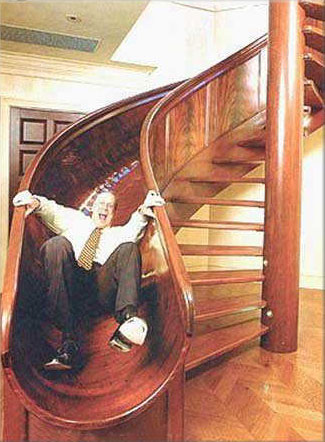
4. slide staircase

designer: rodney miller @ wood innovations

multi-millionnaire scott jones decided to splash his cash on a spiral staircase-slide and instantly made a lot of people jealous. local craftsman rodney miller was called upon to create this 17 ft mahogany toy, a job which took a whopping 15 months to finish. the slide also includes fibre-optic lights which can change to 8 different colours.

5. internal log staircase

designer: dave stewart

thought to be the world’s only internal log staircase, this beauty has been carved from one giant 140 ton kauri log. the beast took a total of 500 man hours to carve and finish and can be found at ‘ancient kauri kingdom’ in new zealand.

6. retractable staircase

designer: aaron tang

industrial designer aaron tang created these futuristic retractable stairs using ’simple hinges and pistons’. they could be used where living space is limited or where access to a certain level of a building needs to be restricted.

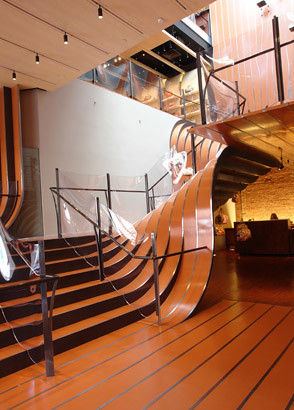
7. steel ribbon stairs

designer: thomas heatherwick

london-based designer thomas heatherwick created this amazing 55 ton steel staircase for the opening of the new longchamps store in new york last year and has since recieved praise from all angles. the construction of the staircase was apparently a logistical nightmare, each of the 17 seperate units having to be installed precisely, stretching up to the ceiling.

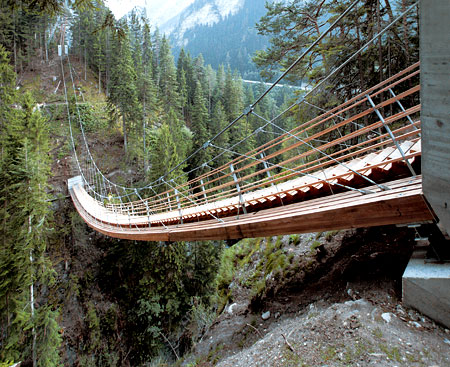
8. suspended stairs

designers: jürg conzett and rolf bachofner

it’s not often you see a stairway used to bridge a gorge. swiss designers jurg conzett and rolf bachofner decided this would be the best way to cross the traversinertobel in switzerland as the only safe opposing points were at different elevations, meaning a traditional bridge could cause a few problems. the incredible staircase-bridge measures 56 metres in length.

9. ‘impossible’ spiral staircase

designer: unknown

there are many mysteries surrounding the construction of the spiral staircase at loretto chapel and many believe the appearance of it to be a miracle. design-wise, the staircase is extremely impressive - there is no visible central beam to hold the staircase up and no nails have been used during its creation. however the central spiral is so narrow that it does indeed act as a support beam for the staircase.

LOTR Origami


can see more at LOTR Origami

Pheonix BIOS to run apps faster- bypass booting

Phoenix says its new technology, HyperSpace, will offer mobile PC users the ability to instantly fire up their most used apps -- things like e-mail, web browsers and various media players -- without using Windows, simply by pressing the F4 button.

"As Windows gets more and more complex, we've seen startup times get longer and longer," says Hobbs. "If I go to the airport and try to connect to a Wi-Fi network, I'm waiting for five minutes just to connect. That's ridiculous -- people usually just give up and use their cell phones or PDAs."

Phoenix Technologies is the company responsible for many computers' basic input/output system, or BIOS, the firmware code that runs when your PC starts up. Usually, the BIOS identifies the hardware on your PC and initializes components, then lets the operating system handle everything else, from storing files to connecting with networks to running applications. In essence, HyperSpace is a simple operating environment, a layer on top of the BIOS, that runs side-by-side with Windows and can efficiently implement some of the most commonly used apps on a PC.

Full story here

Moorea, French Polynesia


The new market portfolio- easily add some previously unavailable asset classes


Harvard and Yale have realized successfully that the actual market is much more than just the S&P 500. Utilizing hedge funds, private equity, managed timber, absolute return funds, commodities and derivatives they have allowed their school's endowment to fund nearly their entire budget with only 4-5% of the total endowment yearly.

Above is a list from Smart Money how you too can easily better diversify your portfolio to mirror this incredibly successful strategy. While some options are not available to the everyday investor and these institutions are non profits and therefore tax exempt, Chismillionare feels several of these plays should be in every portfolio- managed timber is particularly wise being an inflation hedge and a renewable resource!!!!
The old domestic, international, and emerging market equities combined with some fixed income and REITS are woefully inadequate to earn the true market return. This approach will also buffer market downturns better.

Link to the full story here

Chismillionare agrees! Bet on biofuels and not Ethanol

A new startup called KiOR has a promising strategy for producing biofuels.

Ethanol, by far the most common biofuel today, has a number of drawbacks. It can't be transported in pipelines designed for gasoline and diesel, and it contains far less energy than gasoline, resulting in significantly decreased mileage.

A number of companies seem to be taking note, investing in the development of fuels that contain more energy than ethanol and that can use existing pipelines, making them much easier to distribute in large quantities. BP is interested in another alcohol, butanol. (See "BP's Bet on Butanol.") Other companies are developing organisms that can convert sugars into synthetic hydrocarbons. (See "Building Better Biofuels" and "Making Gasoline from Bacteria.")

Today's announcement highlights the latest effort in this direction. KiOR, which is being funded by Khosla Ventures, will make biocrude that can be refined at existing oil refineries. The startup will focus on producing biofuels from cellulosic sources, which are attractive because they are cheap, can be used to produce much more fuel per acre than corn grain can, and have less impact on the environment

Crops That Shut Down Pests' Genes

Monsanto is developing genetically modified plants that use RNA interference to kill the insects that eat them.

Researchers have created plants that kill insects by disrupting their gene expression. The crops, which initiate a gene-silencing response called RNA interference, are a step beyond existing genetically modified crops that produce toxic proteins. Because the new crops target particular genes in particular insects, some researchers suggest that they will be safer and less likely to have unintended effects than other genetically modified plants. Others warn that it is too early to make such predictions and that the plants should be carefully tested to ensure that they do not pose environmental problems. But most researchers agree that it's unlikely that eating these plants would have adverse effects on humans.

RNA interference occurs naturally in animals ranging from worms to humans. It's a process whereby double-stranded RNA copies of specific genes prevent cells from translating those genes into proteins. The new genetically modified plants carry genes for double-stranded RNA targeted to particular insect genes. Two papers published concurrently in Nature Biotechnology this week show that in some insects, eating double-stranded RNA is enough to cause gene silencing. This is surprising: in previous research, RNA interfered with organisms' gene expression only when it was injected.

Google Android mobile phone OS

There's no Gphone just yet, but Google does want a big piece of your cell phone. In November 2007, the company announced its Android mobile operating system, and 34 companies are on board to develop applications for the cell-phone platform as part of the Open Handset Alliance. The open software platform is hoped to go head-to-head with smartphone software from RIM, Apple, Microsoft, Nokia, and Palm.

Google's open-source mobile platform: the best of the blog chatter

Now use the Blackberry Curve as GPS!

AT&T 8310 adds GPS to already great package. T-Mobile's curve still better by offering WiFi

The good: The RIM BlackBerry Curve 8310 adds GPS capabilities to the already impressive and sleek messaging smartphone. You also get a 2-megapixel camera, Bluetooth, and good call quality.

The bad: The Curve 8310 doesn't offer Wi-Fi or 3G support. The Web browser isn't the sleekest, and the camera lacks video-recording capabilities. Also, unlike the T-Mobile version, you only get the proprietary BlackBerry Messenger IM client.

The bottom line: Still offering an attractive design and excellent messaging capabilities, the addition of GPS makes the RIM BlackBerry Curve 8310 an even more attractive choice for road warriors.

Monday, November 5, 2007

Twin girl with eight limbs to have surgery

By Sam Relph and Peter Foster in New Delhi

Last Updated: 5:52pm GMT 05/11/2007

<

An Indian girl born with four arms and four legs is to undergo a 40-hour operation tomorrow as doctors try to give her a chance at a normal life.

  • How the operation will work
  • Peter Foster: Light in the darkness | Doublespeak | Naked at Heathrow
  • Lakshmi Tatma is a two-year-old girl named after the Hindu goddess of wealth who has four arms. She was believed to have been "sent from God" when she was born to a poor rural family in the Indian state of Bihar.


    Two-year-old Lakshmi Tatma plays with her
    mother, Poonam, as she waits for her operation

    As news of her birth spread among the 500 inhabitants of Rampur Kodar Katti — a remote settlement without electricity or running water — men, women and children queued for a darshan, or blessing, from the baby.

    However, it will require the latest techniques in medical science to separate Lakshmi from her "parasitical", headless, undeveloped "twin", which is joined to her body at the pelvis.

    The £100,000 operation will require differently skilled teams of more than 30 surgeons to work in eight-hour shifts to separate Lakshmi's spinal column and kidney from that of her twin.

    After attempting to transplant the shared kidney wholly into Lakshmi's body, another team of surgeons will gradually close up her pelvic girdle while re-orientating her bladder and genital systems. Plastic surgeons will then graft skin to cover her wounds while an "external fixator" will be attached to close her pelvis gradually over a three-week period.

    advertisement

    The procedure has been described as "like shutting an open book".

    Without the operation at the Narayana Health City, on the outskirts of Bangalore, Lakshmi's parents were told their daughter was unlikely to survive beyond early adolescence.

    After more than two months of preparation, Dr Sharan Patil, the consultant orthopaedic surgeon leading the operation, said that her team was reasonably confident that the procedure would succeed in helping Lakshmi to survive.

    "Fortunately, Lakshmi has one complete body with a near perfect set of internal organs," she said.

    "Her skeletal system involves two bodies which are fused together at the level of the pelvis.

    "The operation itself, although it presents several challenges, is not the most complex in the world. What is highly unusual in Lakshmi's case is precisely how her bodies are fused, almost mirroring each other."


    An x-ray photograph of Lakshmi Tatma
    An X-ray picture shows how the two
    bodies are joined at the pelvis

    Her mother, Poonam, and father, Shambu Tatma, who earn about 50p a day as casual labourers and are both in their twenties, were turned away by a government hospital when they asked for help to increase Lakshmi's chances of survival.

    However, they were brought to Bangalore after Dr Patil visited their village.

    "We tried to take Lakshmi to hospital but they turned us away and said nothing could be done," Mrs Tatma said yesterday. "We saved money and even went to Delhi but the hospitals there turned us away too. Lakshmi had never once seen a doctor until Dr Patil came to our village and took an interest in our case.

    "I believe that Lakshmi is a miracle, a reincarnation, but she is my daughter and she cannot live a normal life like this."

    Australian town to run on solar power in 2 years

    Sun Nov 4, 2007 3:44am EST

    SYDNEY (Reuters) - A sun-drenched town in Australia's north hopes to use only solar power in two years after being chosen as the site for a solar thermal power station.

    Remote Cloncurry, which boasts recording Australia's hottest day, would be able to generate electricity on rarecloudy days and at night from the station, which runs off heat stored in graphite blocks.

    The Queensland state government said on Sunday it would build the A$7 million ($6.5 million), 10-megawatt power station as part of a push to make Cloncurry one of the first towns to rely on solar power alone.

    "The town of Cloncurry has long claimed the title of having recorded Australia's hottest day -- 53 degrees (Celsius) in the shade in 1889, so I reckon we're on a winner," Queensland
    Premier Anna Bligh was quoted as saying by Australian Associated Press.

    Solar thermal power differs from photovoltaic panels that make power directly.

    Instead, 8,000 mirrors will reflect sunlight onto graphite blocks. Water will be pumped through the blocks to generate steam which generates electricity via turbines.

    Heat stored in the graphite produces steam well after the sun goes down, allowing electricity generators to keep running at night.

    The Queensland government said the station would deliver about 30 million kilowatt hours of electricity a year, enough to power the entire town. It is expected to be running by early
    2010.

    Australia and the United States have refused to ratify the Kyoto Protocol, which sets binding targets for carbon pollution by developed countries.

    Australian Prime Minister John Howard says any global agreement must include big developing nations such as China and India, whose burgeoning economies have led to rapid growth in
    carbon dioxide emissions, which are blamed for global warming.

    Australia's greenhouse gas emissions are among the world's highest per-capita and the government prefers to focus on energy efficiency and technology to limit carbon emissions.

    8 Locks Picked In Under 80 Seconds Lockpicking High Security


    8 Locks Picked In Under 80 Seconds Lockpicking High Security - Funny bloopers are a click away

    Star wars University

    http://abcnews.go.com/Video/playerIndex?id=3802220

    Sea Urchin at 1000 ft below the sea

    Unique Results from Swedish Study of HIV vaccine

    A Swedish HIV vaccine study conducted by researchers at Karolinska Institutet (KI), Karolinska University Hospital and the Swedish Institute for Infectious Disease Control (SMI) has produced surprisingly good results. Over 90 per cent of the subjects in the phase 1 trials developed an immune response to HIV.

    "Never has such a good result been seen with a vaccine of this type," says Professor Eric Sandström, Chief Physician at Karolinska University Hospital.

    A vaccine developed by SMI scientists has now undergone the first clinical study on healthy individuals in Sweden in order to examine its safety and different methods of administration. The vaccine is what is known as a genetic vaccine, which uses parts of the virus DNA to stimulate the rapid endogenous production of the proteins for which the injected DNA codes.

    The trial subjects were vaccinated on three occasions with this vaccine using a needle-free method of injection. In order to enhance the effect, the researchers also gave the subjects a fourth dose of a vaccine in which parts of the HIV virus DNA had been integrated into another virus (vaccinia = the cowpox virus). This vaccine-based HIV vaccine is produced by the USA's National Institutes of Health and was donated for use in this Swedish study

    "Our vaccine is designed in such a way that it's able to protect against many of the circulating HIV types in Africa and the West," says Professor Britta Wahren at the SMI/KI.

    Over 90 per cent of the trial subjects developed an immune response to HIV, and the vaccines have been tolerated well.

    Scientists now hope to follow up the Swedish study with a larger phase 1  phase 2 study in Tanzania, planned to commence this autumn, in order to corroborate the Swedish results on African subjects and to help train Tanzanians to carry out parts of the study, including sophisticated laboratory examinations, on site.

    For further information, please contact:


    Gunnel Biberfeld, Professor of Immunology, SMI and KI. Phone: +46-8-457 26 60, +46-73-346 26 60. E-mail: gunnel.biberfeld@smi.ki.se

    Eric Sandström, Professor of Dermatovenerology, Chief Physician at Karolinska University Hospital. Phone: +46-8-616 25 71, +46-70-484 60 37. E-mail: eric.sandstrom@karolinska.se

    Britta Wahren, Professor of Virology, SMI and KI. Phone:+46-8-457 26 30, +46-70-674 15 27. E-mail: britta.wahren@smi.ki.se

    Creative Director for Pocket Burgers Inc.