Zazzle Shop

Screen printing

Wednesday, October 22, 2008

Is an Apple Netbook on the Horizon

In a question-and-answer session held during Apple's quarterly earnings call Tuesday, Steve Jobs reminded investors that Apple was not ready to enter the netbook market because it's a "nascent category." However, he hinted that the company is certainly thinking about it.

"We'll wait and see how that nascent category evolves, and we've got some pretty interesting ideas if it does," Jobs said.

He added that to the company's knowledge, netbooks aren't selling all that well. However, recent reports strongly disagree.

Netbooks -- low-powered, inexpensive mini notebooks made primarily for internet use -- are soaring in popularity. ABI Research forecasts that manufacturers will ship 200 million ultra-mobile devices, including netbooks by 2013 -- which is about the same anticipated size as the entire laptop market worldwide.

Also, IDC Research recently said the rise of netbooks "coincided perfectly with market conditions." In its report, IDC noted that Acer is now the third largest computer manufacturer in terms of market share because of its netbook offerings.

To Apple's credit, new MacBooks and MacBook Pros currently crowd several of the top spots on Amazon's list of 25 best-selling notebooks. However, all the other devices on that list are netbooks, and the $400 Acer Aspire netbook sits at number one.

Also, before Apple announced new MacBooks on Oct. 14, netbooks claimed nine out the top 10 spots on Amazon's list of best sellers for several weeks.

Jobs said in the mean time, the iPhone is a solution, since it fits into the category of a pared-down, internet-enabled device. However, many would likely disagree since the handset lacks a physical keyboard and its screen size is only 3.5 inches, while netbook displays are typically 8 to 10 inches.

Nonetheless, Jobs only said Apple isn't ready to step into the netbook category; he implies the company has already thought about what its netbook would be.

Meanwhile, Macworld Expo, where Jobs typically launches brand new products, is coming January. It's unlikely the company will unveil a netbook so soon after Jobs said he wasn't ready for one.

But even if Apple were releasing one, Jobs probably wouldn't call it a netbook anyway, right?

Then again, if you can't wait any longer for Apple, you can always hack a netbook to run Mac OS X.

MacBook, MacBook Pro Reviewed

Macbook_013

MacBook and MacBook Pro

By Mark McClusky

Let’s start under the hood of the newly-redesigned Apple notebook line, and work our way out. Of course, with all the emphasis Apple placed on the new design and construction techniques for these machines, that might seem like attacking the issue backward, but it’s really the performance, rather than the aesthetics that stand out for us. Here's the hard proof as evidenced in our Xbench scores:

Xbenchmacbooks

(** denotes the Pro running the NVIDIA 9400 M. * denotes the Pro running the NVIDIA 9600 M GT graphics card.)

That's no typo. Our Black MacBook (2.2GHz Core 2 Duo, 2GB RAM) got an Xbench of 68.03 with a battery rundown of 2:52. On the other hand, our new Aluminum MacBook (2.4GHz Core 2 Duo, 2GB RAM) scored an Xbench of 116.70 with a battery rundown of 3:01.

Macbook_106 We know, we know ... Xbench is a synthetic benchmark, which doesn’t necessarily reflect the way that people interact with their machine on a day to day basis. But that’s a pretty shocking improvement in the performance numbers, and in our use of the new MacBook, it’s noticeable across the board. This machine, in comparison to the very capable Black Book, just screams.

On the Pro, we haven’t had time to do battery rundown tests yet. But you can see, the new Pro machine is faster, in Xbench at least. In fact, the old ATI graphics card was much faster in Open GL render than either of the new Nvidia cards in the new Pro. It’s also important to note that in the operating system, there’s currently no way to run the video cards in tandem — you have to choose one or the other, and in fact, you have to log out to in order to switch them.

So that’s the short performance story: MacBook Pro gets a little quicker, while the MacBook gets way, way faster. You might notice that the new MacBook outperformed the old Pro in Xbench, and that meshes with our experience. Apple’s produced a consumer notebook that speeds past what was the top of the line just a year ago.

Oh, and by the way, they totally redesigned and re-engineered the machines.

It’s hard to evaluate aesthetics — a jaw dropping beauty to one person is an eye crunching catastrophe to another — but to my peepers, the new Mac laptops are some of the most handsome the company has ever released. I’m a sucker for the black bezel around the screens, and for the glass all the way to the edge of the display. (One bonus is that the laptops and the iMac, as well as Apple’s new Cinema Display, all share the same black and aluminum look. Jony Ive must be doing the dance of joy).

Macbook_033 There are a couple of other changes of note — the battery compartment has been reconfigured. Now you pop off a door that allows access to both the battery and also the hard drive. This is the easiest Mac to hack ever; I’m looking forward to throwing an SSD into the MacBook to see how it runs. Cleverly, the battery life indicator has been moved to the side of the machines, so that you might actually use it.

All the ports live on the left side of the machines, and here we come to one of the downsides of these machines: the death of Firewire 400. The Pro has a Firewire 800 port that can be used with FW 400 with a (non-included) adapter. But the poor MacBook has no Firewire at all, just two USB 2.0 ports.

Now I’m no apologist for Firewire, but this just seems a little shortsighted to me, especially when it comes to the video market. There’s still a metric kiloton of FW gear out there, including cams and hard drive, that people rely on. To take that option away seems like a bad idea.

Of course, this is the sort of thing that Apple does all the time. When they stripped the floppy drive out of the first iMac, people howled in protest (really, there were pitchforks and torches). Down in Cupertino, they’re happy to remove legacy devices a little bit too early rather than a little too late. The downside is a bunch of FW stuff that you can’t use any more. The upside is that you avoid the sort of thing you see on PC laptops, where you can still find a freaking serial port from time to time.

The case design relies on a solid billet of aluminum that’s milled to form the top shell of the computer, as well as providing its structure. Again, the change is most pronounced in the MacBook, which goes from a little bit flimsy to rock-solid while slicing a half a pound. The Pro is lovely as well, but actually gets a little bit wider and taller to accommodate the screen. The new trackpad — which has been turned into one enormous button — felt so natural, we didn't remotely miss the recently jettisoned separate click key.

This isn’t the sort of redesign that makes your jaw drop, although it might be unreasonable to think that Apple has to reach that standard every time they launch a revision. That’s a measure of how inflated our expectations have become. But the Apple notebook line is just miles ahead, and these two machines — especially the MacBook — only put them further out in front.

MacBook

$1600 as tested, apple.com

9 out of 10

MacBook Pro

$2500 as tested, apple.com

8out of 10

The Alt Fuel Race Cars of 2025

Mitsubishi_08_l

Never ones to turn down a chance to sing about vehicles, we can't help but take a little inspiration from Zager and Evans: "In the year 2025, if man is still alive, if race cars can survive, what will we find?" The Los Angeles Auto Show Design Challenge provides a glimpse, and it's freaking rad.

The annual contest allows the auto industry's most creative minds to exercise their genius without concern for bean counters or engineers. This year saw them designing alternative-fuel race cars of the distant future, which in this case refers to that far off time 17 years from now when the world's oil reserves are depleted, electric cars glide on the crumbled remains of our roads and all of Angelina Jolie's children are old enough to drive.

As is so often the case when designers let their imaginations run wild, the cars they've come up with are as unlikley as they are futuristic. But that doesn't make them any less impressive. Check 'em out and vote for your favorite.

Audi_03_l

Audi R25 Audi Design Center California

Built for the inaugural Los Angeles round of the American Le Mans Series 2025, Audi's electric R25 looks like the latest offering from Schick and hopes to cut curves just as closely. Like Hot Wheels' G-Force, it races upside down. Like socks on a wool carpet, it charges from wireless electricity. Ouch.

Bmw_07_l

BMW Hydrogen Powered Salt Flat Racer BMW Group DesignworksUSA

We'll admit this one is our favorite. A Rauschenberg-like combine of found objects, BMW has built a hydrogen car out of (ironically enough) oil barrels and other reused items. We don't know how the ASPCA or PETA will feel about the addition of the goldfish at the tailpipe to check emissions, but any car that evokes the belly tank lakesters of the '50s and '60s is OK in our book.

Gm_05_l_2

GM Chaparral Volt General Motors Advanced Design, California

Let's groove tonight. GM says this concept is meant to evoke the elements of Earth, Wind and Fire. While the tail fin is vaguely reminiscent of Phillip Bailey's hairdo, GM is talking about momentum capture regeneration, turbine extractors and PV panels. It's also betting it survives long enough to see 2025, a bet not all would take.

Honda_07_l

Honda The Great Race 2025 Honda Research and Development

Honda is such a showoff. Sure, it's an expert in marine, automotive, robotic and jet technologies — but do they have to combine them all in one vehicle? Let's hope this Great Race ends up with a pie fight as cool as the old Blake Edwards movie and Honda's Great Race team fares better than its F1 team.

Mazda_02_l_2

Mazda KAAN Mazda Research and Development

If all goes according to Mazda's plan, the E1 electric race series will suffer the Wrath of KAAN. Of course, that's depends on California resurfacing roads with a "sub-level electro-conductive polymer that powers the electric cars of the modern world." Come 2025, California will be lucky to fill in potholes on the 405. KAAN looks like one of those back massagers you can buy at a kiosk in the mall, but it's still prettier than the new Miata.

Mitsubishi_04_l1

Mitsubishi Motors MMR25 Mitsubishi Research and Design of North America

Mitsubishi brings an "8x4" to the table, with active aerodynamics to maximize handling and omnidirectional wheels that keep the car moving forward regardless of where it's pointed. We fear it'll as much an exercise in futility as piloting the four-wheel-steering shopping carts at Ikea

Mercedesbenz_02_l

Mercedes Formula Zero Racer Mercedes-Benz Advanced Design of North America

The economic downturn of 17 years previous didn't affect the wealthy gentlemen racers buying Formula Zero racers. The "luxury racer" combines "the thrill of Formula One, the track dynamics of the bobsled or luge, and the grace and efficiency of yacht racing," Mercedes says. Sadly, it also incorporates the look of a rollerskate.

Toyota_03_l

Toyota LeMans Racer Calty Design Research, Inc.

With a nose like Barbara Streisand, this shape-shifting, hydrogen-burning Toyota gets narrower while accelerating to 350 mph on a long straightaway. It's got a robotic co-pilot, a virtual reality guidance system (huh?) and photovoltaic cells so it doesn't need refueling during the 24 hours of LeMans. Except at night.

Volkswagen_04_l

Volkswagen Bio Runner Volkswagen/Audi Design Center California

The Legolicious BioRunner eschews a steering wheel in favor of direct electrical connections to the driver's hands and feet. Proving they live in Los Angeles, VW's designers include an "arial reconnaissance drone" — what the rest of us might call a helicopter — that provides the driver a live video feed of the car's every move. We suspect that VW will recruit former COPS "stars" to pilot the biofuel-burning car, as they always seem to perform amazing vehicular feats when the copter is following them.

Images courtesy of Design Los Angeles. See many, many more here.

The Flaw at the Heart of the Internet


Seeing Trouble: Security researcher Dan Kaminsky first spotted a basic vulnerability in the Internet last winter.
Credit: John Keatley
Multimedia
photo View an outline of a cache-poisoning attack.

Dan Kaminsky, uncharacteristically, was not looking for bugs earlier this year when he happened upon a flaw at the core of the Internet. The security researcher was using his knowledge of Internet infrastructure to come up with a better way to stream videos to users. Kaminsky's expertise is in the Internet's domain name system (DNS), the protocol responsible for matching websites' URLs with the numeric addresses of the servers that host them. The same content can be hosted by multiple servers with several addresses, and Kaminsky thought he had a great trick for directing users to the servers best able to handle their requests at any given moment.

Normally, DNS is reliable but not nimble. When a computer--say, a server that helps direct traffic across Comcast's network--requests the numerical address associated with a given URL, it stores the answer for a period of time known as "time to live," which can be anywhere from seconds to days. This helps to reduce the number of requests the server makes. Kaminsky's idea was to bypass the time to live, allowing the server to get a fresh answer every time it wanted to know a site's address. Consequently, traffic on Comcast's network would be sent to the optimal address at every moment, rather than to whatever address had already been stored. Kaminsky was sure that the strategy could significantly speed up content distribution.

It was only later, after talking casually about the idea with a friend, that Kaminsky realized his "trick" could completely break the security of the domain name system and, therefore, of the Internet itself. The time to live, it turns out, was at the core of DNS security; being able to bypass it allowed for a wide variety of attacks. Kaminsky wrote a little code to make sure the situation was as bad as he thought it was. "Once I saw it work, my stomach dropped," he says. "I thought, 'What the heck am I going to do about this? This affects everything.'"

Kaminsky's technique could be used to direct Web surfers to any Web page an attacker chose. The most obvious use is to send people to phishing sites (websites designed to trick people into entering banking passwords and other personal information, allowing an attacker to steal their identities) or other fake versions of Web pages. But the danger is even worse: protocols such as those used to deliver e-mail or for secure communications over the Internet ultimately rely on DNS. A creative attacker could use Kaminsky's technique to intercept sensitive e-mail, or to create forged versions of the certificates that ensure secure transactions between users and banking websites. "Every day I find another domino," ­Kaminsky says. "Another thing falls over if DNS is bad. ... I mean, literally, you look around and see anything that's using a network--anything that's using a network--and it's probably using DNS."

Kaminsky called Paul Vixie, president of the Internet Systems Consortium, a nonprofit corporation that supports several aspects of Internet infrastructure, including the software most commonly used in the domain name system. "Usually, if somebody wants to report a problem, you expect that it's going to take a fair amount of time for them to explain it--maybe a whiteboard, maybe a Word document or two," Vixie says. "In this case, it took 20 seconds for him to explain the problem, and another 20 seconds for him to answer my objections. After that, I said, 'Dan, I am speaking to you over an unsecure cell phone. Please do not ever say to anyone what you just said to me over an unsecure cell phone again.'"

Perhaps most frightening was that because the vulnerability was not located in any particular hardware or software but in the design of the DNS protocol itself, it wasn't clear how to fix it. In secret, Kaminsky and Vixie gathered together some of the top DNS experts in the world: people from the U.S. government and high-level engineers from the major manufacturers of DNS software and hardware--companies that include Cisco and Microsoft. They arranged a meeting in March at Microsoft's campus in Redmond, WA. The arrangements were so secretive and rushed, Kaminsky says, that "there were people on jets to Microsoft who didn't even know what the bug was."

Once in Redmond, the group tried to determine the extent of the flaw and sort out a possible fix. They settled on a stopgap measure that fixed most problems, would be relatively easy to deploy, and would mask the exact nature of the flaw. Because attackers commonly identify security holes by reverse-engineering patches intended to fix them, the group decided that all its members had to release the patch simultaneously (the release date would turn out to be July 8). ­Kaminsky also asked security researchers not to publicly speculate on the details of the flaw for 30 days after the release of the patch, in an attempt to give companies enough time to secure their servers.

On August 6, at the Black Hat conference, the annual gathering of the world's Internet security experts, Kaminsky would publicly reveal what the flaw was and how it could be exploited.

Asking for Trouble
Kaminsky has not really discovered a new attack. Instead, he has found an ingenious way to breathe life into a very old one. Indeed, the basic flaw targeted by his attack predates the Internet itself.

The foundation of DNS was laid in 1983 by Paul ­Mockapetris, then at the University of Southern California, in the days of ­ARPAnet, the U.S. Defense Department research project that linked computers at a small number of universities and research institutions and ultimately led to the Internet. The system is designed to work like a telephone company's 411 service: given a name, it looks up the numbers that will lead to the bearer of that name. DNS became necessary as ARPAnet grew beyond an individual's ability to keep track of the numerical addresses in the network. Mockapetris, who is now chairman and chief scientist of Nominum, a provider of infrastructure software based in Redwood, CA, designed DNS as a hierarchy. When someone types the URL for a Web page into a browser or clicks on a hyperlink, a request goes to a name server maintained by the user's Internet service provider (ISP). The ISP's server stores the numerical addresses of URLs it handles frequently--at least, until their time to live expires. But if it can't find an address, it queries one of the 13 DNS root servers, which directs the request to a name server responsible for one of the top-level domains, such as .com or .edu. That server forwards the request to a server specific to a single domain name, such as google.com or mit.edu. The forwarding continues through servers with ever more specific responsibilities--mail.google.com, or libraries.mit.edu--until the request reaches a server that can either give the numerical address requested or respond that no such address exists. As the Internet matured, it became clear that DNS was not secure enough. The process of passing a request from one server to the next gives attackers many opportunities to intervene with false responses, and the system had no safeguards to ensure that the name server answering a request was trustworthy. As early as 1989, Mockapetris says, there were instances of "cache poisoning," in which a name server was tricked into storing false information about the numerical address associated with a website.

In the 1990s, the poisoner's job was relatively easy. The lower-level name servers are generally maintained by private entities: Amazon, for instance, controls the addresses supplied by the amazon.com name server. If a low-level name server can't find a requested address, it will either refer the requester to another name server or tell the requester the page doesn't exist. But in the '90s, the low-level server could also furnish the requester with the top-level server's address. To poison a cache, an attacker simply had to falsify that information. If an attacker tricked, say, an ISP's name server into storing the wrong address for the .com server, it could hijack most of the traffic traveling over the ISP's network. Mockapetris says several features were subsequently added to DNS to protect the system. Requesting servers stopped accepting higher-level numerical addresses from lower-level name servers. But attackers found a way around that restriction. As before, they would refer a requester back to, say, the .com server. But now the requester had to look up the .com server's address on its own. It would request the address, and the attacker would race to respond with a forged reply before the real reply arrived. Ad hoc security measures were added to protect against this strategy, too. Now, each request to a DNS server carries a randomly generated transaction ID, one of 65,000 possible numbers, which the reply must contain as well. An attacker racing to beat a legitimate reply would also have to guess the correct transaction ID. Unfortunately, a computer can generate so many false replies so quickly that if it has enough chances, it's bound to find the correct ID. So the time to live, originally meant to keep name servers from being overburdened by too many requests, became yet another stopgap security feature. Because the requesting server will store an answer for some period of time, the attacker gets only a few chances to attempt a forgery. Most of the time, when the server needs a .com address, it consults its cache rather than checking with the .com server. Kaminsky found a way to bypass these ad hoc security features--most important, the time to live. That made the system just as vulnerable as it was when cache poisoning was first discovered. Using Kaminsky's technique, an attacker gets a nearly infinite number of chances to supply a forgery. Say an attacker wants to hijack all the e-mail that a social-­networking site like Facebook or MySpace sends to Gmail accounts. He signs up for an account with the social network, and when he's prompted for an e-mail address, he supplies one that points to a domain he controls. He begins to log on to the social network but claims to have forgotten his password. When the system tries to send a new password, it does a DNS lookup that leads to the attacker's domain. But the attacker's server claims that the requested address is invalid. At this point, the attacker could refer the requester to the google.com name servers and race to supply a forged response. But then he would get only one shot at cracking the transaction ID. So instead, he refers the requester to the nonexistent domains 1.google.com, then 2.google.com, then 3.google.com, and so on, sending a flood of phony responses for each. Each time, the requesting server will consult Google's name servers rather than its cache, since it won't have stored addresses for any of the phony URLs. The attack completely bypasses the limits set by the time to live. One of the attacker's forgeries is bound to get through. Then it's a simple matter to direct anything the requesting server intends for Google to the attacker's own servers, since the attacker appears to have authority for URLs ending in google.com. Kaminsky says he was able to pull off test attacks in as little as 10 seconds.

A Cache-Poisoning Attack
Cache poisoning causes a requesting server to store false information about the numerical address associated with a website. A basic version of the attack--without some of the more sophisticated techniques Kaminsky employs--is outlined below. 1. To begin, the attacker lures the victim's server into contacting a domain the attacker controls. The attacker could, say, claim to have forgotten a password, prompting the victim to respond by e-mail.
2. The victim performs a DNS lookup to find out where to send the e-mail. But the attacker's name server refers the victim to another server, such as that of example.com. Since the attacker knows that the victim will now start a DNS lookup for that server, he or she has an opportunity to attempt to poison its cache. 3. The attacker tries to supply a false response before the legitimate server can supply the real one. If the attacker guesses the right ID number, the victim accepts the guess reply, which poisons the cache.

In the Dark
On July 8, Kaminsky held the promised press conference, announcing the release of the patch and asking other researchers not to speculate on the flaw. The hardware and software vendors had settled on a patch that forces an attacker to guess a longer transaction ID. Kaminsky says that before the patch, the attacker had to make tens of thousands of attempts to successfully poison a cache. After the patch, it would have to make billions. News of the flaw appeared in the New York Times, on the BBC's website, and in nearly every technical publication. Systems administrators scrambled to get the patch worked into their systems before they could be attacked. But because Kaminsky failed to provide details of the flaw, some members of the security community were skeptical. Thomas Ptacek, a researcher at ­Matasano Security, posted on Twitter: "Saying it here first: doubting there's really any meat to this DNS security announcement." Dino Dai Zovi, a security researcher best known for finding ways to deliver malware to a fully patched Macbook Pro, says, "I was definitely skeptical of the nature of the vulnerability, especially because of the amount of hype and attention versus the low amount of details. Whenever I see something like that, I instantly put on my skeptic hat, because it looks a lot like someone with a vested interest rather than someone trying to get something fixed." Dai Zovi and others noted that the timing was perfect to promote Kaminsky's Black Hat appearance, and they bristled at the request to refrain from speculation. The lack of information was particularly controversial because system administrators are often responsible for evaluating patches and deciding whether to apply them, weighing the danger of the security flaw against the disruption that the patch will cause. Because DNS is central to the operation of any Internet-dependent organization, altering it isn't something that's done lightly. To make matters worse, this patch didn't work properly with certain types of corporate firewalls. Many IT professionals expressed frustration at the lack of detail, saying that they were unable to properly evaluate the patch when so much remained hidden. Concerned by the skepticism about his claims, Kaminsky held a conference call with Ptacek and Dai Zovi, hoping to make them see how dangerous the bug was. Both came out of the call converted. But although Dai Zovi notes that much has changed since the time when hardware and software manufacturers dealt with flaws by simply denying that security researchers had identified real problems, he also says, "We don't know what to do when the vulnerabilities are in really big systems like DNS." Researchers face a dilemma, he says: they need to explain flaws in order to convince others of their severity, but a vulnerability like the one ­Kaminsky found is so serious that revealing its details might endanger the public. Halvar Flake, a German security researcher, was one observer who thought that keeping quiet was the more harmful alternative.Public speculation is just what's needed, he says, to help people understand what could hit them. Flake read a few basic materials, including the German Wikipedia entry on DNS, and wrote a blog entry about what he thought Kaminsky might have found. Declaring that his guess was probably wrong, he invited other researchers to correct him. Somehow, amid the commotion his post caused in the security community, a detailed explanation of the flaw appeared on a site hosted by Ptacek's employer, Matasano Security. The explanation was quickly taken down, but not before it had proliferated across the Internet. Chaos ensued. Kaminsky posted on Twitter, "DNS bug is public. You need to patch, or switch to [Web-based] OpenDNS, RIGHT NOW." Within days, Metasploit, a computer security project that designs sample attacks to aid in testing, released two modules exploiting Kaminsky's flaw. Shortly after, one of the first attacks based on the DNS flaw was seen in the wild. It took over some of AT&T's servers in order to present a false Google home page, loaded with the attacker's own ads.
Out of Cookies
Thirty minutes before Kaminsky took the stage at Black Hat to reveal the details of the flaw at last, people started to flood the ballroom at Caesar's Palace in Las Vegas. The speaker preceding Kaminsky hastened to wrap things up. Seats ran out, and people sat cross-legged on every square inch of carpet. Kaminsky's grandmother, who was sitting in the front row, had baked 250 cookies for the event. There were nowhere near enough. Kaminsky walked up to the podium. "There's a lot of people out there," he said. "Holy crap." Kaminsky is tall, and his gestures are a little awkward. As of early August, he said, more than 120 million broadband customers had been protected, as Internet service providers applied patches. Seventy percent of Fortune 500 companies had patched their systems, and an additional 15 percent were working on it. However, he added, 30 to 40 percent of name servers on the Internet were still unpatched and vulnerable to his 10-second cache-poisoning attack. Onstage, he flipped between gleeful description of his discovery's dark possibilities and attempts to muster the seriousness appropriate to their gravity. He spoke for 75 minutes, growing visibly lighter as he unburdened himself of seven months' worth of secrets. As he ended his talk, the crowd swept close to him, and he was whisked off by reporter after reporter. Even those security experts who agreed that the vulnera­bility was serious were taken aback by Kaminsky's eager embrace of the media attention and his relentless effort to publicize the flaw. Later that day, Kaminsky received the Pwnie award for "most overhyped bug" from a group of security researchers. (The word "pwn," which rhymes with "own," is Internet slang for "dominate completely." Kaminsky's award is subtitled "The Pwnie for ­pwning the media.") Dai Zovi, presenting the award, tried to list the publications that had carried Kaminsky's story. He gave up, saying, "What weren't you in?""GQ!" someone shouted from the audience. Kaminsky took the stage and spat out two sentences: "Some people find bugs; some people get bugs fixed. I'm happy to be in the second category." Swinging the award--a golden toy pony--by its bright pink hair, he stalked down the long aisle of the ballroom and out the door. Who's in Charge?
Depending on your perspective, the way Kaminsky handled the DNS flaw and its patch was either dangerous grandstanding that needlessly called public attention to the Internet vulnerability or--as Kaminsky sees it--a "media hack" necessary to train a spotlight on the bug's dangers. Either way, the story points to the troubling absence of any process for identifying and fixing critical flaws in the Internet. Because the Internet is so decentralized, there simply isn't a specific person or organization in charge of solving its problems.And though Kaminsky's flaw is especially serious, experts say it's probably not the only one in the Internet's infrastructure. Many Internet protocols weren't designed for the uses they're put to today; many of its security features were tacked on and don't address underlying vulnera­bilities. "Long-term, architecturally, we have to stop assuming the network is as friendly as it is," Kaminsky says. "We're just addicted to moving sensitive information across the Internet insecurely. We can do better." Indeed, at another security conference just days after Kaminsky's presentation at Black Hat, a team of researchers gave a talk illustrating serious flaws in the Internet's routing border gateway protocol. Like Kaminsky, the researchers had found problems with the fundamental design of an Internet protocol. Like the DNS flaw, the problem could allow an attacker to get broad access to sensitive traffic sent over the Internet.
Many experts say that what happened with the DNS flaw represents the best-case scenario. Mischel Kwon, director of US-CERT, a division of the Department of Homeland Security that helped get out the word about the DNS bug, hopes the network of organizations that worked together in this case will do the same if other flaws emerge. Though there's no hierarchy of authority in the private sector, Kwon says, there are strong connections between companies and organizations with the power to deploy patches. She says she is confident that, considering the money and effort being poured into improving security on the Internet, outdated protocols will be brought up to date. But that confidence isn't grounded in a well-considered strategy. What if ­Kaminsky hadn't had extensive connections within the security community or, worse, hadn't been committed to fixing the flaw in the first place? What if he had been a true "black hat" bent on exploiting the vulnerability he'd discovered? What if his seemingly skillful manipulation of the media had backfired, and the details of the flaw had become known before the patch was in place? What's more, even given the good intentions of researchers like Kaminsky, fixing basic flaws in the Internet isn't easy. Experts agree that the DNS problem is no exception. Several proposals are on the table for solving it by means more reliable than a patch, mostly by reducing the trust a requesting server accords a name server. Proposals range from relatively simple fixes, such as including even more random information in the requests made to name servers, to moving the entire system over to a set of protocols that would let name servers sign their responses cryptographically. In the meantime, both Kaminsky and Vixie say attackers have started to make use of the DNS flaw, and they expect more trouble to come. Kaminsky notes that the flaw becomes particularly dangerous when exploited along with other vulnerabilities. One such combination, he says, would allow an attacker to take over the automatic updates that a software vendor sends its customers, replacing them with malware. Kaminsky says he's spent the last several months on the phone to companies that would be attractive targets for that kind of attack, such as certificate authorities, social networks, and Internet service providers, trying to convince them to patch as soon as possible. "The scary thing," Dai Zovi says, "is how fragile [the Internet] is. ... And what are we going to do about it? " Erica Naone is an Assistant Editor at Tech­nology Review.
Untangling Web Information with Twine


Tied together: Twine lets users create or join "twines" devoted to a particular topic in order to collect, share, and discuss information. But Twine’s semantic AI engine also helps users discover related information and people with similar interests.
Credit: Twine
Multimedia
video Watch TR’s reporter use Twine and discuss its features.

The next big stage in the evolution of the Internet, according to many experts and luminaries, will be the advent of the Semantic Web--that is, technologies that let computers process the meaning of Web pages instead of simply downloading or serving them up blindly. Microsoft's acquisition of the semantic search engine Powerset earlier this year shows faith in this vision. But thus far, little Semantic Web technology has been available to the general public. That's why many eyes will be on Twine, a Web organizer based on semantic technology that launches publicly today.

Developed by Radar Networks, based in San Francisco, Twine is part bookmarking tool, part social network, and part recommendation engine, helping users collect, manage, and share online information related to any area of interest. For the novice, it can be tricky figuring out exactly where to start. But for experienced users, Twine can be a powerful way to research a subject collaboratively or find people with common interests, with the usual features of a bookmarking site augmented by Twine's underlying semantic technology.

After creating an account, a user adds a Twine bookmarklet to her browser's bookmarks, then adds items to her Twine page by clicking the bookmarklet as she surfs the Web. Bookmarks, too, can easily be imported from a browser or from another Web bookmarking service.

Twine uses artificial intelligence--machine learning and natural language processing--to parse the contents of Web pages and extract key concepts, such as people, places, and organizations, from the pages that a user saves. The site then uses these concepts to link information and users. For example, creating a twine--a bundle of bookmarks related to a particular topic--devoted to a specialized technique in computer game design quickly led to the discovery of twines (created by other users) devoted to other areas of game design and to twines devoted to a popular game that uses the technique. It also led to other users interested in the subject. Twine is also meant to automatically generate tags, descriptions, and summaries of bookmarked Web pages. In the preview, or beta, version, this feature didn't always work properly, but Nova Spivack, CEO of Radar Networks, says that the functionality has been improved ahead of the public launch. Twines offer a hub for collecting, sharing, and discussing information. For example, users have created twines devoted to twentieth-century music, science and technology, philosophy, and cool things found around the Web.

On the surface, Twine looks a lot like many other social-networking applications: users make connections, share, and discuss information, and the artificial intelligence, machine learning, and natural language processing built into the website is not immediately obvious. "The Semantic Web is a technology that's useful. It's a means to an end, not an end in itself," says Spivack. "What we're doing with this release and going forward is, we're talking about what you can use Twine for, and the fact that it's powered by the Semantic Web is a detail for geeks."

But Jim Hendler, a professor of computer science at Rensselaer Polytechnic Institute and a member of Twine's advisory board, says that Semantic Web technologies can set Twine apart from other social-networking sites. This could be true, so long as users learn to take advantage of those technologies by paying attention to recommendations and following the threads that Twine offers them. Users could easily miss this, however, by simply throwing bookmarks into Twine without getting involved in public twines or connecting to other users.

It would be nice to be able to use Twine for a few more specialized purposes. For example, it seems ideal for finding events related to areas of interest--indie rock bands playing in Boston, for example. But the current interface deals awkwardly with dates. A Twine calendar, which categorizes events intelligently, would be a logical extension of the service. Spivack says that such a feature, as well as further developments, are on the way. As these arrive, and as the company adds more ways to classify data, the real value of the Semantic Web could well start to surface.

Reactors for the Middle East


Credit: United States Deptarment of Energy

Novel designs for nuclear reactors, being drawn up by researchers at MIT and a new research institute in the United Arab Emirates (UAE), could decrease the risk that nuclear fuel could be diverted for use in nuclear weapons.

When nuclear materials are in use inside a nuclear reactor, they're too hot to steal, says Youssef Shatilla, a professor at the Masdar Institute, in the UAE. The greatest danger comes when fuel is being manufactured, when enrichment facilities can be used to make weapons-grade materials, or when nuclear materials are in transit, during either delivery or waste removal. To lessen the first danger, the government of the UAE plans to lease its fuel from other countries rather than making its own fuel. As a result, it won't have the technology to enrich uranium for making nuclear weapons.

The MIT and Masdar researchers are working on the second problem. They're designing new reactors that would need to be refueled far less often than conventional ones--once every 15 to 30 years rather than every 5 years. This would decrease the frequency of deliveries and the chances that the materials could fall into the wrong hands. "If you look at how you can divert nuclear material so it can be used in a weapons program, it is when the nuclear fuel is outside of the reactor core, when it's relatively cool and people can manipulate it," Shatilla says. "Our strategy is to keep the fuel inside the core as long as we can." The new reactors would have the added benefit of producing at least one-third of the waste of existing plants.

The new designs are part of an effort by the UAE to convince the international community to approve its plans to build nuclear reactors to generate electricity. The UAE and other Middle Eastern countries want to build nuclear power plants as a way to meet fast-growing domestic electricity demand. This would let them export oil and gas rather than burning it to generate electricity. "You cannot stay on course burning your own precious resources to generate electricity," Shatilla says. "In 30 to 40 years, oil and gas will be very expensive commodities--too expensive to burn."

To decrease the frequency of refueling, the researchers at MIT and Masdar are investigating ways to get more energy out of a given amount of fuel. One way to do this, says Mujid Kazimi, a professor of nuclear engineering at MIT, is to increase the concentration of uranium-235, the isotope of uranium that undergoes fission to create the heat that drives nuclear power plants. Currently, nuclear fuels contain less than 5 percent uranium-235, but this can be enriched to about 20 percent without making the material suitable for use in weapons. However, increasing the enrichment level poses a couple of challenges. Manufacturing plants that make fuel pellets from enriched uranium will require new safety precautions, Kazimi says. What's more, the fuel will need to be modified to ensure that the reactions don't proceed too quickly. The presence of so much "fissionable material," Kazimi says, could lead to a relatively quick chain reaction that would use up fuel too quickly. By incorporating materials known as burnable poison that absorb neutrons emitted during fission to slow down the reactions, the fuel could slowly generate heat over 15 years or more, he says.

Another way to increase the amount of energy that can be extracted from nuclear fuel is to promote the creation of more fissionable material within the reactor itself. In ordinary nuclear power plants, some of the neutrons released during fission are absorbed by uranium-238, a material that does not undergo the process. When this happens, it triggers a series of reactions that produce other types of fissionable material that can generate heat in a nuclear reactor. Essentially, these reactions turn uranium-238 into fuel, allowing the plant to operate longer between refueling. Researchers have long known how to increase this fuel production within the reactor, even to the point that certain reactors can produce more fuel than they consume. But again, the danger is that creating too much new fuel could provide materials for nuclear weapons. So the researchers are investigating ways to increase fuel production, but not so much that it becomes a nuclear proliferation risk. The result would still be both more energy from a given amount of fuel and less waste.

Finally, Kazimi and Shatilla are designing the new plants to operate at higher temperatures than conventional reactors, thereby increasing the efficiency with which they convert heat energy into electricity. This would also make nuclear plants more useful as a source of heat for chemical reactions, such as hydrogen generation. Toward this end, the pair is investigating unconventional materials for coolants, such as molten salts, which are less corrosive at high temperatures than the water that is commonly used. The researchers are also studying the use of superheated steam, which involves boiling water to create steam, and then heating the steam to yet higher temperatures. The higher temperatures yielded will also require new materials in the core, such as a silicon carbide ceramic that Kazimi has been developing. This silicon carbide is made in the form of a mesh that can stretch without breaking as the reactor heats up and cools down.

Kazimi notes that the research project is still only one year old and that final designs could be several years away. Ultimately, Shatilla says, the goal is to produce designs in which "there is no possible pathway to divert nuclear material into a weapons track, and then at the same time produce nuclear power with the environment in mind." If the project is successful, he says, the designs could be useful in many more places than just the Middle East.

Otherwordly- Shoot your Pics in Infrared

Interesting Development: Using an infrared filter blocks visible light, yielding a trippy effect. Daniel Sun
Infrared photography, which blocks visible light and captures only the IR spectrum to produce strange, beautiful images like the one above, has been around for more than a century. But it’s become more popular recently, since now anyone with a point-and-shoot camera can easily take these unusual shots. Not all subjects are suitable—some objects reflect part of the infrared spectrum, making them appear white and almost ghostly, so you won’t want to shoot, say, candid family shots. When done right, however, IR can work wonders. Formal portraits, for example, gain a delicate touch. Because IR softens the image, your subject’s skin will be imbued with a smooth glow that effectively hides blemishes and wrinkles. Landscapes, too, take on an ethereal look.

Infrared light can cause color shifts and soft focus, so manufacturers today make digicams less IR-sensitive by installing an IR-blocking filter in front of the sensor. That need not stop you, though. There are a number of methods you can use to make infrared photos [launch them here]. No matter which one you choose, before long you’ll have a whole portfolio of haunting artistic shots.

Click here for a gallery of tips to get IR pics.

Skiing Double- Breakthrough Ski changes Shape depending upon Conditions

Tip to Tail: The ends of this ski hold expandable rubber inserts (bottom view in black, top in gray): Courtesy Atomic

The Atomic D2 Vario Cut is like two skis in one: It's straight and narrow for zooming downhill but expands to be wider at the tip and tail when you turn -- creating a curved ski that, like a sharply turned car wheel, carves through a tight arc.

The D2 gets its shape-shifting abilities from flexible rubber inserts that run down its center, eight inches in from either end. When a skier begins to turn, he slows down, putting extra pressure on the skis. This force stretches the rubber, increasing the width of the tip and tail by about one sixth of an inch (a hefty amount for a ski that's just 4.2 inches wide). With more of an hourglass shape, the ski naturally slides in a semicircle so that you can turn with less effort. As you straighten out of a turn, removing pressure, the ski contracts, its arch and surface area shrink, and it rockets straight to the bottom.

Get it: $1,660, atomicsnow.com

And check out three more extreme ski gadgets!

The Drug Pumper- Sub Dermal Drug Delivery

John Santini, 36, Microchips: caseymcnamara.com; digital imaging by Neil Duerden

When he was 12, John Santini's ankle swelled up to the size of a grapefruit. Several hospital visits later, he was diagnosed with lupus, a chronic disease marked by the immune system's attacks on healthy parts of the body. He learned he'd have to take medication indefinitely. But he has used his condition as inspiration, and has spent his life devising a completely new way to deliver drugs.

Santini is the co-founder and CEO of MicroCHIPS, a Massachusetts-based company that builds electronic devices that are implanted under the skin. These "chips" sense changes in body chemistry or deliver medications when needed; small wells pop open to release a drug or invite body fluid in to be analyzed and monitored. The chip is about the size of a dime, and it sits in the body in an Oreo-size pack with an antenna and simple electronics so that patients can trigger it with a small wireless remote.

Next year, the company will test its first glucose-monitoring chip for patients with diabetes in human clinical trials (it works well in animals). The chip, which monitors glucose levels continuously for a year, is much more precise than finger-sticks, so it minimizes risks for diabetic complications like blindness and kidney failure. Clinical tests for a chip that releases daily doses of an osteoporosis drug will also begin next year.

Santini envisions future chips that could look for the biological signatures of heart or kidney failure before they happen. Smaller biodegradable versions could also be injected, without the casing, straight into the body to release drugs or multiple vaccine doses over time. And although they're not yet ready to handle his lupus, he's just getting started.

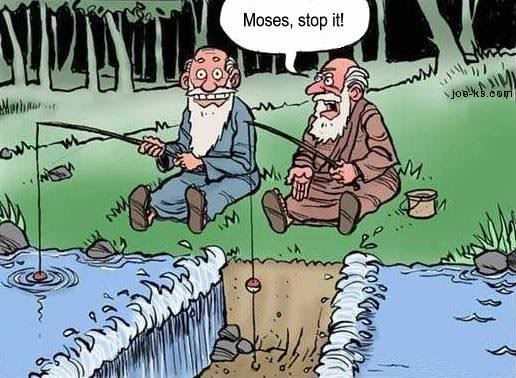
President Bush and Moses

Recently, while allegedly going through an airport during one of his many trips, President Bush encountered a man with long gray hair and beard, wearing a white robe and sandals, holding a staff. President Bush went up to the man and said, ‘Has anyone told you that you look like Moses?’

The man didn’t answer. He just kept staring straight ahead. The president said, ‘Moses!’ in a loud voice. The man just stared ahead, never acknowledging the president.

The president pulled a Secret Service agent aside and, pointing to the robed man, asked, ‘Am I crazy or does that man not look like Moses to you? The Secret Service agent looked at the man and agreed.

‘Well,’ said the president, ‘every time I say his name, he ignores me and stares straight ahead, refusing to speak. Watch!’ Again the president yelled, ‘Moses!’ and again the man ignored him. The Secret Service agent went up to the man in the white robe and whispered, ‘You look just like Moses. Are you Moses?’

The man leaned over and whispered back, ‘Shhhh! Yes, I am Moses. But the last time I talked to a bush, I spent 40 years wandering in the desert and ended up leading my people to the only spot in the entire Middle East with no oil.’

A Two Foot Insect!

Chan's Megastick: At 22-inches long, Chan's Megastick is about an arm's length. via Daily Mail

If earwigs, centipedes or spiders give you the creepy crawlies, quit while you're ahead. Otherwise, meet "Chan's megastick" (Phobaeticus chani). Recently named the world's longest living insect, the thin, bamboo-looking stick insect—best known for its camouflaging abilities to deter predators—was discovered in Southeast Asia's island of Borneo. Measuring approximately 22 inches long with its legs, or 14 inches just counting its body, megastick swiped away the title from its previous record holder of more than a century, Phobaeticus kirbyi—also a stick insect from Borneo—by almost an inch. Further, scientists in England have confirmed it is a new species of stick insect, adding to the 3,000 known species of the bug mainly found in the tropics and subtropics.

Although British scientists formally announced the new record holder last week, the dead, female stick insect was found in Borneo's rainforests by a local collector around 30 years ago. It was not until a decade later in 1989 that Malaysian naturalist, Datuk Chan Chew Lun, whom the insect is named after, saw the villager's collection and noticed the insect, also full of eggs, as a new species. Megastick was later passed on to scientists in England, where it now has a new home in the Natural History Museum in London.

Via PhysOrg

Wachovia Reports $24 Billion Dollar loss

NEW YORK (CNNMoney.com) -- Wachovia reported a massive loss of nearly $24 billion Wednesday, in what could have been the bank's last time reporting results before it becomes part of Wells Fargo.

The struggling Charlotte, N.C.-based bank, which agreed to be acquired by Wells Fargo earlier this month, reported a net loss of $23.9 billion, or $11.18 a share, which included a whopping $18.8 billion impairment charge partly related to the planned merger.

Not including the charge, Wachovia would have reported a loss of $4.76 billion, or $2.23 a share.

Just a year ago, the company reported a profit of $1.62 billion, or 85 cents a share.

Despite the recent turmoil in financial markets, analysts were actually expecting the company to report a profit during the quarter of $547 million, or 2 cents a share.

Wachovia (WB, Fortune 500) shares fell 3% in pre-market trading on the news.

Wells Fargo execs, including its chief executive officer John Stumpf, said Wachovia's results were about as dreary as they had expected after poring over the company's books and agreeing to buy the bank earlier this month.

"Wachovia's third-quarter results were very much in line with our expectations," Stumpf said in a statement.

(Big customers flee)

Like many of its peers this quarter, Wachovia was hit hard by issues of credit. Rising loan losses and efforts by the company to set aside more cash for bad loans weighed on its results.

During the quarter, the company said it set aside $6.6 billion for loan losses, as the economy showed increasing signs of weakness and as the housing market continued to deteriorate in already hard-hit parts of the country such as California and Florida.

Non-performing assets, or loans that are not collecting interest or principal payments, increased five-fold from a year earlier to just over 3% of all loans.

Assuming the company's anticipated merger with Wells Fargo (WFC, Fortune 500) comes off without a hitch, Wachovia's latest quarterly numbers will prove largely moot.

Still, the results offer a glimpse into just how badly the company was faring when investors seemed all but certain that Wachovia was destined to collapse.

Fears about Wachovia's ultimate demise first took hold in mid-September following the collapse of Lehman Brothers and shortly after Lehman rival Merrill Lynch was forced into the arms of Bank of America (BAC, Fortune 500).

Speculation continued to swirl about the 129-year-old bank in the days that followed, including rumors of a possible merger with with investment bank Morgan Stanley (MS, Fortune 500).

After the collapse of savings and loan Washington Mutual, regulators finally interceded on Wachovia's behalf, helping broker a $2.2 billion purchase of Wachovia's banking assets by Citigroup (C, Fortune 500).

Wachovia had a change of heart just days later, as it agreed to a sweetened offer from San Francisco-based Wells Fargo for all of Wachovia's operations.

After some legal wrangling, Citigroup eventually walked away, leaving Wells Fargo in control of Wachovia in a deal worth $11.7 billion.

Wachovia shareholders have yet to approve the deal, although they are widely expected to do so by year's end.

Like many of its peers, Wachovia bet big on the U.S. mortgage market, which prompted it to suffer painful losses earlier this year. Some analysts have blamed the company's ill-timed 2006 acquisition of the California mortgage lender Golden West Financial Corp. for the company's woes. To top of page

Oil falls below $70 on recession fears

LONDON (AP) -- Oil prices fell below $70 a barrel Wednesday as investors shrugged off a looming OPEC production cut after company forecasts suggested the U.S. may be headed for a severe economic slowdown that would crimp demand for crude.

Light, sweet crude for December delivery dropped $2.63 to $69.55 a barrel in electronic trading on the New York Mercantile Exchange by noon in Europe.

The November contract expired Tuesday and fell $3.36 to settle at $70.89. Last Thursday, that contract had declined as low as $68.57 a barrel, the lowest since June 2007.

Crude investors have followed equity markets this week, looking for signs on how the U.S. economy will weather the current global financial turmoil.

On Tuesday, DuPont (DD, Fortune 500), Sun Microsystems (JAVA, Fortune 500) and Texas Instruments (TXN, Fortune 500) reported disappointing earnings and bleak forecasts, sending the Dow Jones industrials average down 2.5%.

"Oil is now highly correlated with the stock market," said Clarence Chu, a trader with market maker Hudson Capital Energy in Singapore. "People are looking to the Dow for sentiment on the economy."

The Organization of Petroleum Exporting Countries, which accounts for about 40% of global oil supply, has signaled it plans to announce an output quota reduction at an emergency meeting Friday in Vienna.

But investors are skeptical about how much of the cut will be implemented, given the history of OPEC members exceeding their production quotas.

"There should be a short-term boost to prices when they announce a cut on Friday," Chu said. "But OPEC production has always been above their quotas, so there's a credibility problem."

Crude oil is down 53% from its peak of $147.27 reached in mid-July.

A stronger dollar this week has also pushed oil prices lower. Investors often buy commodities like crude oil as an inflation hedge when the dollar weakens and sell those investments when the greenback rises.

The euro fell below $1.28 for the first time in nearly two years on Wednesday. The 15-nation euro dipped as low as $1.2736 in morning trading before rising slightly to $1.2873, down from $1.3003 late Tuesday in New York.

Investors are also watching for signs of slowing U.S. demand in the weekly oil inventories report to be released Wednesday from the U.S. Energy Department's Energy Information Administration.

The petroleum supply report was expected to show that oil stocks rose 2.9 million barrels last week, according to the average of analysts' estimates in a survey by energy information provider Platts. The Platts survey also showed that analysts projected gasoline inventories rose 3.0 million barrels and distillates went up 600,000 barrels last week.

In other Nymex trading, heating oil futures fell 6.03 cents to $2.12 a gallon, while gasoline prices dropped 5.39 cents to $1.64 a gallon. Natural gas for November delivery jumped 1.0 cents to $6.85 per 1,000 cubic feet. To top of page

Mercedes SLR 722 GT Video

It was right around a year ago that the Mercedes McLaren SLR 722 GT was first shown to the public boasting a cost of approximately $2 million while not even being street legal. See, the 722 GT was a limited production run of race cars developed by RML, a U.K.-based motorsports shop, designed to run in its own series at various International venues. Essentially a spec racing series for the ultra-wealthy, there were concerns that that the 722 GT Trophy series would not be a hit, and owners of the cars would be left with track machines with nowhere to race.

Apparently, there was no need to worry. Recent video footage shows the series is still alive and well, and in this video race driver Bruno Senna finds himself behind the wheel of one of the series' cars. Of course, these are no ordinary SLR 722s. With 671 hp on tap from the supercharged AMG-developed 5.5L V-8 engine (along with over 400 modified components), these are serious machines. Click here to check the footage out for yourself. And turn up the volume - these cars sound amazing!

Source: YouTube

Insurance Companies refuse to Cover Driving Schools, Track Days

Insurance companies have long kept drivers uninsured if they raced their cars, but they are finally catching on to a loophole that many amateur racers had been able to take advantage of.

The wording that insurance companies had used to define racing was a timed event. This left track days and high-performance driving schools in the clear as far as the insured drivers were concerned. All this is changing now that insurance companies have realized how costly this loophole could be for them.

Jerry Kunzman, executive director of the National Auto Sport Association, says that participation at its track events have jumped five-fold since 2003. He also said many of the drivers attending are unaware that they are not covered at the events. "Maybe 25 or 30 percent have done the research," he remarked. "The middle third just assumes they are covered and the top third just don't have a clue."

Some insurance companies have experimented with coverage for racetracks but this idea was universally rejected when it was shown that the vast majority of claims were huge losses for the companies.

Source: New York Times

Viper Eligible for Employee Pricing


Here's some good news for Chrysler employees: you're now eligible to receive employee pricing on a 2009 Dodge Viper.

Years ago, it used to hold that new, high-performance, and flagship models weren't available for employees to purchase at a discount. That glass ceiling seems to be shattered, as current employees and retirees are now able to cash in what's left of their savings on a new SRT-10 coupe or roadster.

Seeing as we're not employed under the auspices of Mother Mopar, we don't have the exact employee pricing figures. Still, we're told that employee pricing typically shaves approximately seven- to nine-percent off a car's MSRP. Judging by our guestimates, that could shave approximately $6100 to $9000 from the $88,385 base price of an SRT-10 roadster.

The caveats? For starters, the car's still not cheap - eighty-eight grand is still a heck of a lot of money, and that's before we factor in gas guzzler tax ($2300), options, and the cost of pumping sixteen gallons of 93-octane fuel into the snake's belly.

Secondly, Chrysler employees pining for an ACR coupe can forget it - the track-tuned supersnake isn't applicable for the deal. Third, this isn't an "employee pricing for all" sales drive - these prices are available primarily to employees and retirees of the Pentastar - along with their "friends and family."

There is an exception however - the same release notes that employees of Wal-Mart are now eligible for the employee pricing plan. We may be cynical, but we're not expecting droves of Vipers parked at the house that Sam built anytime soon...

Source: The Scoop

Acura Confirms V8 Engine Development


It has been confirmed that Acura will be offering a V-8 engine option within 18 months. Acura dealer Mark McKellop remarked that having a flagship sedan with an eight cylinder engine is a necessity to elevate the brand.

Dealers say that having a vehicle that is offered with a V-8 is a must-have in order for Acura to compete against luxury brands like Mercedes-Benz and BMW. Those within Honda have long talked about making Acura a top-tier luxury brand, and at a dealers' meeting last April, Acura "put a stake in the ground" and made the shift official, says Jeff Conrad, vice-president of the Acura division at American Honda Motor Co.

A new large luxury sedan in the works at Acura set for release by 2011 or 2012 may be fitted with the V-8, but the 18 month commitment by the automaker suggests that we could see an Acura V-8 even sooner.

Some dealers have speculated that the next RL, which is due out in 2010, could be the recipient of the first V-8 engine. The current RL is sold model with a 300 hp, 3.7 liter V-6 engine - the most powerful engine ever offered in an Acura.

Source: Automotive News

Ferrari Lays Out Future Plans


Ferrari seems to be recession-proof as energy and economic problems loom. Cars sent to the United States are sold before they even arrive, and then appreciate wildly. Despite stable sales, the Italian automaker is looking to the future with a range of new offerings.


The new California, which debuted at the 2008 Paris motor show, the first offering designed to produce fewer emissions and return better fuel economy. Still, the two-seat, all-aluminum roadster will use a 460-hp 4.3-liter V-8, mated to Ferrari's seven-speed dual-clutch transmission.

Waiting in the wings is the replacement for the F430. The mid-engine car will be redesigned in the second half of 2009, and will feature a new aluminum chassis, a direct fuel injection, and a version of the California's seven-speed dual-clutch transmission.

The 599 GTB Fiorano is also being refreshed, and already carries a waiting list despite it won't appear earlier than 2011, when a new 612 Scaglietti will also debut. We also hear a limited-edition high-performance car is under consideration by the company. Should it progress, it will be patterned after the Millechili concept, which used lightweight materials and a rear-mounted V-12 engine.

Source: Automotive News

A 500hp Toyota Pickup Truck?


A 500 hp Totyota anything is amazing enough, but in a full size pickup? This is the Prius company right?? Well God Bless em I say! And for 40 grand - a gem.

When Homer Simpson was presented with a military-grade deep fryer that could flash-fry a buffalo in 40 seconds, he replied, "Forty seconds? But I want it now!" Even sad-sack Homer can teach us something, and this time it's that even if you overachieve beyond the wildest of expectations, universal acceptance can be elusive.

And so it is with the 2008 Toyota Tundra Supercharged by TRD. This one-off vehicle brings back the concept of the sport truck. Two parts supercar, one part pack mule, the sport truck tries to persuade us that the fortification of horsepower and cornering grip can make a silk purse out of what dynamically is a sow's rectum. So what you get is the best of both worlds, a silk purse that can haul a rainforest's worth of lumber and do burnouts 'til next Wednesday. If you're Homer Simpson, it's buffalo meat and an expedient browning.

Mother Toyota has yet to build a gloves-off sport truck in the vein of the defunct Dodge Ram SRT10 and Ford Lightning. Instead, Toyota Racing Development (TRD), Toyota's official in-house provider of performance accessories, has tackled the task and the result is the 2008 Toyota Tundra SR5 Supercharged by TRD that you see here.

Burnouts
Pencil-pushing naysayers will remind you that speed and trucks cannot coexist, since pickups boast the sleekness of a parking garage, not to mention a similar curb weight. Adding insane amounts of horsepower to the equation is the vehicular analogy of the irresistible force meeting the immovable object.

So TRD has smartly chosen the lightest Tundra possible in order to showcase its wares — a rear-wheel-drive regular cab with a short bed and none of the weight-adding frills of the higher-zoot Tundra Limited. Then it stuffed in a TRD-designed and -developed supercharger conversion. Based around the recently introduced four-lobe Eaton supercharger also found in the stonking Chevy Corvette ZR1, the system is a slick bolt-on affair that is 50-state legal.

Blowing 8.5 psi of boost pressure into the hungry cylinders ratchets horsepower from 381 to 504, while torque makes a similar leap from 401 pound-feet up to a towering 550 lb-ft. (TRD actually takes the trouble to have an outside supplier measure the results according to the SAE methodology.) These are numbers that are stout enough to contend with this Tundra's equally stout 5,182-pound curb weight. Fortunately, burnouts are immune to the effects of curb weight.

Actually designed for towing applications, the supercharger kit is available for all 2007-'09 Tundras and 2008-'09 Sequoias equipped with the 5.7-liter V8. This $5,875 kit is not simply a blower and belt, as the conversion includes everything — a liquid-to-air intercooler, revised intake, reflashed engine control unit, larger injectors and fuel pump. About 8-10 hours of installation are required, and when the work is completed by a Toyota dealer, the engine retains its Toyota factory-backed warranty. A performance dual exhaust adds $1,065.

Mass
This particular Tundra has been equipped with all the sport truck items from the TRD catalog, including lowering springs ($1,699), a beefy rear antiroll bar ($299) and colossal 22-inch wheels with 285/45R22 Toyo Proxes S/T rubber ($4,699 for the wheels and tires). It's all meant to reduce body roll and improve cornering grip, but let's be honest — a sport truck is a one-trick pony. And that trick is to signal the release of dead pterosaurs' pent-up frustration with clouds of acrid tire smoke.

At our test track, the 2008 Toyota Tundra dispatched 60 mph in 5.1 seconds (4.7 seconds with 1 foot of rollout like on a drag strip) and elbowed its way through the quarter-mile in 13.3 seconds at 103.8 mph. This performance slices a half-second out of the performance of the erstwhile Dodge SRT10 Ram. You know, the one powered by a Viper V10 engine.

Though the Tundra's six-speed automatic transmission shifts up a few hundred rpm shy of the indicated redline, its closely spaced gear ratios and the engine's volcanic midrange torque combine to keep this truck powering irresistibly forward like a ballistic ekranoplan, that cross between a hovercraft and an airplane that was built as a mobile missile launcher by the Russians during the Cold War.

Few trucks — heck, very few cars — can hang with this supercharged weapon. Want to be over there? Wood the gas and bam, you're there. If it could be properly coupled, the power band could pinch-hit for the Hadron supercollider.

Keeping It on the Ground
TRD has also fitted this 2008 Toyota Tundra with a monstrous big brake kit. And we're not kidding about big brakes, because each rotor is 16 inches across and is given the squeeze by six-piston calipers the size of a hibachi barbecue. This is one nice setup, and it one-ups the factory brakes by transforming the feel at the pedal. It's firm to the point that your foot's pressure on the pedal alone rather than pedal travel dictates braking force. This makes for intuitive modulation and a huge confidence boost when you're negotiating this big truck through traffic. The brake kit is worth its $2,795 price tag for the pedal feel alone.

Stopping from 60 mph requires 129 feet, or about a dozen fewer feet than the stock version of this truck. This respectable improvement is at least in part aided by the TRD Tundra's lower ride height and stickier tires. We wish we could report that the brakes remained robust no matter what, but the first traces of fade crept in at the end of a few full-effort stops from 60 mph, a reminder that this truck weighs 5,182 pounds.

This truck's ultimate grip on the skid pad is not bad at 0.77g. Of course, perhaps we should rephrase this. That is, the modest limits of grip might as well be infinite since they can rarely be explored with confidence due to the indifference of the TRD Tundra's steering. There's so little feedback from the tires and such absurd lightness in the steering effort that you'd never know if the front tires have left contact with the ground. Maybe ignorance is bliss, since this low, stiff truck doesn't soak up bumps either, which results in a busy ride that quickly grows tiresome.

As if it matters, the truck pounded its way through the slalom at 59 mph. Did we mention the burnouts it can do?

Execution
It's worth noting that the 2008 Toyota Tundra Supercharged by TRD never once pinged, overheated, botched a shift, hiccupped, farted or otherwise gave any indication that the supercharger kit was anything other than a fully factory-developed offering. The calibration and execution are so good that even prolonged burnouts in hot, dry weather didn't faze it.

Paradoxically, the truck's suppressed supercharger whine and relatively mellow exhaust note might disappoint hard-core sport truck enthusiasts craving a deafening soundtrack to accompany the engine's red-meat output. Then again, the rest of the neighborhood will appreciate the truck's civility.

Give us the brakes and the supercharger, easily the most compelling parts of the TRD Tundra. We'll pass on the lowering springs. This is a pickup, and tweaking a truck's handling is like trying to shine a sneaker. You can't have your buffalo and eat it, too. Just ask Homer.