Zazzle Shop

Screen printing

Monday, September 8, 2008

Can a family eat on $100 a week?

As a test, MSN Money puts a household's food budget on a strict diet. The experiment has its downsides (no more rice, please!) but shows how to take a bite out of grocery bills.

By Melinda Fulmer

Feed a family of four for $100 a week -- no coupons, no backyard garden or mystery meat.

That was the challenge MSN Money gave me (and, indirectly, my husband and two children).

I knew it wouldn't be easy. Even a food stamp allowance for a family of four is $117. With gas and corn prices surging, the retail costs of basic items such as milk, apples, pork chops and potatoes have gone up 8.5% in the past year, according to the most recent American Farm Bureau Federation's Marketbasket Survey.

But with a little planning and the help of a couple of nutritionists, I figured out what to buy and what to leave on the shelf. And no, we didn't eat beans or pasta every night. The rules:

  • All of the food had to come from a major national grocery chain. No low-priced ethnic markets or bag-your-own-groceries warehouse stores. I could have saved even more, but this had to be something everyone could do.

  • No coupons. I'm not a big coupon user anyway, and besides, many of these are for things that are too fattening or just too expensive to begin with.

MelindaFulmer @ Maya Myers

Melinda Fulmer

  • No cleaning products or paper goods. There wasn't enough room in the budget.

  • The meals I served had to be relatively healthful. Otherwise, what's the point?

Did we make it?

First, let's say that any reduction in my grocery bill was welcome, as most weeks we spend nearly $250 at a grocery store. That's well above the $182 budget the U.S. government considers "moderate" for a family of our size and ages.

Spending less than half what we normally do was tough. A $100 budget gave us $1.19 a meal per person, obviously not enough for dinners or coffees out and barely enough to put decent meat on our plates.

Did we spend $100 or less? No.

I cheated twice, and both were on items I wasn't proud of.

The first time, I bought a sodium-packed $1.07 bean burrito at a fast-food place as I rushed off starving to an appointment for my son. The second time was at the end of the week, when I caved to several minutes of back-seat whining for soft-serve ice cream.

Those purchases brought my total expenditures for the week to $105.03, meaning I overspent by about 6 cents a meal per person.

The experts weigh in

With a $100 budget, there's no room for error. Every meal and snack has to be meticulously planned, and the whole family has to eat it. In my case, with two adults, a toddler and a 4-year-old, that's a pretty wide swing.

"That's a real challenge," says Elizabeth Somer, a registered dietitian and the author of "10 Habits That Mess Up a Woman's Diet." She told me to use meat sparingly. Instead of a steak, I should buy extra-lean beef stew meat and cook it in a soup or stew.

"Americans are obsessed with protein, but it's the one nutrient we actually get too much of," Somer said.

Continued: Add beans

To shave off more money, I should also consider adding at least three bean-based meals to my week, whether it's a burrito, bean soup or rice and beans for dinner, she said.

My other expert, Cynthia Sass, a dietitian and the nutrition director of Prevention magazine, advised me to consider canned products, such as salmon, tuna, chicken and clams, when the butcher department got too expensive. These are fine in pasta and rice dishes, wraps and casseroles.

A crockpot, Sass said, would be a good way to tenderize inexpensive and often-tough cuts of meat.

But, most important, she said, was the planning.

"People tend to buy less food than what they really need," Sass said. And that means going out again, which often leads to greater spending (and impulse buying).

Most people could reap the biggest benefits from stockpiling a few weeks' worth of items in their pantry or freezer when they see a good sale. (MSN Money columnist Liz Pulliam Weston outlines this strategy in "The emergency fund you can eat.")

Smart shopping is the key

On a Saturday morning, I sat down with the sales circular from my local store (something I had just tossed in the past) and started planning my attack. I looked to see which meat, fruit and vegetables were the cheapest and put those on my list, devising a rough menu in my head. I later cracked open a few cookbooks to make sure I had everything I needed.

I made a list of snacks my family would eat that are healthful and dirt-cheap, such as:

  • Raisins (from the big generic canister).

  • Popcorn (made on our stove popper, rather than in the microwave).

  • Carrot sticks.

  • Pretzels.

  • Cheese.

  • Bananas.

"The most inexpensive snacks are also some of the healthiest," says grocery expert Stephanie Nelson, better known as The Coupon Mom.

I checked Nelson's Web site for a list of unadvertised specials at my local store and found a few other items that would round out my meals for the week. It also lists advertised specials for each store and region, so shoppers can compile a grocery list from all of the discounted items.

What was left off my grocery list were things packaged for convenience, like those 100-calorie snack packs or baby carrots, a lot of brand-name items (unless they were on sale) and processed foods such as cookies, crackers or waffles.

At the store, I was surprised to find out how little fresh produce I could get for my money, even with most of my choices -- including broccoli, cabbage, nectarines, green beans, carrots, zucchini and corn -- selling for 99 cents a pound or less. So, I added some canned fruit and frozen vegetables, such as lima beans and peas, that Sass said are almost as nutritious.

Into my cart went the cheaper two-packs of milk jugs, a canister of quick-cooking oatmeal, a bag of inexpensive puffed rice cereal and some eggs, a cheap source of protein. I bought diced tomatoes, beans, corn tortillas, pasta, marinara sauce and luncheon meat.

Continued: Meat

In the butcher section, boneless pork shoulder, chicken breasts and round steak were on sale and on my menu. And I added canned salmon, rice, potatoes, bread and a few other items to fill up my pantry. I used the oil, flour, sugar and spices that were at my house but bought ketchup because we were running low.

I had brought along a calculator to keep track of what I was spending, but with a toddler in tow, my calculations quickly became estimates, so I just tried my best to stay under the total.

Ultimately, however, I walked out the door having paid $95.22. However, I did have to make another run at the end of the week for $6.62 of groceries, including more eggs, a small container of milk, another loaf of bread and a few bananas.

And now the hard part

By midweek, we were all a little sick of rice and potatoes. By the end of the week, I never wanted to see another raisin, carrot, pretzel or piece of puffed rice again.

Here's what we ate:

  • Breakfasts were fairly easy, with most of my family eating the eggs, cereal, plain yogurt, oatmeal or homemade French toast I had planned. However, my son missed his waffles sorely.

  • Lunches were a bit harder to scrape together. They consisted of dinner leftovers, bean and cheese burritos, or sandwiches of luncheon meat or peanut butter and jelly.

  • Dinners were tasty but required a lot more preparation than I was used to. I prepared salmon patties, rice, corn and zucchini one night; barbecue chicken, green beans and rice another; as well as family favorites like spaghetti and meatballs; sloppy Joes; and a slow-cooker pork and cabbage meal (which my 4-year-old took just two bites of).

  • With such a tiny budget, if I wanted dessert I had to make it myself, so I used the butter and flour I had at home with the milk, eggs, canned pineapple and bread I bought to make a quick pineapple bread pudding and poured juice into molds to make popsicles.

No family members were harmed in the writing of this story, but was it a healthful diet? Yes and no.

Most of the dinners were relatively healthful, with plenty of protein and a vegetable. But we padded out our meals with a lot of starches, including potatoes and rice. And I don't think grilled cheese night was a nutritional home run.

My family didn't eat as much fresh fruit, nuts and vegetables as we usually do. My toddler and I missed avocadoes a great deal. And we missed having at least one dinner out as a family.

However, on the upside, we also ate smaller, more realistic portions without feeling like we were missing out too much.

Could we do this again? Probably. But I don't think we would. Saving money is like dieting: You can't cut back too much at once or you'll blow the plan completely. The next week I spent more than ever, to make up for feeling deprived.

But the week did teach me a lot about being more strategic with my shopping and my planning of meals around what was in season or on sale. With a little more wiggle room in the $100 weekly budget -- OK, at least $75 -- I could save as much as $300 a month, still get one dinner out and actually be satisfied with what I was eating. 

The Muppet Show Cake (Slideshow)


This is the exact opposite of a guilt-free dessert. I would have nightmares after devouring defenseless muppets.

read more | digg story

Marijuana Ingredient May Fight Bacteria


By HENRY FOUNTAIN

Marijuana may be something of a wonder drug — though perhaps not in the way you might think.

Researchers in Italy and Britain have found that the main active ingredient in marijuana — tetrahydrocannabinol, or THC — and related compounds show promise as antibacterial agents, particularly against microbial strains that are already resistant to several classes of drugs.

It has been known for decades that Cannabis sativa has antibacterial properties. Experiments in the 1950s tested various marijuana preparations against skin and other infections, but researchers at the time had little understanding of marijuana’s chemical makeup.

The current research, by Giovanni Appendino of the University of the Eastern Piedmont and colleagues and published in The Journal of Natural Products, looked at the antibacterial activity of the five most common cannabinoids. All were found effective against several common multi-resistant bacterial strains, although, perhaps understandably, the researchers suggested that the nonpsychotropic cannabinoids might prove more promising for eventual use.

The researchers say they don’t know how the cannabinoids work, and whether they would be effective as systemic antibiotics would require much more research and trials. But the compounds may prove useful sooner as a topical agent against methicillin-resistant Staphylococcus aureus, or MRSA, to prevent the microbes from colonizing on the skin.

Max Payne Director Pissed About R-Rating, Blames Batman Blow***


John Moore, director of the Max Payne movie adaptation, is pissed. Moore has a bone to pick with the Motion Picture Association of America for slapping his movie with an R-rating, something he tells Das Gamer he didn't seek out; Payne was supposed to be PG-13.

Moore says that the MPAA hobbled his movie, financially, with an R because it's dark and "feels R," theorizing that the ratings body "gave The Dark Knight a PG-13 rating and basically sucked Warner Bros. cock."

The Dark Knight, Moore thinks, was "pretty gnarly for PG-13" and that his own film was going to get the same treatment. Not so, despite the film being "not yet rated" officially.

The Max Payne director says that Wahlberg intentionally avoided some salty language and that Moore "didn’t go cutting people’s heads off and ripping their eyeballs out just for the fun of it" to help nab the PG-13, something he's still lobbying for. Perhaps a reversal of MPAA and film studio roles could help, John? MPAA volunteers need blowjobs too.

Max Payne Director John Moore Just A Tad Pissed With Film Ratings Board [Das Gamer]

High Tech MotorCycle Safety

The Dainese Airstream Course D-Nect (left) and the Nolan N102 N-Com.
Photo: Thomas Hannich

Riding a motorcycle while talking on the phone is just plain dumb. But if you really must take that call, Mr. President, please consider a Bluetooth helmet. Some connected headgear can even tie in to your GPS and MP3 player, pausing tunes for directions on long trips. Might we suggest "Freebird"?

Nolan N102 N-Com
$740
Every new N102 works with Nolan's N-Com connection kits, so if you're not ready to ride into debt, you can get the base helmet for $350 and add Bluetooth when the next paycheck rolls through town. Modular models like this — where the entire front flips up to expose your face — are in vogue only with the AARP set, but as the demographic profile of the classic Cadillac owner proves, old men know how to live it up: This incredibly nerdy brain bucket is also incredibly comfortable and incredibly capable.
Wired: More hookups than JDate: Bluetooth, intercom, even a 3.5-mm jack for your iPod. Quick-release chin strap is mega-convenient. Flip-front easily accommodates bifocals. Volume control. Tough paint hides scratches well. Can I get this Geordi La Forge-style flip-down sunshade installed on my skull?
Tired: Noisy, but all modulars are. Microphone boom requires constant relocation when taking the helmet on and off — and apparently makes you sound like you're trying to eat it. Can't we get some Bluetooth stereo? Fulfills its destiny as the Winnebago of the helmet world by being one of the largest headpieces on the road.

Dainese Airstream Course D-Nect
$599, dainese.com
The Airstream Course is Dainese's premier skull shield, sharing its shell with the models pro racers use; the D-Nect version adds Bluetooth. Despite it having fewer connectivity options than the Nolan, we found ourselves grabbing the Airstream more often. Why? It's simply better at its primary job: motorcycle helmet. It's lightweight, comfortable, and quiet. No, it won't jack into your MP3 player, and yes, the interface is maddening — but after a few hours in this composite sanctuary, we really didn't feel the need to call anyone to complain.
Wired: Gorgeous lines draw more compliments than a playoff ring. Outstanding ventilation and polystyrene foam liner keep your head cool — until someone cuts you off. Top-mounted spoiler stabilizes your noggin at speed. 1-900 operators reported excellent sound quality. Rear reflective patch makes up for the too-stealthy matte paint job.
Tired: Limited techno-functions: All it does is pair with your cell phone or GPS. One-button interface responds only to Dainese's Morse Code-ish tap-language. Available in any color you like, so long as it's black.

Which NFL Team Has the Drunkest Fans?

iamdrunk.jpg
Eagles fans wear their alcoholism proudly. But are they the NFL's most hammered? (Photo courtesy of Frants photography)

Through careful research, we've picked winners(?) in all eight divisions, wild card teams, conference champions and a Super Bowl Champion of Hammeredness. Why? Because football is America's game, and there's nothing Americans are more devoted to than get really hammered in parking lots. Preferably shirtless.

Click here for More (inc Vids) | digg story

Collection of Cool Bottle Openers

Collection of Cool Bottle Openers

Nowadays, bottle openers come in all shapes and sizes. This post showcases our favorite examples of cool bottle openers.

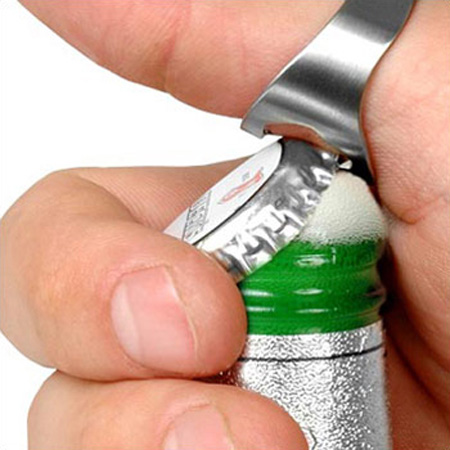
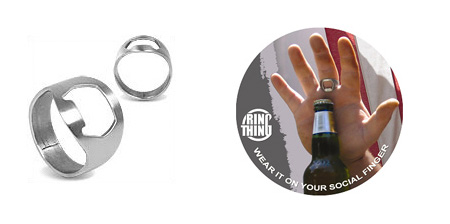
Ring Thing Bottle Opener

A ring that’s a bottle-opener. How brilliantly simple is that? $9.95 [link]

Ring Thing Bottle Opener

Ring Thing Bottle Opener 2

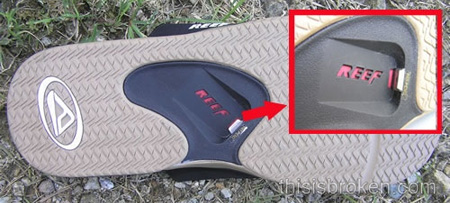
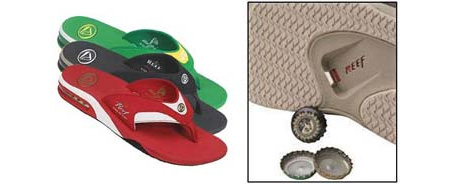
Reef Sandals Bottle Opener

The only sandals with a built in bottle opener. $45.95 [link]

Reef Sandals Bottle Opener

Reef Sandals Bottle Opener 2

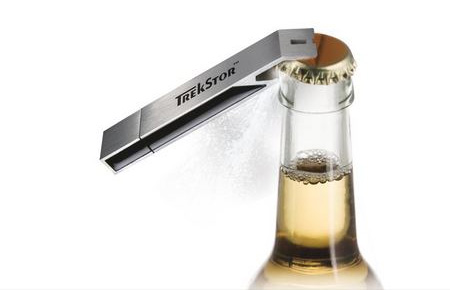
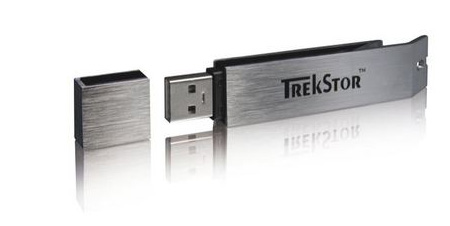
TrekStor USB Drive Bottle Opener

TrekStor has put a bottle opener on a USB memory drive. The USB stick CO, as it will be called, will start at 6.99 euros for the 1GB model and 49.99 euros for the 16GB version. Drinkers need not apply till October. [link]

TrekStor USB Drive Bottle Opener

TrekStor USB Drive Bottle Opener 2

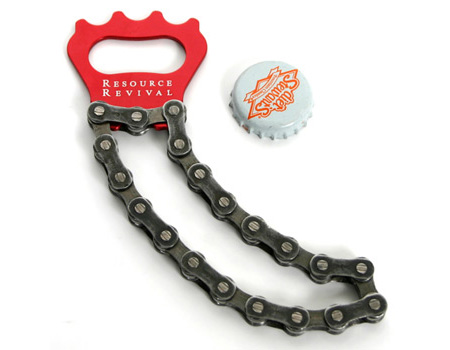
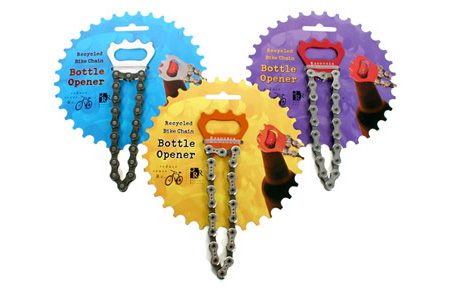
Bike Chain Bottle Opener

These bottle openers are so cool you will wish twist-offs had never been invented. The flexible chain handle provides endless fiddling fun. $12.00 [link]

Bike Chain Bottle Opener

Bike Chain Bottle Opener 2

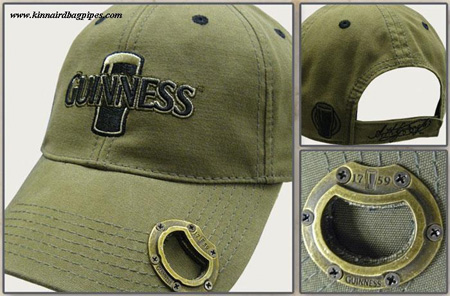
Bottle Opener Ball Cap

Guinness bottle opener hat. $30.00 [link]

Bottle Opener Ball Cap

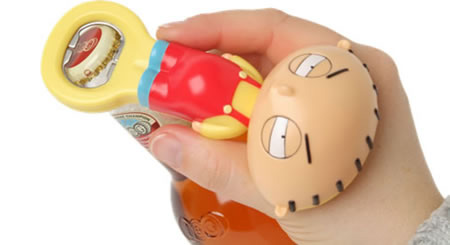
Family Guy Talking Bottle Opener

With this Talking Stewie Bottle Opener you’ll be able take over the world like Stewie wants to, as you’ll have an army of followers desperate to open their beer with your equipment! £8.95 [link]

Family Guy Talking Bottle Opener

Credit Card Bottle Opener

Size: 85mm x 54mm, Material: 1.2mm Stainless Steel. £6.95 [link]

Credit Card Bottle Opener

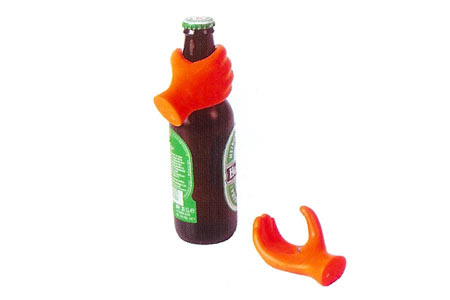
Helping Hand Bottle Opener

Helping Hand Bottle Opener is fun and functional. Store hanging on a beer in your fridge - you’ll never be left searching for your bottle opener again. $6.99 [link]

Helping Hand Bottle Opener

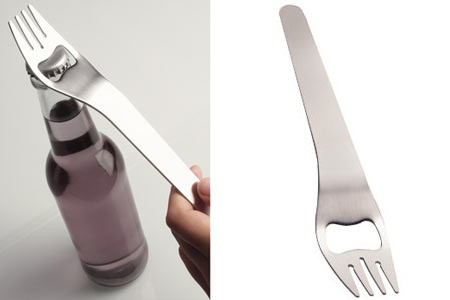
Fork Bottle Opener

This stainless steel fork contraption is the perfect tool for your summer cookouts! $7.99 [link]

Fork Bottle Opener

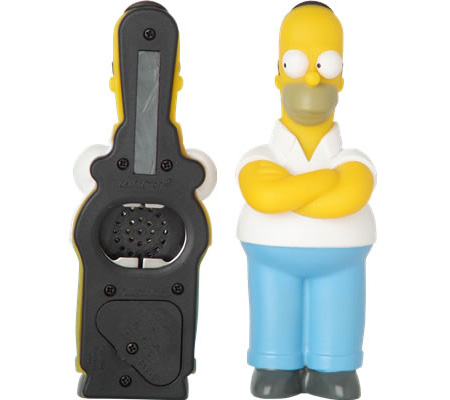
Simpsons Talking Bottle Opener

Each time you use it this great bottle opener gives you one of three great Homer Simpson phrases!  It will have you in stitches, whether you’re a Simpsons fan or not!

- 80% of the human body is water or in my case beer!
- To alcohol…the cause of and solution to all of life’s problems!
- Drink up, not drinking is only gonna make it worse!

£8.95 [link]

Simpsons Talking Bottle Opener

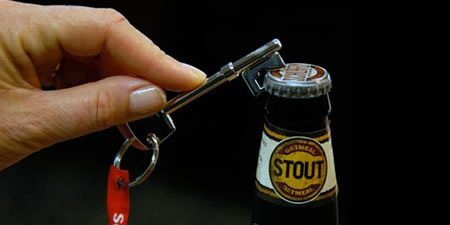
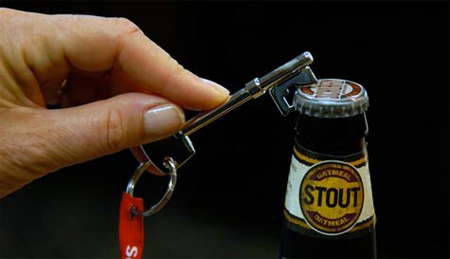
Skeleton Key Bottle Opener

The Key Bottle Opener can’t open a secret chest filled with gold dubloons. But, it can open a beer, which we figure is just as good. The Skeleton Key Bottle Opener is made from tough nickel steel and is the perfect size and shape to hang from your keychain. $9.95 [link]

Skeleton Key Bottle Opener

LEGO Bottle Opener

Newspaper Bottle Opener

Opening a Beer Bottle with a Chain Saw

Open Beer with One Dollar Bill

Apple News-- Will it be Itunes 8- Subscriptions for content?


Tomorrow, Apple will unveil... Something. The press event, entitled "Let's Rock", is the usual Apple tease. Apple has apparently been pushing this as a big event, encouraging journalists to fly out to the Yerba Buena Center for the Arts. Usually, Apple events take place at the smaller Moscone Center, which means that this actually could contain some surprises.

And, for the sake of the share prices, there's going to have to be a surprise. The new 4G Nano has seen so much coverage already that the information should be considered more a flood than a leak. This is the downside of Apple's infamous secrecy: if your secrets get out, you have nothing left to tell anyone.

Earlier this year, at its quarterly earnings conference call, Apple's CFO Peter Oppenheimer stated that the next quarter revenue would affected by a "future product transition". This has been taken by many to be the fabled tablet Mac (with unicorn-horn antenna). Others think it will be a touchscreen MacBook Pro. I call nonsense on these.

September's Apple Events have, for the last few years, been all about the iPod, with some iTunes announcements thrown in. A new Nano isn't enough to hire a bigger venue and encourage the press to fill it up. And a few new widescreen iPods certainly isn't a major "product transition". The evidence here all points to a brand new iTunes.

What will those new features be? Rose:

- New audio visualization

- Genius playlist

- Genius sidebar

- Grid view

The first and last are UI tweaks, and alone wouldn't justify a full-point update. The Genius Playlist and Sidebar would, though. These, if real, are expected to work something like Pandora or Last.FM, recommending music based on your tastes and either sending you off to the App Store or putting together a playlist of your existing music.

But again, this doesn't account for the "transition". My suspicion is that we will finally see a subscription model for music. There, I said it. ITunes 8 will appear tomorrow and will allow users to pay a yearly or monthly subscription for as much music as they can listen to. If you love it, click to buy. Steve Jobs will want to pitch this as a better product as all the other streaming services, so expect up to 256kbps streaming, based on bandwidth.

This will also, I expect, tie-in to the iPod and iPhone. Expect streaming over Wi-Fi (forget 3G and EDGE -- the telcos couldn't cope with the bandwidth) for the Touch and iPhone. Less sure, but certainly possible, would be iPods which come with a subscription in a box. Pay, say, $100 more for the iPod and it effectively comes with free music for a year.

This would certainly be a "future product transition". Overall revenue might not take a hit, but Apple would have to account for music sales the same way as it has to account for iPhone sales. These are not counted at the time of purchase, so all the profits would be shifted to the following year, making the current year look a little lean.

So that's the big surprise for tomorrow morning. A new Nano? Sure. Revised iPod Touches? We hope so. IPods shipping with as much music as you could ever listen to? Why not?

23 Beautiful and Sustainable Natural Swimming Pools [PICS]


Cool Off in These Beautiful, Sustainable Green Pools

read more | digg story

The 65mpg Ford We Can't Get Here


http://images.businessweek.com/story/08/600/0904_mz_ecocar.jpg

The ECOnetic will go on sale in Europe in November


If ever there was a car made for the times, this would seem to be it: a sporty subcompact that seats five, offers a navigation system, and gets a whopping 65 miles to the gallon. Oh yes, and the car is made by Ford Motor (F), known widely for lumbering gas hogs.

Ford's 2009 Fiesta ECOnetic goes on sale in November. But here's the catch: Despite the car's potential to transform Ford's image and help it compete with Toyota Motor (TM) and Honda Motor (HMC) in its home market, the company will sell the little fuel sipper only in Europe. "We know it's an awesome vehicle," says Ford America President Mark Fields. "But there are business reasons why we can't sell it in the U.S." The main one: The Fiesta ECOnetic runs on diesel.

Automakers such as Volkswagen (VLKAY) and Mercedes-Benz (DAI) have predicted for years that a technology called "clean diesel" would overcome many Americans' antipathy to a fuel still often thought of as the smelly stuff that powers tractor trailers. Diesel vehicles now hitting the market with pollution-fighting technology are as clean or cleaner than gasoline and at least 30% more fuel-efficient.

Yet while half of all cars sold in Europe last year ran on diesel, the U.S. market remains relatively unfriendly to the fuel. Taxes aimed at commercial trucks mean diesel costs anywhere from 40 cents to $1 more per gallon than gasoline. Add to this the success of the Toyota Prius, and you can see why only 3% of cars in the U.S. use diesel. "Americans see hybrids as the darling," says Global Insight auto analyst Philip Gott, "and diesel as old-tech."

None of this is stopping European and Japanese automakers, which are betting they can jump-start the U.S. market with new diesel models. Mercedes-Benz by next year will have three cars it markets as "BlueTec." Even Nissan (NSANY) and Honda, which long opposed building diesel cars in Europe, plan to introduce them in the U.S. in 2010. But Ford, whose Fiesta ECOnetic compares favorably with European diesels, can't make a business case for bringing the car to the U.S.

TOO PRICEY TO IMPORT

First of all, the engines are built in Britain, so labor costs are high. Plus the pound remains stronger than the greenback. At prevailing exchange rates, the Fiesta ECOnetic would sell for about $25,700 in the U.S. By contrast, the Prius typically goes for about $24,000. A $1,300 tax deduction available to buyers of new diesel cars could bring the price of the Fiesta to around $24,400. But Ford doesn't believe it could charge enough to make money on an imported ECOnetic.

Ford plans to make a gas-powered version of the Fiesta in Mexico for the U.S. So why not manufacture diesel engines there, too? Building a plant would cost at least $350 million at a time when Ford has been burning through more than $1 billion a month in cash reserves. Besides, the automaker would have to produce at least 350,000 engines a year to make such a venture profitable. "We just don't think North and South America would buy that many diesel cars," says Fields.

The question, of course, is whether the U.S. ever will embrace diesel fuel and allow automakers to achieve sufficient scale to make money on such vehicles. California certified VW and Mercedes diesel cars earlier this year, after a four-year ban. James N. Hall, of auto researcher 293 Analysts, says that bellwether state and the Northeast remain "hostile to diesel." But the risk to Ford is that the fuel takes off, and the carmaker finds itself playing catch-up—despite having a serious diesel contender in its arsenal.

Purchase your Complete Genome


You, on a platter: A customer who pays $350,000 for Knome’s service receives a silver box containing an eight-gigabyte USB drive housing his or her genome sequence and specialized browser software.
Credit: courtesy of Knome, Inc.

Last month, Jorge Conde handed out the first of his company's precious products: an engraved silver box housing a USB drive. On the drive, protected by encryption software, was the sequence of the recipient's entire genome, a proprietary analysis of his genetic risks for disease, and software for browsing the data.

The event signals a shift in the world of human genome sequencing. Until now, the handful of people who have had their genomes sequenced, including genomics pioneers Craig Venter and James Watson, have been part of government or industry efforts to study the human genome or showcase new sequence technologies. But thanks to Knome, a startup based in Cambridge, MA, genome sequencing is no longer just a research tool. Anyone with $350,000 to spare and an adventurous spirit can now have his or her own genome sequenced.

Knome is at the forefront of the push toward so-called personalized medicine. Scientists and physicians hope that when sequencing costs come down enough, genetic analysis will become a ubiquitous part of health care, helping doctors choose the best treatments for a specific patient, or helping individuals take steps to prevent diseases for which they are at risk.

While Knome has not yet disclosed the number of people who have signed up for its service, it aims to sequence 20 genomes this year. "We have individuals at every stage of the process," says Conde, Knome's president and chief executive officer. "We collected data from additional clients in Europe last week and have people being sequenced now." That number may grow as sequencing costs plummet: the company soon plans to announce a lower price. And competition from other companies, such as Illumina, based in San Diego, could push down costs further.

Cheaper personal-genomics services are already available: three companies--23andMe, Navigenics, and Decode--offer analysis of hundreds of thousands of genetic variations, to predict risk of disease or assess ancestry and other traits. But Knome sequences the entire genome--nearly all three billion bases. "That has a tremendous advantage, because the information is significantly greater and more complete than other services," says Raju Kucherlapati, scientific director of the Harvard Partners Center for Genetics and Genomics at Harvard Medical School, in Boston. "Ultimately, this is the direction to go. The only impediment is really the cost."

At this point, Knome's customers are buying a product that has aspects of both a well-equipped Lamborghini and Internet service circa 1985. The $350,000 price tag is out of reach to all but a very few. But interpreting a person's genome sequence requires comparing it with a database of human genetic information linking particular variations with health or other traits. The greater the number of genomes sequenced, the richer the analysis; but at the moment, that number is pretty low. "This information is going to be thorny and problematic in terms of interpretation," says James Evans, a professor of genetics and medicine at the University of North Carolina at Chapel Hill and editor in chief of Genetics in Medicine. "We all have mutations and alterations that we simply don't understand. As usual, the technology will be ahead of our ability to use it.

Nonetheless, early adopters could give scientists insight into how to use the mammoth resource that is our genomic information. "They are trying to answer some of the more thorny questions about how this deluge of information will be used," says Evans. "I believe it will give us some kind of idea of how to deal with this information when the price is more like $3,000."

To provide a customer with personalized genome data, Knome extracts DNA from a blood sample and sends it to the Beijing Genomics Institute for sequencing. A team of informatics experts and medical consultants then analyzes the information, tailoring the process according to the interests of the client. "Each one is crafted to the individual," says George Church, founder of the company and a geneticist at Harvard Medical School. (Church started the company to deal with the frequent requests that he fielded from wealthy people wanting to sequence their genomes.)

The first things the analysts look for are small variations that are found frequently in the broader population and have been linked to increased risk for myriad diseases. They then look for other types of genetic changes--including DNA deletions or duplications--linked to specific diseases. Lastly, they scan the genome for novel variations, changes that have not yet been spotted in the limited amount of human DNA that has been sequenced to date. The effects of such changes are uncertain, but the scientists try to predict them by considering the structure of the resulting proteins.

The results are revealed at a mini symposium dedicated to the recipient's genome, where scientists explain the results, the process behind them, and their limitations. Knome's first client, for example, found out that he was at increased risk for a particular disease that runs in his family. In this case, the finding didn't affect his medical care--he was already being monitored for that condition by his physician. But Conde says that the company makes it clear that the information should not be viewed as a diagnostic or medical service. "If they choose to take medical action, they should only do so with the advice of a physician," he says.

Clients can decide whether or not they want their data deposited in a public database accessible to genetic researchers. In what the research world might consider an ironic twist, Knome's private service has generated a massive genomic resource: the company has likely accumulated the largest repository of whole-genome information in the world. Public projects to accumulate genome-wide databases, including the internationally funded 1,000 Genomes Project and Church's Personal Genome Project, have focused early efforts on sequencing only the part of the genome that codes for proteins.

Semantic Search


Credit: Technology Review

Even if you have a great idea for a new search engine, it's far from easy to get it off the ground. For one thing, the best engineering talent resides at big-name companies. Even more significantly, according to some estimates, it costs hundreds of millions of dollars to buy and maintain the servers needed to index the Web in its entirety.

However, Yahoo recently released a resource that may offer hope to search innovators and entrepreneurs. Called Build Your Own Search Service (BOSS), it allows programmers to make use of Yahoo's index of the Web--billions of pages that are continually updated--thereby removing perhaps the biggest barrier to search innovation. By opening its index to thousands of independent programmers and entrepreneurs, Yahoo hopes that BOSS will kick-start projects that it lacks the time, money, and resources to invent itself. Prabhakar Raghavan, head of Yahoo Research and a consulting professor at Stanford University, says this might include better ways of searching videos or images, tools that use social networks to rank search results, or a semantic search engine that tries to understand the contents of Web pages, rather than just a collection of keywords and links.

"We're trying to break down the barriers to innovation," says Raghavan, although he admits that BOSS is far from an altruistic venture. If a new search-engine tool built using Yahoo's index becomes popular and potentially profitable, Yahoo reserves the right to place ads next to its results.

So far, no BOSS-powered site has become that successful. But a number of startups are beginning to build their services on top of BOSS, and Semantic Web companies, in particular, are benefiting from the platform. These companies are developing software to process concepts and meanings in order to better organize information on the Web.

For instance, Hakia, a company based in New York, began building a semantic search engine in 2004. Its algorithms use a database of concepts--people, places, objects, and more--to "understand" concepts in documents. Hakia also creates maps linking together different documents, such as Web pages, based on these concepts in order to understand their relevance to one another. Riza Berkan, CEO of the company, says that focusing on the meaning of pages, instead of simply on the links between them, could serve up more relevant search results and help people find content that they didn't even know they were looking for.owever, in order to do this well, Hakia needs to have access to as many Web pages as possible, and this is where BOSS fits in. For a given query, Hakia uses Yahoo's BOSS index to determine a set of relevant results. Hakia's software then determines whether these pages have already been analyzed by the company's semantic software. If they haven't, they will be processed, and the results will be stored on Hakia's servers. "We crawl the Web anyway," says Berkan. "But without Yahoo's index, we'd be behind on the sites that people are searching for today." And the more popular pages Hakia scans, the better its index will be.

Another semantic startup, called Cluuz, from Ontario, Canada, is taking a slightly different approach. When a user searches with Cluuz, she will see Yahoo BOSS results, but they are reordered according to the startup's own semantic search technology. "When you do a query," says Alex Zivkovic, CTO of Cluuz, "we pass it on to Yahoo BOSS, and we get a list of results back . . . Then for each of those pages, the Cluuz engine analyzes the content, extracts entities--people, companies, phone numbers, and those sorts of things." These concepts, he explains, are then checked against the concepts found on other pages, and the concepts that arise most often are deemed most relevant.

"Instead of looking at pages being linked based on the physical links, we're looking at them in terms of whether or not they are talking about the same concepts," says Zivkovic. This leads to a different user experience, he adds. For instance, terms relevant to a search query are pulled from the Web and highlighted on the right of the results page. A search for "Kate Greene" immediately pulls up my e-mail address at Technology Review, the university I attended, and a number of the people I've interviewed for past stories. Additionally, Cluuz provides other tools that allow the links and relationships between different semantic concepts to be visualized easily.

Even with the power of Yahoo's index behind a company, there's no guarantee that Hakia or Cluuz will be a success. But if they do take off, it could help Yahoo, which still lags way behind Google in terms of popularity, regain the edge. "The underlying philosophy [with BOSS] is, we're not going to be able to invent everything on our own," says Raghavan. "So we should facilitate innovation."

Spider-Man 4 And 5 Swing Back To Back. Both To Have Tobey and Raimi

    By George 'El Guapo' Roush 

Deadline Hollywood is reporting that Sony has locked in both Tobey McGuire and Sam Raimi for Spider-Man 4 and 5:

It's time to end once and for all the rampant speculation. Sony doesn't want any info to leak but I'm told that both star Tobey Maguire and director Sam Raimi will be returning to make Zodiac screenwriter Jamie Vanderbilt's script of Spider-Man 4. Sources tell me that Sony has recently locked in both veterans of Spider-Man 1 through 3. And I do mean recently because just a few weeks ago sources told me that Sony Pictures co-chairman Amy Pascal was openly discussing Tobey's potential replacements [A topic we covered back in May] with various Hollywood agents because Tobey was hanging tough about a deal. "She was looking around to cover herself because Sony wanted him badly and Tobey wasn't sure he wanted to do it," an insider explained to me. There's no deal yet for Kirsten Dunst but Mary Jane Watson will be in the movie again. I'm told Sony "would never recast her" despite her rehab problems. But expect another gal part, too.

Sony would never recast Kirsten Dunst? Why? Was she that awesome in the role? I don't think so. There are a ton of actresses who coud play the part. Besides, Mary Jane in the comic books looked more...what's the word I'm looking for...womanly to me. Is womanly a word? If it isn't, then it is now.

The article continues on about the spinoff Venom movie that I believe can only be awesome as fuck or suck major donkey balls. I don't think there will be any middle ground on this one:

And Sony has hired a pair of screenwriters to get going on the Spider-Man spinoff movie Venom. Given that comic book artist/writer and action figure maker, Todd McFarlane, who is one of the creators of the Marvel villain, doesn't think a Venom movie could do well with a villain as the central character, my sources think Sony should let Topher Grace, even though he was blown up at the end of Spider-Man 3 (yet a portion of the Venom costume survived), stay in the role because the likeable actor could be a a sympathetic evildoer.

Click HERE to read the entire article.

This whole Spider-Man thing really makes me angry. Here's what I would have done:

They had an awesome opportunity to do a back to back Spider-Man 3 and 4 with Venom in the 3rd movie as the sole villain and a carry over Carnage story for the 4th. Sure, you could do some small thing with Harry Osborn in the 3rd, but the main plot would have been the creation of Venom and how he hates Parker/Spider-Man. In the middle of the movie is an enormous fight where Venom kicks the shit out of Spider-Man, leaving him almost dead, but telling him he's not  going to kill him. He's going to make him suffer first by going after the ones he loves. This creates a big battle at the end with Harry helping Peter defeat and kill Venom. (Just my basic story outline)

This cover right here helps to explain what I'm talking about.


Imagine the end of the 3rd movie. Carnage comes into play after Venom is defeated with a 'To Be Continued' seconds after. Fans would have shit in their pants. Then part 4 is Spider-Man really fighting for his life when this psycho, Cletus Kasady, gets loose on the streets with Venom's offspring.


They could have even had Venom live for a huge Venom/Carnage fight. Make Spider-Man and Venom become unwilling allies (Harry is still dead) to take down Carnage because he's become a threat to both of them. THAT could have led to a Venom spin-off movie.


But noooooo, nobody in Hollywood wants to think ahead. So for Spider--Man 3 we got stuck with 10 minutes of Venom and Peter Parker dancing on tables in a jazz club. Awesome.

What do you guys think should be the story for 4 and 5? Should it be one big story or separate stories? And what villains would they use? Kraven? Hobgoblin? Rhino? Shocker?

Comment away people. Maybe we can make some noise so they can get it right this time. 

The Best of Johnny Drama: Quotes and Clips


First there was the impressive list of Babes of Entourage and then there were some photos from the premiere party. Now it is time to get to one of the best parts of the whole show. Johnny Drama. Here are some of his best quotes and some video clips.

read more | digg story

Hussman Funds Weekly Market Comment

Deja Vu Again
Recession looking more and more like a given.

Accepted, dreaded part of the game

Knee injury knocks out Brady; Patriots soldier on to victory


FOXBOROUGH - It's football, remember?

Football is a contact sport, a collision sport, a physical sport, a violent sport, a brutal sport, and, some might say, a barbaric sport. If American mothers had their way, there would be no football, at least none involving their precious sons. Injury in football is not surprising. It is inevitable.

Tom Brady has started 128 consecutive games, which, frankly, is beyond fortunate. No one knows this morning when he will start the next one because the greatest fear of every Patriots fan - not to mention the owner, the coach, and Brady's teammates - was realized with 7:27 left in the first quarter of yesterday's game against the Kansas City Chiefs at Gillette Stadium when the whistle blew and Brady failed to get up.

And now there is a very real fear that he sustained a torn anterior cruciate ligament - yes, the dreaded ACL - and has thrown his last pass of the 2008 season. Unless the Patriots choose to dabble in the free agent market for the likes of (hold your nose) Trent Dilfer, the new starting quarterback around here is Matt Cassel.

Brady had completed a 28-yard pass to Randy Moss, who wound up fumbling the ball. But those interested in the fortunes of the Patriots were not as concerned about the team's second such turnover of the first quarter as they were about the status of Brady, who limped off the field with what coach Bill Belichick confirmed was an injured left knee, not to be seen again.

"I was standing right there," said running back Sammy Morris, "and I couldn't help him up. It's a tough feeling, but it's part of the game."

It's part of the game.

It certainly is. Morris knows all about it. He sustained a sternum-clavicle separation in last season's sixth game and never played another down. He can empathize.

"You see the hurt on his face, and you feel the same hurt," Morris said.

The reigning league Most Valuable Player religiously had been placed (some say mischievously placed) on the weekly injury report by Belichick for more than two years with an unspecified right shoulder injury, and he had missed all four exhibition games because of an issue with his right foot. But what happened yesterday had nothing to do with a shoulder or a foot. It had to do with a blitzing Kansas City safety named Bernard Pollard being picked up by Morris and then, after being knocked to the ground, reaching out and grabbing Brady's lower left leg in an attempt to bring him down. Brady fell awkwardly, injuring his left knee.

Was it necessary for Pollard to do that? Most Patriots either didn't see the play or declined to express an opinion, but wide receiver Randy Moss was rather forthright.

"I don't really want to get into it," he said. And then he got into it.

"Me personally, I thought it was dirty," said Moss, who had studied the replay. "I've never been a dirty player. I honestly don't even know how to play dirty. I just play the game. It is not my decision. Hopefully, the league will look into it. If it's good, it's good. If it's bad, it's bad. They [NFL] will handle it."

Whether it was dirty, unnecessary, or extraneous, it happened, and the Patriots did not have time to call a team meeting to discuss and analyze the situation. There was a scoreless game that had more than 52 minutes left to play. Brady was gone, Cassel was going to be the quarterback, and that was that.

These men are professionals, and they have been trained to expect the unexpected. Other important players have gotten hurt during this glorious Patriots run, and the team always persevered. One of its most valued individuals even suffered a stroke, which was a very emotional situation to deal with. But life always went on, and so it would against the Chiefs.

"Football players are used to seeing guys get hurt," said guard Logan Mankins. "You've got to move on."

It all starts with the coach. Belichick has stood before the media countless times and discussed the necessity of people just "doing their job." So it was really no more complicated than that.

"We always have the feeling," explained linebacker Tedy Bruschi, the aforementioned stroke victim, "that the next person in line is prepared. Hopefully, he did his homework. Tom's Tom. He's our quarterback. But it's just, 'Who's next?' "

Who's next was Cassel, who has been the primary Brady understudy for four years, and who, if he's known for anything, is the curiosity who spent his entire time at Southern California backing up Heisman Trophy winners Carson Palmer and Matt Leinart, and thus has not started a regular-season game for anyone since his senior year at Chatsworth (Calif.) High School some time back in the late 20th century.

Let's be honest. The fans had no faith in Matt Cassel, especially after an exhibition season in which he had failed to generate a touchdown for the team, despite being given ample opportunity to do so. But he proved to be a perfectly adequate short-term replacement, going 13 for 18 for 152 yards, one touchdown (an acrobatic Moss grab at the back of the end zone), no interceptions, and, most notably, a signature play any Brady or Manning would have been proud to hang his hat on. For in his first series of downs, on third and 11 a half-yard from his end zone, he recognized a Moss improvisational theater breakoff of a route and hit the great wideout for a 51-yard gain.

If any teammates had doubted him, that play won them over. "That play showed he had a little something going right there, and everyone stopped holding their breath after that," said defensive tackle Ty Warren.

It was one play, and this was one game, and it was against the Chiefs, who should feel perfectly free to schedule family vacations for the month of January, 2009. But when it was all said and done the Patriots had 17 points and the Chiefs had 10 and the Patriots were the same 1-0 they would have been had an untouched Tom Brady thrown for 350 yards and four TDs.

"It's always about a team effort," Warren reminded. "A collective effort of guys contributing, whatever their job is. Tom is a big part of that. But, like I say, the game has to go on, with all due respect."

When Brady went down, it immediately became a losable game. The postgame reflections could have contained lots of couldas, shouldas, and wouldas. But there was none of that. The rest of them just did their job, and, no matter who happens to be the quarterback, they'll all head down to the Meadowlands with the same attitude next week against the Jets.

That's what true professionals do.

Bob Ryan is a Globe columnist. He can be reached at ryan@globe.com.

Family Sedan Showdown


Chismillionaire's take: The new 6 must be some kind of vehicle. I think it is just incredible that the class leading Altima of a couple years ago, now is the laggard of the pack, and last year's all new Accord is the runner up. While it's a solid car, my guess is the Chevy Malibu would have finished 4th here. Just goes to show how competitive this segment has become.


Our recent test of the 2009 Mazda 6 s Grand Touring showed us that Mazda can still offer sporting dynamics in its all-new family sedan, even while providing more room, more features and more power. We were concerned that the sporting spirit of the last-generation, fun-but-snug Mazda 6 might have been lost in the search for commercial success, but we came away believing this new car still has that zoom-zoom thing.

Like Mazda, we believe a family sedan can be lively as well as practical. So to gauge the way in which the 2009 Mazda 6 fits into the new world of family sedans, we figured a comparison is in order. A 2009 Mazda 6 s Grand Touring would be our starting point.

Then we enlisted the 2008 Nissan Altima 3.5 SE with its continuously variable automatic transmission. It's the car that most people consider to be the sportiest in this category, matched with a transmission that shatters all expectations about CVTs. (We know this car is available with a manual transmission, but we also know the CVT is a better choice. Trust us.)

The all-new 2008 Honda Accord is the standard of the category, the winner of our last comparison test of family sedans. A 2008 Honda Accord EX-L Navi matched up nicely. Hailed for its value, refinement and excellent quality, the well-mannered Accord would challenge the Mazda's practical abilities.

And so we began our family sedan comparison test, and we're wondering how far the Mazda 6's fun-o-meter has swung away from "I could use a Red Bull" toward "My adrenal gland is sore and I need to grow up."

Motivating V6s
This is the top-of-the-line 2009 Mazda 6 s Grand Touring model, and it features the most power in our test courtesy of its 272-horsepower 3.7-liter V6 nicked from the Mazda CX-9 crossover. At the drag strip, this engine helped the 3,596-pound Mazda 6 dash to 60 mph in just 6.5 seconds (6.2 seconds with 1 foot of rollout like on a drag strip). This makes the heaviest car of this trio the quickest, as the 3,590-pound Accord takes 7.5 seconds to get to 60 mph (7.2 seconds with 1 foot of rollout like on a drag strip) and the 3,399-pound Altima takes 7.0 seconds to do the task (6.6 seconds with 1 foot of rollout like on a drag strip). The Mazda V6's power delivery is smooth and broad, and this is the only engine of these three that feels fast from the first exploratory run up the tachometer.

Our fuel-economy logbook surprisingly shows the Mazda to be the easiest on fuel, and our observed average of 20 mpg exactly matches this car's EPA rating for combined average mpg. Perhaps because this 3.7-liter V6 offers the highest torque at the lowest rpm, the Mazda 6 doesn't have to be driven as aggressively as the Accord or Altima to get the job done. The Accord's 268-hp 3.5-liter V6 managed only 18 mpg in our hands, while the Altima's 270-hp 3.5-liter V6 recorded just 17 mpg. (The Altima V6 also requires premium fuel.)

In terms of real power, the Mazda 6 went through the quarter-mile in 14.7 seconds at 95.6 mph, while the Accord did the task in 15.6 seconds at 91.0 mph and the Altima did 15.0 seconds at 95.2 mph.

Shifting for You
The Mazda's six-speed automatic transmission can be shifted manually for added control or exhilaration, and the shifts are crisp and positive. This is a better-than-average automatic from Japan, but we're hoping that one day the Mazda 6 might incorporate a transmission that would deliver a throttle blip to match revs during downshifts for an even more sporting feel.

In comparison, the five-speed automatic of the Honda isn't really programmed to do much more than "Drive." It allows a downshift to 3rd, but there's no way to manually select 4th gear. It might be the Honda Way, but it's a mystery to us.

The 2008 Nissan Altima features a CVT that combines the best of both worlds with six discreet ratios that can be manually selected, and a carefully optimized Drive mode. What the CVT does — and this one does it very well — is resolve what the best ratio and/or rpm is for the desired effect, be it acceleration or highway cruising. Our experience has shown that only when such a transmission is combined with a torque-rich engine (like this V6 in the Altima) is a CVT preferable to a traditional automatic with discreet gears. This combination helps the Altima accelerate truly seamlessly, and the transmission always seems in lockstep with the driver's intent.

Riding and Handling
The enduring goodness of the BMW 3 Series has shown that a well-sorted version of a simple strut-type independent front suspension can be made to work very well. The Nissan Altima uses this configuration, and mostly to good effect. We've often lauded the Altima for its crisp handling, but have also criticized it for its flinty, stiff-legged ride. This Altima hasn't changed our minds.

The 2008 Honda Accord and 2009 Mazda 6 both feature double-wishbone independent front suspension and score significantly higher than the Altima for their smoother, more isolated rides. The most noticeable differences arise over really rough, broken pavement, where the Altima's suspension crashes and booms, and even shakes the steering column. The Accord performs somewhat better, while the Mazda remains poised and sure-footed, though busy.

Our test track results also prove the Mazda 6 the best handler, as its 0.81g on the skid pad represents the most stick and its 66.4-mph run through the slalom leads the pack. The sharp-handling Altima musters 0.79g and 65.9 mph in the same tests, while the Accord records an admirable 0.80g combined with a pedestrian 63.3 mph.

The Mazda 6 loses a few points in road noise, where its wide, 18-inch Michelin tires produce high-frequency tread clamor that's especially sensitive to certain surfaces. The Honda and Nissan, on the other hand, are saddled with wind and engine noise. So when our sound-level meter showed that all three of these cars produce near-identical results at 70 mph, we weren't surprised.

Interior and Packaging
Assigning scores to a car's interior design is a largely subjective exercise, but there are elements and systems in each of these three sedans that deserve special attention.

Combining a traditional three-box silhouette with relatively thin C-pillars, the Honda offers better outward visibility than the more fastback shapes of the Mazda and Nissan. Compared to the Mazda and Nissan, the Honda driver sits higher and the cabin feels open and spacious. To counter this deficiency in visibility, the Mazda 6 features an effective, unobtrusive blind-spot warning system, while the Nissan has a back-up camera included in the optional navigation system.

The dashboards of these three cars offer either too little or too much. The Accord EX-L Navi groups its controls for the audio, navigation and ventilation systems in logical places, but there are so many buttons that it requires either thorough pre-flight study or too much on-the-fly attention to navigate the myriad buttons, displays, knobs and dials. The Nissan Altima's stark dash couldn't be simpler to operate or understand, but in this base-model version, the ventilation system doesn't offer automatic or dual-zone functions, and the radio features push-button manual tuning. Taking a lesson from each, the Mazda 6's contemporary-looking dash offers all the functionality of the Honda (minus the optional navigation system in this car), with the intuitiveness of the Nissan. It's nice to see a new design with some ideas that actually make some sense.

Honda's strong suit continues to be the ergonomics of the control layout and the tactile feel of all the buttons. The Mazda is a very close 2nd, while the aging Nissan is in dire need of some fresh ideas and upgrades. Granted, the Nissan is at a slight disadvantage here without a leather package, but to get leather requires ordering the $4,200 Premium package that adds a long list of other items you might not want or need.

Seating Matters
Both the top-line 2009 Mazda 6 s Grand Touring and 2008 Nissan Altima 3.5 SE come with smart keys that can remain in your pocket or purse to unlock/lock and start the vehicle. It's a nice touch we appreciate and hope the trend proliferates in the segment. All three sedans feature large front doors, making ingress and egress about equal among them. Once seated, however, you'll discover divergent missions in the seating choices each has made.

The Nissan's wide seats will accommodate a wide range of driver physiques, while the deep, aggressively bolstered buckets in the Mazda are clearly intended to support an enthusiast's frame. Somewhere in the middle, the Accord offers good support within its medium-size buckets. All the steering wheels here are adjustable for rake and reach, so a good driving position can be found.

When it comes to the rear seats, the same philosophies carry through, although the Altima gets demerits for a lower ceiling and squishy (though large) seats. It's also curious that not one of these three top-line sedans was equipped with rear vents for the climate control.

Junk in the Trunk
Popping the trunk in each (only the Honda doesn't offer an exterior touch-pad release), we were pleased to find the Mazda offers the largest and most useful cargo area. It was also the only one to use scissor hinges, which don't intrude into the cargo space. The Mazda 6 offers 16.6 cubic feet of cargo capacity, the Altima has 15.3 cubic feet and the Accord has 14.0 cubic feet.

These trunks are all shaped very differently. The lumpy, oddly configured Accord trunk can be expanded by folding down the one-piece rear seatback (although there's a narrow pass-through), while the Mazda and Nissan offer convenient 60/40-split-folding rear seatbacks.

All three of these cars carry small donut-style spare tires to maximize trunk room. Each trunk includes a cargo light, but none is equipped with an electrical power point.

Hitting the Sweet Spot
After all the poking, prodding, driving and scoring, the $30,690 2009 Mazda 6 s Grand Touring earns a total of 70.3 points in our comparison for a 1st-place finish. Second place goes to the $30,930 2008 Honda Accord EX-L Navi with 66.3 points. To level the playing field, we weighted as-tested prices as 20 percent of the final score just like the feature content, but even with a sizable price advantage, this $27,275 2008 Nissan Altima 3.5 SE CVT couldn't make up for its missing features that are standard equipment on its rivals, including Bluetooth connection, dual-zone climate control, electronic stability control and leather upholstery.

Although some might complain that the new, larger 2009 Mazda 6 has lost some of the sport sedan flavor of its predecessor, a comparison with the turbocharged, all-wheel-drive Mazdaspeed 6 we last tested shows the '09 Mazda 6 s Grand Touring is only slightly less capable, yet far more livable.

The Mazda 6 has, indeed, found that sweet spot between the well-designed, highly competent and yet somewhat generic Honda Accord and the more highly strung yet modestly priced Nissan Altima. The Mazda 6 combines both sense and sensibility, and it does so with a style that inspires comparison to cars further up the evolutionary scale like the Acura TSX or Nissan Maxima.

We've always believed that a family sedan can still be fun to drive, and it's great to discover that Mazda thinks so, too.

Sunday, September 7, 2008

Treasury to Bail out Fannie & Freddie

NEW YORK (CNNMoney.com) -- Federal officials on Sunday unveiled an extraordinary takeover of Fannie Mae and Freddie Mac, putting the government in charge of the twin mortgage giants and the $5 trillion in home loans they back.

The move, which extends as much as $200 billion in Treasury support to the two companies, marks Washington's most dramatic attempt yet to shore up the nation's housing market, which is suffering from record foreclosures and falling prices.

The sweeping plan, announced by Treasury Secretary Henry Paulson and James Lockhart, director of the Federal Housing Finance Agency, places the two companies into a "conservatorship" to be overseen by the Federal Housing Finance Agency. Under conservatorship, the government would temporarily run Fannie and Freddie until they are on stronger footing.

"A failure [of Fannie and Freddie] would affect the ability of Americans to get home loans, auto loans and other consumer credit and business finance," Paulson said at a press conference in Washington. "And a failure would be harmful to economic growth and job creation."

Fannie (FNM, Fortune 500) and Freddie (FRE, Fortune 500), which were created by the U.S. government, have been badly hurt in the last year by the sharp decline in home prices as well as rising mortgage delinquencies and foreclosures. All told, the two firms have racked up about $12 billion in losses since last summer.

On Sunday, officials stressed that both Fannie and Freddie will be open for business on Monday morning, although the firms will have undergone a dramatic facelift by then.

Freddie CEO Richard Syron and Fannie CEO Daniel Mudd will no longer run the agencies, while the FHFA will assume control of the boards. Regulators took care not to foist blame on the two executives, adding that they would stick around to help with the transition.

Syron and Mudd will be replaced by two finance veterans charged with restoring the mortgage titans to health. Herb Allison, the former chairman and CEO of pension provider TIAA-CREF, will head Fannie Mae. Allison formerly served as president of Merrill Lynch.

David Moffett, who served as vice chairman and chief financial officer of U.S. Bancorp until early 2007 and then joined the Carlyle Group private-equity firm as a senior adviser, will take over Freddie Mac.

At the same time, dividends on both common and preferred shares will be eliminated in an effort to conserve about $2 billion annually. All of the firms' lobbying and political activities will be halted immediately and charitable activities reviewed.

In addition, the Treasury Department announced a series of moves targeted at providing relief to both housing and financial markets.

Paulson said Treasury would boost housing by purchasing mortgage-backed securities from Freddie and Fannie, as well as offering to lend money to the companies and the 12 Federal Home Loan Banks. The home loan banks advance funds to more than 8,000 member banks. (Read what Paulson said.)

The Treasury, with fellow regulator FHFA, will also buy preferred stock in Fannie and Freddie to provide security to the companies' debt holders and bolster housing finance.

The government, in agreeing to backstop the firms, said it would receive $1 billion in each company's senior preferred stock. The government will also receive a quarterly dividend payment and the right to own 79.9% of each company.

How we got here

Sunday's announcement brings an end to months of speculation about the fate of the two firms. Shares of Fannie and Freddie, which have fallen more than 80% as of the end of Friday's session, were hammered this summer among concerns they would need to raise additional funds to cover future losses or need to be taken over by its federal regulator. Investors feared that either step would reduce or wipe out the value of current shareholders' stakes.

In mid-July, the Treasury Department and Federal Reserve announced steps in to make funds available to the firms if necessary and Congress approved the sweeping proposals later that month.

Shortly thereafter, regulators stepped up their review of Fannie and Freddie. Paulson announced in August that he had tapped Wall Street firm Morgan Stanley (MS, Fortune 500) to help him examine the firms.

Sources familiar with the matter told Fortune that Morgan Stanley had determined that both Freddie and Fannie faced "meaningful" capital issues before deciding last week that government intervention was necessary. Morgan Stanley has called a firm-wide meeting on Monday morning to explain the deal.

Officials ruled out a capital infusion - a less drastic option than convervatorship - after considering questions such as whether the government would have to keep putting money in and how best Treasury officials could protect taxpayers, according to one of the sources.

In the end, the route taken amounts to "a timeout, not a liquidation," says the source. "Conservatorship leaves all options open for the next administration."

Following an exhaustive review, FHFA's Lockhart said Sunday that the two companies could not continue to operate without taking "significant action."

Fannie and Freddie have become virtually the only source of funding for banks and other home lenders looking to make home loans. Their ability to do so is crucial to the recovery of the battered home market and the broader U.S. economy.

The two firms buy loans, attach a guarantee, then sell securities backed by the loans' income stream. All told, they own or back $5.4 trillion worth of home debt - half the mortgage debt in the country.

Reaction to the news

The Treasury-FHFA plan, which was widely anticipated after financial markets closed on Friday, drew praise from regulators, lawmakers and some market experts.

President Bush called the move "critical" to the housing market recovery. "Americans should be confident that the actions taken today will strengthen our ability to weather the housing correction and are critical to returning the economy to stronger sustained growth in the future," he said.

Federal Reserve Chairman Ben Bernanke, who along with Paulson has led efforts to help get the U.S. housing market and the broader economy back on track, endorsed the move by Lockhart and Paulson.

"These necessary steps will help to strengthen the U.S. housing market and promote stability in our financial markets," Bernanke said in a statement.

Sen. Charles Schumer, D-N.Y., a member of the Senate Banking Committee, said that Paulson had "threaded the needle just right" with the plan, noting that it will likely be met with praise from other lawmakers.

At first blush, Wall Street seemed encouraged by the news, although the true test will come when financial markets around the globe open Monday. Pimco's Bill Gross, a widely followed bond fund manager, said that the Freddie-Fannie plan was the right move.

"This is a significant step and almost exactly what we had hoped for," Gross told CNNMoney.com Sunday.

In addition to confirming the government's sovereign credit rating, Standard & Poor's affirmed its sterling AAA rating on both Fannie Freddie on the news, adding that its outlook for the two firms is stable.

Unanswered questions

The cost of the government intervention remains unclear however. Experts argue that it will depend in large part on the structure of the rescue, the direction of home prices and mortgage default rates.

Still it seems almost certain it will run into the billions and will most likely eclipse such other high-profile government bailouts including than the Federal Reserve's $29 billion backing of Bear Stearns assets when it was taken over by J.P. Morgan Chase.

Paulson said that the cost to taxpayers would largely depend on the future financial performance of Fannie and Freddie.

Another unintended yet unavoidable consequence may be the impact to the nation's banks.

Some of the nation's largest financial institutions including JPMorgan Chase (JPM, Fortune 500) and Sovereign Bancorp (SOV, Fortune 500) own a big chunk of the estimated $36 billion in preferred shares of Fannie and Freddie, according to research published last month by Keefe, Bruyette & Woods, an investment bank that specializes in financial firms. Those stakes are at risk of being wiped out as a result of Sunday's announcement.

Top banking regulators, including the Federal Reserve as well as the Federal Deposit Insurance Corp., said in a joint statement Sunday that a limited number of smaller institutions have significant preferred share holdings in Fannie and Freddie. They added they are prepared to work with these institutions to come up with a plan should they need to raise capital.

Still, the rescue of Fannie and Freddie could go a long way toward its intended aim - bringing stability to the housing market while making it easier for consumers to obtain affordable mortgages.

Saturday, September 6, 2008

Fitzy Presents: "LET'S GO PATS 2008!"

Folks, I'm so psyched for the upcoming Pats season I assembled a little video to rally the troops and put the NFL back on notice, in the twisted way that only a GFY-head like myself could, or would...


Cheers, drink up, stay in touch, let's go Pats and GFY!

Fitzy
townienews. com