10 Most Anticipated Movies After The Dark Knight

'X-Men Origins: Wolverine,' 'Terminator 4' and Heath Ledger's final film also have us excited for next year.
read more | digg story


'X-Men Origins: Wolverine,' 'Terminator 4' and Heath Ledger's final film also have us excited for next year.
read more | digg story
 |
| Credit: Technology Review |
It's now possible to go online and mail-order genetic tests that will predict your genetic risk for common diseases. But because the meaning of the genetic risk factors flagged--how they boost risk for disease--is not yet clear, such tests have received major criticism. In many cases, it's unclear how to use the findings to improve an individual's health.
A new $31 million project aims to address that issue by revisiting large epidemiological studies encompassing tens of thousands of people whose medical status has already been well documented. Scientists will use previously donated DNA samples to identify 100 different variations in the participants, and then sift through data to clarify how they affect health. The results could have a broad impact on public-health recommendations, such as who would benefit most from additional screening for cancer or diabetes. They could also provide new targets for drug development.
The deluge of data linking specific genes to common diseases comes from new tools that allow scientists to quickly scan the genome for up to a million common genetic variations. In the past two years, these so-called genome-wide association studies have identified more than 300 genetic variants that boost risk for illnesses such as diabetes, arthritis, and Crohn's disease, a form of inflammatory-bowel disease. By examining the entire genome without bias, scientists have found genes that they never expected would be involved in a particular disease.
"We're being inundated with [genome-wide association] results, and that's a good thing," says James Evans, a professor of genetics and medicine at the University of North Carolina at Chapel Hill and editor in chief of Genetics in Medicine. "But the next step will be the hardest step, and that is figuring out what it means for human health."
Although genome-wide association studies have shed light on a great number of genetic variations, it's not clear how these genetic changes boost risk for different diseases. For example, a variation that boosts risk for type 2 diabetes might do so by disrupting part of the insulin regulation pathway, or it might act through some less well understood pathway, such as inflammation. Both of those possibilities could point to a specific molecular pathway to target in the development of novel diabetes drugs.
"We want to try to understand more about [these genes], in terms of how they are related to disease and whether they are really causative," says Teri Manolio, director of the Office of Population Genomics at the National Human Genome Research Institute, which is sponsoring the new study.
The project will focus on four existing epidemiological studies in which scientists have spent years tracking participants' medical information, such as blood pressure, medications, lifestyle, and nutrition. The people being studied encompass a broad swath of the United States' population, including African Americans, Hispanics, American Indians, and Asian and Pacific Islanders. That's especially important because most genome-wide association studies were done in people of European descent; other groups may carry that variant at different frequencies.
One of the groups under study is the population screened by the National Health and Nutrition Examination Survey, a survey done every year by the Centers for Disease Control, in Atlanta. "It's meant to be a snapshot of American health at the time the information is collected," says Dana Crawford, an assistant professor of molecular physiology and biophysics at Vanderbilt University, in Memphis, TN, who is leading one arm of the project. "We have data on pesticide exposure and occupational exposure--it's a huge opportunity to look at gene-environment interaction." (Genes have differing effects under different conditions. For example, some studies link pesticide exposure to Parkinson's disease, but this risk may only be realized in people who possess certain genetic risk factors.)
"I think this kind of effort will be useful because it will cast a wide net looking at the way results [from genome-wide association studies] can be used to improve human health," says Evans. "Arguably, much of the utility of this knowledge being generated by [these] studies will be at the population level and could have very useful effects on how we practice medicine from the perspective of public health."
By Emily Singer
 |
| Seek and destroy: Magnetic nanoparticles (above, red) coated with cancer-targeting peptides can seek out and glom on to cancer cells like the one shown above. The peptides were designed to bind with a molecule found on the surface of ovarian-cancer cells. Researchers hope to use the nanoparticles to filter cancer cells from the abdominal fluid of patients with ovarian cancer, perhaps preventing metastasis. Credit: J. Am. Chem. Soc. Copyright 2008 American Chemical Society |
Magnetic nanoparticles coated with a specialized targeting molecule were able to latch on to cancer cells in mice and drag them out of the body. The results are described in a study published online this month in the Journal of the American Chemical Society. The study's authors, researchers at Georgia Institute of Technology, hope that the new technique will one day provide a way to test for--and potentially even treat--metastatic ovarian cancer.
"It's a fairly novel approach, to use magnetic particles in vivo to try to sequester cancer cells," says Michael King, an associate professor of biomedical engineering at Cornell University, who was not involved in the study.
With ovarian cancer, metastasis occurs when cells slough off the primary tumor and float free in the abdominal cavity. If researchers could use the magnetic nanoparticles to trap drifting cancer cells and pull them out of the abdominal fluid, they could predict and perhaps prevent metastasis. Although the nanoparticles were tested inside the bodies of mice, the authors envision an external device that would remove a patient's abdominal fluid, magnetically filter out the cancer cells, and then return the fluid to the body. After surgery to remove the primary tumor, a patient would undergo the treatment to remove any straggling cancer cells. The researchers are currently developing such a filter and testing it on abdominal fluid from human cancer patients.
"It's possible that the particles may not ever have to go into the patient's body," says John McDonald, chief scientific officer of the Ovarian Cancer Institute at Georgia Tech and a senior author of the paper. "That would be preferable, because then you don't have to worry about any potential toxicity."
The particles, which are just 10 nanometers or less in diameter, have cobalt-spiked magnetite at their core. Most of the time they are not magnetic, but when a magnet is present, they become strongly attracted to it. On the surface of the particles is a peptide--a small, proteinlike molecule--designed to attach to a marker that protrudes from most ovarian cancer cells.
To test the new technology, the researchers injected first cancer cells and then the magnetic nanoparticles into the abdominal cavities of mice. The cancer cells were tagged with a green fluorescent marker, and the nanoparticles with a red one. When the team brought a magnet near each mouse's belly, a concentrated area of green and red glow appeared just under the skin, indicating that the nanoparticles had latched on to the cancer cells and dragged them toward the magnet.

Just when you thought you couldn't waste enough time on your Xbox 360, Microsoft has decided to add another way to get you to stare at your tube for longer, by streaming movies and TV shows through its popular game console. The tech giant announced its partnership with the movie-rental company Netflix this week at the E3 video game convention in Los Angeles. While video-gamers were leaping for joy at the convention when Square Enix announced Final Fantasy XIII for the Xbox 360, avid movie fans were leaping even higher to hear about Microsoft's movie deal. Consumers, however, will have to wait for the fall and sign up with Netflix in order to access 10,000 movies and TV shows through their Xbox. Currently, movies are available for download on the console, but only about half that number.
It's a sweet deal for Netflix, which normally offers its services through the internet and a DVD-by-mail program, but even more so for Microsoft, which has faced tough competition from other game stations. Even though it has sold more than 10 million Xbox 360 units in the U.S., the company has had to compete for living-room entertainment space with Sony's PlayStation 3 which has a Blu-Ray high-definition DVD player built in. With this new partnership, though, Microsoft might stand to kick its competition out of the room.
 |
| Apps on the side: As of Sunday night, Facebook users have the option of a new profile design, which changes the way that they interact with the site’s third-party applications. In particular, most applications have been moved from the profile’s main page to a "boxes" tab, circled in the image above. The redesign also lets users add further tabs for their favorite applications. Developers say that the changes will affect their ability to promote their applications. Credit: Facebook |
As of Sunday evening, Facebook users can try out a new profile design. While part of the redesign seems aimed at cleaning up the site's interface, the changes also affect the third-party applications that run on Facebook, undercutting some of the techniques that application developers use to expand their audiences.
Facebook opened up to third-party developers just over a year ago, with the launch of Facebook Platform in May 2007. Developers host their applications on their own servers but make them available through Facebook's interface. Facebook users can browse through lists of applications and add any that they find interesting to their profile pages. Users can grant applications permission to access some of the information in their profiles, to publish notices that appear on the profile pages, and to send notices to their friends. Developers raced to get access to Facebook's users, who the site claims now number more than 80 million.
However, the initial gold rush had its excesses. A user who installs a Facebook application is given the option of recommending it to his or her friends, but some developers made it difficult to skip that step. Facebook responded by forbidding applications from preselecting long lists of users' friends to receive notifications. The company also suspended a few high-profile applications that it said weren't respecting Facebook's privacy policy. The profile redesign continues the process of reining in third-party applications, while adding features that the company says will make for a better user experience. "Third-party applications are more tightly integrated into Facebook in order to make using applications simpler and more seamless," the company said on a Facebook page dedicated to the redesign. "Users will have the option to interact with an application before adding it, grant it access to their information, and decide where they want it placed, if at all, on their profiles."
Specifically, the profile redesign splits the existing profile into tabs, emphasizing the wall, where a user's friends leave him or her short, semipublic messages, and the news feed, which describes the user's activities on the site. Most important for third-party developers, it removes most of the applications that the user has installed from the main page of the profile, relegating them to a "boxes" tab instead. To compensate for the applications' reduced visibility, Facebook allows users to add tabs for their favorite applications, presenting the possibility that developers could design entire sections of a user's profile.

Detecting art forgeries is an inexact science—even some certified masterpieces have a cloud of doubt over their authenticity. But in recent years James Z. Wang and his colleague Jia Li have been putting Van Gogh under the microscope to create a database they hope will eventually thwart art fakers and revolutionize the detection of forgeries. Using 23 high-resolution gray scale images known to be by Van Gogh, the Penn State team broke the images down into 2.5 x 2.5 inch squares, analyzing “wavelet” based texture features and the geometric characteristics of the master’s brushstrokes. In other words, they developed an algorithm that recognizes the artist’s signature “handwriting.”
The team then used the model to analyze 78 other scans from works thought to be by Van Gogh and known copies, correctly weeding out some of the fakes. As their database increases in size and spans works from all periods in the artist’s life, they hope to create a digital fraud detector that will take most of the guess work out of the art historian’s job. “Through tackling these tough problems, we can advance the core technologies at the same time,” says Wang. “I anticipate computer scientists, art historians and mathematicians will collaborate more in the future.”
Posted 07.18.2008 at 2:39 pm
NEW YORK (CNNMoney.com) -- The Congressional Budget Office on Tuesday estimated Tuesday that a government plan to stabilize mortgage giants Fannie Mae and Freddie Mac could cost government coffers an average of $25 billion.
CBO's estimate is an average based on "the path of housing prices in the next several months." They considered three scenarios: prices stabilize, grow modestly or decline steeply.
The CBO said it thinks there is probably a better than 50% chance that the Treasury would not need to step in. In addition, it said there is nearly a 5% chance that Freddie and Fannie's losses would cost the government $100 billion.
The CBO report came out one day before the House is expected to debate and vote on a rescue plan proposed by Treasury Secretary Henry Paulson last week. Paulson asked Congress to give the Treasury broad, but temporary powers intended to provide a liquidity and capital "backstop" for the two government-sponsored enterprises (GSEs).
Paulson requested that the Treasury be allowed to offer Fannie and Freddie an unlimited line of credit for 18 months and be given authority to buy stock in the companies if necessary.
Both critics and supporters of the Paulson plan have expressed concern that loaning or investing money in the GSEs could leave taxpayers with a fat bill to pay.
In a speech in New York on Tuesday, Paulson stressed again there are no immediate plans to exercise the powers he seeks and characterized the proposal not simply as a way to support Fannie (FNM, Fortune 500) and Freddie (FRE, Fortune 500) but to support the U.S. capital markets and the economy.
"The best way to protect the taxpayer is to have very flexible powers which are temporary," Paulson said. His reasoning: That's the best way to boost market confidence in the two companies and minimize the likelihood that the government would need to lend a hand.
Even though Paulson wants as much flexibility as possible, lawmakers are expected to impose some parameters, such as giving Congress the right to limit executive pay at Fannie and Freddie and insisting that if government money is used the GSEs agree to pay Uncle Sam before paying investors dividends, or if they're liquidated, assets. By the time you finish this paragraph, someone will have driven home with an appliance car. They will awaken tomorrow morning and turn the key to their transportation device, back it out of their vinyl-sided suburban domicile, and quietly motor to work. This is what we've been told will happen when we get older, get jobs, and need to start transporting hatchlings to soccer practice. This is also why we are glad that sporty mainstream sedans like the previous Mazda6 exist, because given the choice between floating around in a mayonnaise-filled sensory deprivation tank on wheels and not having kids, the staggering emasculation of a vasectomy actually starts to look like a good option.
The thing is, there weren't enough buyers of a similar mind to make the 6 catch on in North America. Designed as a global sedan, it was sold in the States with the same compact dimensions that helped it scoot down the narrow backstreets of Japan. To hear Mazda execs tell it, expecting a midsize car with a tiny backseat to win over buyers on account of its eager handling made about as much sense as going to Benihana for the pierogi. To hear our grumblings around the office, the failure of the Mazda6 to triumph over appliance cars is further proof of a bitter and malevolent God.
So now Mazda's bread-and-butter sedan is in its second iteration, and my how it's grown. 6.1 inches longer and 2.3 inches wider than the car it replaces, with 4.5 extra inches between its wheel bearings, the 2009 Mazda6 now follows the same formula that Honda and Toyota twigged to in the nineties: Americans like their cars bigger than other locales. The 6 has been pulled and stretched, growing larger than all of its rivals but the Accord — itself no mighty mite. It may look similar to the refreshed Mazda6 launched on the other five continents last fall, but our version is actually 7.3 inches longer and 1.8 inches wider than its global twin.

Instead of taking the easy way out and stretching the sheetmetal to make our Mazda6 resemble a global version that's swallowed the air hose, the American car was given a wholly new body that plays to its, ahem, generous proportions. The wider fenders roll and curve over their wheel arches, visually slimming down the 6's nose and recalling shades of RX-8. Definition creases arc across the bottoms of the window line, terminating in crystalline LED taillamps. Polished metal trim forms an aluminum corona around the greenhouse. The look is shockingly upscale and restrained for a car whose predecessor looked like it crashed through a Super Autobacs and all the bits inside stuck to it.

Inside, the Mazda6's newfound maturity continues: The old car's interior was awash in black-gloss plastic doing its best to resemble lacquered piano wood. For 2009, the Mazda6 is brimming with broad expanses of textured soft-touch materials. The center console floats above the lower stack, and its red-backlit LCD status bar — small, high-mounted, and bristling with information from every system in the car — is as unreadable here as it's been in other Mazdas past. Gauges are big and legible and light up in familiar Mazda blue-and-reds. The lower console houses rotary climate controls and a start button big enough to be stump-punched by an amputee.


Pressing the button with just my index finger brings the Mazda online. My destination is Decker Canyon Road, California State Road 23, running south from Fillmore to the Pacific Coast Highway in Malibu. Hundreds of feet below the road surface and lined with boulders, poison oak, and the impaled steel hulks of the unfortunate, the inhospitable base of Decker Canyon promises a quick yet exciting end for those who fail to navigate the 75 turns making up the stretch's southern end. There's a sign on the approach to Route 23 warning drivers not to attempt driving the canyon road with a trailer in tow. I ignore it since I'm in a lone Mazda6 sedan. The next sign warns that the speed limit is 25 mph. I ignore that one, too.
Despite its class-leading 273 horsepower and thumping 3.7 liters of displacement, the V-6-powered Mazda6 never feels especially quick. A Nissan Altima 3.5SE on hand for comparison’s sake — down three horsepower on the Mazda and yoked to a CVT — was not only more raucous but more tractable, its sweet VQ engine working within its elastic powerband to slingshot the car out of corners. The V-6 in the 6 also returns only 17 mpg city and 25 highway — the same mileage the EPA says you'll get traipsing down urban roads in a Ford Flex. That could be why Mazda thinks nearly three-quarters of buyers will instead drive home with the base 170-horsepower, 2.5-liter four under their hoods. A bored and stroked version of the old 6's 2.3-liter mill, the 2.5-liter not only bumps mileage up to 21 city and 30 highway, it lops a solid 238 pounds of weight off the front axle — and it's also the only engine in the new 6 that's available with a manual.
Yes, you read that right: The three-pedal Mazda6 V-6, which sold in nearly fractional percentages, has been dropped from the lineup. There was no transmission in the parts bin that would mate up to the Ford-designed 3.7-liter V-6, and all five people who would order one didn't justify the cost. The five-door hatchback and the wagon have both been sent packing, too, leaving the sedan as the sole model in the lineup.
This would be the part of the article where you'd expect me to say that the new Mazda6 is bigger and heavier than the outgoing car, and as such has lost its raison d'être, but I can't because this is the part of the article where the road started getting curvy. Which would also be, appropriately, where the Mazda6's chassis reveals its beguiling genius.
The new Mazda6's larger body shell has had its bending rigidity increased by 39 percent and its torsional rigidity improved 17 percent, the result of sills with wider cross-sections, doubling the number of spot welds used on seams, and adhesive welding of critical joints. High-strength steel now makes up 30 percent of the structure versus the old 6's piddling eight. Attached to that stiffened structure is a carryover of the old car's double-wishbone front suspension, with forged one-piece lower control arms designed to help reduce bump steer versus the old 6's two-piece, double-ball-jointed arms. The rear multilink suspension had its shocks moved out further and positioned nearly vertical to make their damping more effective.
Also carrying over are the previous 6's brakes — 11.8-inch vented front and 11.0-inch solid rears — which sounds like someone in product planning has gone barking mad until the scales are tallied up and it's found that the new 6 packs on only 35 additional pounds for the most common automatic four-cylinder model. The pedal is easy to modulate with pressure rather than travel, and even when the interface begins to go soggy after ten miles of pegging the binders into hard corners, they still stop the car confidently, just with a grab point that has worked its way progressively nearer the floor.

 Does the 2009 Mazda6 still do the voodoo that it did before? Damn skippy. The Mazda6 coped with the undulating pavement by digging in and only succumbing to understeer when pushed well beyond what would have sent the average Camry into the ravine. On a series of quick switchbacks, the 6's suspension compresses and releases suddenly and repeatedly, but the car never loses its composure. The hydraulic steering rack, despite a somewhat leisurely 16.2:1 ratio, locks in on-center and allows the meting out of tiny inputs that make setting the car up for a corner fiendishly simple — and once that vector is plotted in, the 6 obediently stays on line. This isn't to say that the Mazda will be sneaking up on canyon-berserking Porsches; there are limits, after all, to how much power a front-drive chassis can slap down through just two contact patches that are also tasked with steering. But after driving the Mazda6 back-to-back with both four- and six-cylinder versions of its Japanese rivals, I feel confident calling the new 6 — competent and conceived as a whole — the most rewarding of the bunch.
Why can't a car tell you exactly how much power and torque it's making in real time? Those of us who've been around cars and test equipment forever shrug and respond, "because that sort of thing requires giant stationary roller drums and megabuck machinery." But 16-year-old Taylor Blackwood of Germantown, Tennessee, was unsatisfied with that line of adult reasoning. He wanted to quantify the power bump he was getting from each modification made to his Mustang GT without schlepping down to a speed shop and renting pricey dynamometer time and risking potential variability from one dyno or operator to another. He reckoned there had to be a way to measure torque somewhere between the engine and the wheels. The universal joint just aft of the transmission seemed as good a spot as any. He convinced his dad it might be possible, and together they commissioned a machine shop to grind down the U-joint pins that mount to the driveshaft yoke, so they could wrap them with paper-thin (8/1000 inch) Powertech pressure sensors. Their leads connect to a battery-powered signal conditioning unit and wireless transmitter located in a two-piece, weight-balanced plastic collar that bolts onto the driveshaft about halfway between the yoke and the center bearing. Several iterations of this design over a period of two years have yielded sensors that can withstand the torque of his now supercharged V-8 without being crushed, and a collar that doesn't fly apart under the extreme centrifugal forces experienced on the driveshaft. He's even been granted a provisional patent for the concept. Initial tests reportedly show close agreement between Blackwood's U-joint gizmo and a proper Dynojet dynamometer. Naturally, the system can report realistic output figures only when the rear tires are "hooked up" and the vehicle is pulling-it can't infer the torque lost to a squealing, smoking tire. But a pull from low rpm to redline in second gear could yield an actual, measured peak torque figure without even breaking the speed limit. Calculating power and torque using quarter-mile acceleration data introduces errors related to launch technique, exact vehicle weight, and aerodynamics. Significant hurdles remain. Sorting out the electronics required to collect OBD II information on vehicle speed and engine rpm in order to infer the gear ratio (and hence the torque multiplication inside the transmission) is proving tricky at engine speeds over 4000 rpm, but a design firm is currently helping with that. The user interface is under development, but the goal is a power and/or torque gauge similar to the one on the Bugatti Veyron that regular tuner-aficionados could afford. As envisioned, his product would be specifically engineered for different vehicle lines, not sold as a kit for do-it-yourselfers to adapt to any car. Initial kits would target the Mustang, then other rear-drive vehicles popular with tuners (front- or all-wheel-drive applications would need two, three, or four sets of sensors). I can't help but think this is an idea the performance engineers at Ford, GM, or Chrysler should license and develop. By engineering it into their Mustangs, Camaros, or Challengers, they could employ inductive charging to eliminate the replaceable batteries and integrate the whole works into the driveshaft for improved robustness. They might even be able to incorporate weather info to correct the results per SAE standards. If I were buying a car to tune I'd love to have a gauge that could quantify my performance improvements and perhaps even plot a graph I could download to a USB drive. If car-scribbling paid venture-capitalist wages, I'd be drafting some legalese for the now college-bound Blackwood to sign. If you want in, contact him at powertachhp@gmail.com.

What's most interesting is the 400hp L99 engined automatic SS is faster than the 422hp LS3 engined stick shit SS..... Much shorter gearing on the auto box no doubt.
NORTH HOLLYWOOD, California — GM engineers at today's official 2010 Chevrolet Camaro unveil were all too willing to provide performance numbers for their hot, new muscle car, including quarter-mile and 0-60-mph times.
Al Oppenheiser, chief engineer for GM's North American rear-wheel-drive platform and owner of a first-generation Camaro convertible, was pleased to run through his baby's accomplishments.
According to Oppenheiser, the new 300-horsepower 3.6-liter V6-equipped Camaro will run from zero to 60 mph in 6.1 seconds regardless of transmission choice. The V6 coupe will cover the quarter-mile in 14.5 seconds with an auto and 14.7 seconds with a manual, both at 97 mph. The brakes don't sound quite as impressive, though, as Oppenheiser said the base Camaro stops from 60 to zero mph in 132 feet.
Not surprisingly, the V8-equipped Camaro SS delivers better numbers across the board. Chevy's Camaro SS outfitted with the 422-hp 6.2-liter LS3 V8 six-speed manual hits 60 mph in 4.9 seconds and runs a 13.4-second quarter-mile at 108 mph according to Oppenheiser. Strangely enough, Oppenheiser also claims that the automatic-equipped SS Camaro, which is rated at 400 hp, runs from zero to 60 mph in just 4.6 seconds and through the quarter-mile in 13.3 seconds. "We optimized the shift points," he said.
Both versions of the V8 Camaro SS pull a maximum 0.90 g on the skid pad. Four-piston Brembo brakes help stop the Camaro SS in 117 feet.
What this means to you: If Chevrolet's numbers pan out, the Camaro SS will be every bit as fast as the Dodge Challenger SRT8 for a lot less money. — Kelly Toepke, News Editor
It is, at least if you're talking about the 2010 model-year Chevrolet Camaro. Although we've given you full details on the car already, the official unveil of the V6-powered cars was this afternoon, at which time the production launch was revealed.
The Camaro's arrival at dealerships is closer than you might have expected. Production of both V6 and V8 models begins February 16, 2009 at the Oshawa, Ontario, Canada plant. Deliveries to dealers should be sometime in the middle of March. The Camaro Convertible should arrive about a year after that as a 2011 model.
The Camaro will be available with either a 3.6-liter V6 engine making about 305 horsepower or a V8 making around 425 hp. Either engine can be had with either a six-speed manual or six-speed automatic.
Chevy won't announce a price for the car. But Cheryl Pilcher, product manager for the Camaro, says, "We know where Mustang is and we're going to be competitive." A Mustang V6 starts at $20,530 and a GT is $27,220. We'd be shocked if the more powerful, more efficient and plain newer Camaro can match those prices — but maybe not as shocked as Ford would be.
What this means to you: There will be plenty of time for you to work on your burnout technique before next summer's laying-epic-rubber-in-front-of-the-Dairy-Queen season begins.
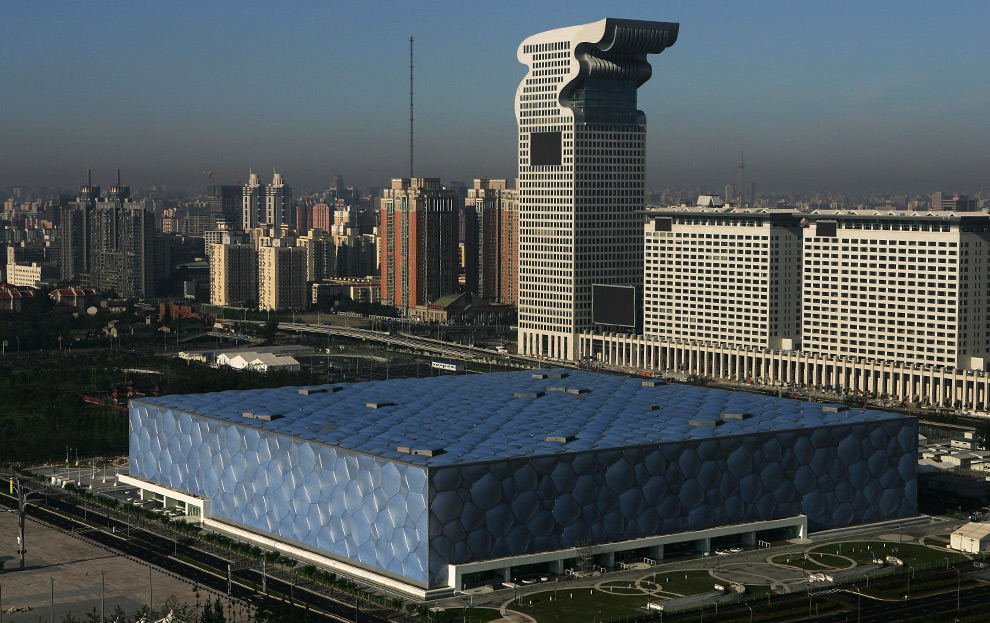
Final preparations for the 2008 Summer Olympics are in full swing in Beijing. This includes completing hundreds of construction projects, reconstructions, pollution controls, cultural training, and a general "beautifying" of greater Beijing. Rehearsals and drills take place daily as Chinese citizens hurry to finish up.
read more | digg story

Richard Nouveau Burger: $175
This rabbi believes he has discovered a new way to read the unreadable Hebrew name of God, and it means the Creator is a dual-gendered entity. Whatever your faith or beliefs, it's a pretty interesting read.
read more | digg story

VALENCIA, Spain — Audi is moving ahead quickly with its new S tronic seven-speed dual-clutch manual transmission — at least in Europe. In addition to offering the S tronic gearbox on selected gasoline and diesel versions of the all-new 2009 Audi Q5 compact SUV, which hits European dealers in the fourth quarter of this year, Audi is dropping it into the European-spec 2009 Audi S5 as a replacement for the coupe's optional six-speed automatic transmission.
Although this S tronic gearbox is being marketed under the same name as the Borg-Warner-developed, six-speed twin-clutch transmission (previously known as the Direct Shift Gearbox, or DSG) in the U.S.-spec Audi A3 and Audi TT, it's a completely different unit. Parent company Volkswagen AG engineered it in-house and it will be built at VW's factory in Kassell, Germany. Cooling is significantly improved on the new S tronic, thanks to a vacuum booster that effectively doubles the amount of oil available to lubricate the twin clutches, and this helps the transmission cope with higher engine torque loads — up to 406 pound-feet (550 Nm), says Audi. The older S tronic transmission tops at 258 lb-ft (350 Nm). Moreover, because the clutches and oil pump are oiled separately from the gearsets and differentials, this S tronic gearbox can be more easily packaged with the longitudinal engine layouts used in most Audis, including the new Q5 and the A4, A5, A6 and A8 families.
Along with this packaging flexibility, the new dual-clutch transmission is designed to satisfy a wide range of driving situations. In the 2009 Audi Q5s we drove in Valencia, Spain, the S tronic was nearly as smooth as the best of today's conventional automatic transmissions in normal traffic, while offering much sharper response during more aggressive maneuvers. Shift paddles at the nine-and-three positions on the steering wheel allow you to call up your own shifts. Depending on the urgency of your throttle and brake inputs, downshifts requested in manual mode are rev-matched. Equally important, the transmission's large number of gear ratios make it as good a match for the 3.2-liter gasoline V6 we'll see in U.S.-market Q5s as it is for the Europe-only 3.0-liter turbodiesel V6 (3.0 TDI).
Our seat time in the S tronic-equipped 2009 Audi S5 was limited to a low-speed autocross course. While this provided little insight into the gear ratio spread, at a minimum it suggests that the S tronic can be matched with a 354-horsepower 4.2-liter V8 without self-destructing.
Audi executives tell us that in addition to the Q5 and S5, the S tronic will be offered in many of the upcoming S and RS models, including the next S4 and RS4 and the long-awaited RS5. The bad news is that Audi has no immediate plans to offer this dual-clutch transmission in the U.S.-spec versions of these models.
"We have specifically decided not to do the S tronic in the Q5 and that thinking dates back several years," says Filip Brabec, general manager of product planning for Audi USA. The six-speed Tiptronic automatic transmission slated for use in the U.S.-spec Q5, which goes on sale here in March 2009, "comes pretty close to matching an S tronic type of shift," he notes. Also, Brabec tells us, Audi feels that American customers place a higher priority on comfort than do Europeans and may not be prepared to accept the S tronic's edgier shift quality, particularly in a small SUV. Mainly, the company is worried that you'll complain about "rough shifting" with the S tronic, a powertrain executive tells us.
What this means to you: Audi is waiting for exactly the right moment to launch the S tronic in the U.S., and we expect that moment will involve a hard-core performance car rather than a compact SUV. — Erin Riches, Senior Editor
 Projection tech companies like Real D see 4,000 screens as the magic number for a breakthrough 3D release on a national scale, with James Cameron’s Avatar as the likely torch holder. (Photograph Courtesy of Real D)
Journey to the Center of the Earth may be generating only lukewarm box office, but don’t count 3D out just yet—or IMAX, after Batman rocked opening weekend. With James Cameron’s Avatar on the way, and theater owners scrambling to install the technology, 3D cinema could be on the verge of explosive growth.
read more | digg story

Copyright 2008 by KETV.com. All rights reserved. This material may not be published, broadcast, rewritten or redistributed.


The Celtics lost James Posey to the open market, but today they were able to retain a couple of other free-agent reserves from their championship season.
The Celtics agreed to terms with guards Eddie House and Tony Allen to return, general manager Danny Ainge announced today. Both will get two-year contracts (though House's second year is a player option, according to an NBA source). House's deal was made using a portion of the team's $5.5 million mid-level exception. According to the source, House will make $2.7 million next season and $2.9 million the year after if he excercises his option.
House, who will enter his second season with the team, averaged 7.5 points and 19 minutes per game during the regular season, but those averages dropped to 2.5 points and just under 8 minutes in the postseason. Allen, who will enter his fifth season in green, averaged 6.6 points and just over 18 minutes per game during the regular season and 1.3 points in about 4 minutes per game in the playoffs.
***
Agent Mark Bartelstein, who also represents House, said the Celtics are interested in another of his free-agent clients: forward Devean George, who averaged 3.7 points per game for the Mavericks last season. The 31-year-old George played on three Lakers title teams.
I was in the process of writing my own review for the Dark Knight...but I stumbled up this review....this guy Glen..is right on the movie.. all I can see is go IMAX!!!!!!!!!!!!!!!
There are only a few movies that break the norms and become something special because they didn’t do what everyone else did before them. The latest Batman movie The Dark Knight is just one of those movies.
I should probably preface this post with the fact that honestly, I’m not that much of a Batman fan. Growing up I enjoyed the Old Skool Batman movie with Michael Keaton, but since then I’ve had a hard time with all of the later Batman movies. Still, I managed to snag a much-coveted ticket to a midnight showing of The Dark Knight, and was incredibly impressed. I won’t give another gushing review, because you can read those anywhere. But I do believe this movie will win actual awards (Best Actor, Best Movie?) from the Academy later on.The Dark Knight is an exceptional movie because the people who created it thought completely outside of the box.
Starting From Scratch
The writers of The Dark Knight completely tore down all stereotypes surrounding the Batman movies. By completely re-thinking every aspect of the movie, they were able to create something exceptional and unlike any other comic movie ever. Here’s how they did it:
1. Sparse and creepy music - Instead of crafting a film score like other action/superhero blockbusters, The Dark Knight takes a minimalist approach to film score. Instead of using loud, broad music to set the tone in the movie, the film score effectively steps out of the way, letting the incredible acting by Heath Ledger and Company take over the tone of the movie.
The music also has another interesting twist to it: When music is actually present, it’s done with almost a horror movie feel. When the Joker is going to do something creepy, there is a slight buzzing sound that grows. It’s not an instrument, just a buzzing sound. Very creepy, and very effective.
2. Going IMax - Shooting a film largely with IMAX cameras had been a goal of director Christopher Nolan for a long time, but the right project hadn’t come along until The Dark Knight. There are many obstacles to shooting in IMAX. First, they’re much heavier and bulkier than traditional cameras, so Nolan had to modify the camera arms so that they could support the weight. However, an even bigger obstacle proved to be the limited film was the fact that IMAX cameras have 2 and a half minute load times.
Even though there were many obstacles to filming the movie in IMAX, the results are breathtaking. The frames are much larger and clearer, and everything comes to life. By overcoming obstacles with IMAX technology, The Dark Knight was allowed to reach a whole new level of engagement.
3. NOT geared towards children - Children are what put the dollars in the bank for hero movies. It seems almost crazy for a comic book company to not market their movie towards children and add dialogue and sequences (a la some guy getting hit in the nuts) that children love. Not so with The Dark Knight. As a matter of fact, it’s as though the writers completely ignored the children that would be watching the movie. This was an adult film, through and through.
Yet I don’t think that ignoring the kiddies is going to hurt the money made from this movie. Kids will still buy all the toys, memorabilia and everything else that they normally would (if not more). The only difference is that parents are loving the movie just as much as the kids. (Note: I wouldn’t recommend the movie to small children, as it’s really dark.)
4. No cheese - Comic book movies (X-Men, Spider Man, etc.) tend to have a lot of “cheese” written in to the dialogue. There always tend to be dumb one-liners thrown in, either to appeal to kids (see #3) or to make the movie like the comic book. Yet I couldn’t count a single one in The Dark Knight. And there were plenty of opportunities for it too. But the writers made a savvy move by not making the movie seem like a bunch of action sequences thrown together with cheesy dialogue, like most action movies.
5. Relied on real acting as opposed to special effects - I’ve never walked away from a movie and been so amazed by the quality of acting from all actors in the movie. This is not usually the case for action movies, or any movies for that matter. By holding out for the best actors and getting the right chemisty between them, the writers and casting crew ensured that the movie was a step-above all other action movies this summer.
6. Re-working the Joker’s character from the ground-up - A common theme to the direction of the movie was to “re-work” every aspect of the movie. There’s no better example of this than Heath Ledger’s portrayal of the Joker. Instead of taking the typical, mostly-funny and hardly scary crack at one of the most portrayed villains, Ledger created something altogether different. The Joker is insane. He is by far scarier and altogether demented. In fact, that’s what makes him so scary. You can still tell he’s a person. Just the most twisted person you’ve ever seen. Instead of a playful villian, he’s something that any city would fear to have running loose.
7. Less like a comic book - Instead of making the movie a grandiose production like Spider Man, The Dark Knight felt almost nothing like a comic book. The writers of the movie realized that the over-the-top approach had been flogged to death, so they made the whole movie feel more believable. Sure, there are some pretty outlandish aspects of the movie (Batman’s “toys”, Two Face’s charred face, etc.), but as a whole the movie was much more believable than any other comic book movie. And the fact that it was more believable made the story more scary and gripping.
8. A lot more detail about the characters - Instead of placing the sole emphasis of the movie on limitless special effects budgets, the writers of The Dark Knight brought out the storyline of the characters more than any other Batman movie. This allowed you to identify with the characters much better, pulling you in to the movie as opposed to being a spectator.
It’s ALL about risks
It’s safe to say that the actors, writers and directors of The Dark Knight took some huge risks by completely doing away with comic movie norms. Heath Ledger could have played the Joker just like Jack Nicholson. The film score could have been huge and in the way, and they could have ensured success by writing the dialogue with children in mind.
But they didn’t.
Instead, they have an unprecedented blockbuster, and the movie is only 3 days old. The Dark Knight has already broken opening weekend records, and I think it’s safe to say that it will be breaking many more, plus being mentioned for some major awards. Did it pay for Christopher Nolan and Company to think outside the box while making the movie? You bet your sweet movie popcorn it did.
First death in 8-year history of event happens during 1,500-meter swim
The Associated Press
NBC Sports

Want to turn tonight's amorous encounter into an erotic adventure? Give your mattress a rest and attempt our new, superhot pleasure poses.
read more | digg story

If you have ever used a computer that had more than one monitor or a computer with a very big monitor attached to it, it’s hard to go back to using just one little monitor. Now imagine using one of the huge gigantic multi monitor setups listed here. Going back to even two or three monitors would feel extremely small in comparison.
read more | digg story

Nobody ever claimed a visit to the doctor was a pleasant way to pass the time. But if you’re timid about diving onto a psychiatrist’s couch or paranoid about popping pills, remember: It could be worse. Like getting-a-hole-drilled-into-your-skull worse. Or having-a-doctor-infect-you-with-malaria-to-cure-you worse.
read more | digg story
Apple released the iPhone 3G on 11 July and nine days later, iPhone hacking crew the iPhone Dev Team posted the latest version of the their jailbreaking and unlocking utility, PwnageTool.First, PwnageTool 2.0 won't unlock a 3G iPhone, but it will jailbreak one to allow third-party apps to be installed through an alternative channel to the one Apple
read more | digg story

F15 Eagle takes off from Cold Lake, Alberta during the very last launch of Exercise Maple Flag 2008.
 .
.

 Posts
All Comments
Posts
All Comments


